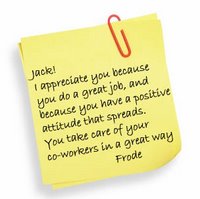
A few days ago I wrote one post-it note to all my employees, they all started with these words: “I appreciate you because…” and I tried to write what I genuine appreciate about each one, all notes ended up differently, as all of them are appreciated for different reasons.
I thought this was a fun thing to do at the office and I hoped it would make them smile for a while. This evening I was walking around at the office and noticed that several notes where hanging at their partition wall. And I started to realize that this really meant a lot for some of them.
“And now, you want us to prop up your business.”
“Well clearly we can’t let the savings and deposits of millions of investors …”
“But while we’re propping up your business for all those unfortunate millions of investors, you expect ‘business as usual’ when it comes to your remuneration?”
“Of course!”
“Of course? Why of course?”
“Well if salaries or bonuses drop, we won’t be able to hold onto the brightest and best minds in the industry!”
“I see. And these would be the brightest and best minds who devised and implemented the strategies that have led to the collapse of all these institutions?”
“Ah yes, but as I said, conditions became very hostile …”
“Mmmmm, very hostile. Because someone had the temerity to ask how much the houses behind the Triple-A paper were actually worth?”
“Well when you put it like that, it just sounds stupid …”
And finally the coolest thing I’ve ever seen on a plane: A flight attendant who raps.
My new book is coming out on May 14 and I just got to see the front cover design for the first time:
Unlike my first book which came out in English first and then Danish this one is coming out in Denmark first. The title means “Hooray, there’s a crisis – use it as a springboard for more happiness, progress and profits at work.”
It sounds a LOT better in Danish :o)
The theme of the book is happiness at work in a crisis (duh!). This is of course inspired by the current financial crisis but the book is directed at any workplace in trouble.
The book has three central claims: 1: Most of what companies traditionally do in a crisis doesn’t work.
The way many organizations typically handle crises is by cutting back on all expenses and doing mass layoffs. While this can be necessary, studies actually show companies who choose this approach recover more slowly.
2: It is possible to be happy at work even in a workplace in trouble.
Of course it’s easier to be happy when everything is going swimmingly, but people can still be happy at work in a crisis. It takes determination and focus, but it can be done. Surprisingly, a crisis can make people happy at work, provided that it becomes a reason for people to focus and pull together – rather than an excuse to give up.
3: Happy workplaces get out of a crisis faster.
Especially in a crisis, an organization needs to get the best out of its people – and when we’re happy at work we are more motivated, creative and productive.
I’ve got plenty of real-life stories and case stories of people and companies who refused to just give in to tough times and instead used them to create even more happiness. My favorite story from the book is the one about Xilinx, a computer chip company in Silicon Valley whose revenues fell to about half during the dotcom implosion. Their CEO Wim Roelandts refused to do what everyone else in the IT industry did (ie. mass layoffs) and instead found a more creative way that brought the organization out of the crisis stronger and faster than their competitors.
We have a new partner in crime! Or rather in happiness :o)
We’ve been emailing with Karl Staib for a while now, and we finally got a chance to meet him at the WorldBlu conference in New York in October ’08.
Here’s a short piece that Karl wrote to introduce himself. If you need a US-based speaker on happiness at work, Karl’s your man! Karl will also be guest blogging here over the next couple of weeks while I’m om vacation snowboarding in Whistler!!.
Alex asked me to introduce myself because I’ve been helping spread the work happiness message. I’ve learned a lot from talking to Alex and reading his book and blog. He introduced me to the concept of happiness at work and the importance of creating an atmosphere that encourages great work and fun at the same time.
My Working Woes
I’ve struggled with working happy at most of my jobs. It’s why I started Work Happy Now. I knew there was a better way to work instead of enduring the torture I had been through. I researched books, websites, and online video (before YouTube kicked in).
I found Alex’s site and was floored by the content. I literally fell back in my chair. There was a likeminded person who was actually making a difference within organizations! I got up out of my seat and did a little happy dance. I found my passion. I wanted to help people work happier. It wasn’t that quick and easy to find my passion, but just know that Alex lit the fuse.
Work Happy Now
So after years of research (business books, personal development books, interviews and my own internal discoveries) I created “Work Happy Now” over a year ago and have been going strong ever since.
I’ve committed to going out and helping people who struggle at work like I had done. Work happiness should be available to all of us. There are so many tools at our disposal. We are living in a golden age of work. Managers can’t just tell us to shut up and do our work. Well they can, but most managers take our feelings into account.
There are companies like Google, Southwest airlines, and Starbucks that are leading the employee revolution. They know that a happy employee will produce better results, stay at their job longer, and care about the success of the company.
According to Alex, and I agree, we need to focus on two main themes when trying to improve our working environment:
Results
Relationships
When we have a chance to accomplish great work and do it with people we like, our work becomes more enjoyable.
Alex has a brilliant quote in is his presentation:
“Each individual should work for himself. No one wants to sacrifice himself for the company. People come to work in the company to enjoy themselves.”
– Soichiro Honda
Companies can truly thrive when they can start caring about their employees’ emotional needs, and stop the faulty thinking that as long as they pay their employees they will work hard.
Giving Work Happiness Presentations
I will be giving work happiness presentations using Alex’s time tested techniques. I’ve made his presentation my own, changing a few things here and there, but never veering off from the core concepts.
If you are interested in hiring me to come to your company, please visit my “Hire Me” page and let me help your company improve its happiness and productivity.
Thanks to Alex
Alex has been a huge help in guiding me through the beginning phases of getting my speaking career off the ground. So if you want to hire me while I’m still a bargain, you should act now. My rates won’t stay low for very long.
For those of you who are not quite ready to bring me in to your organization, you can always check out Work Happy Now and sign up for email updates. That way you can stay updated on the latest ideas (my blog has a different twist than Alex’s blog) and improve your work happiness from additional angles.
The economy may be bad but Wim Roelandts isn’t really bothered much by that because, as he told me, this is his 8th recession so far.
Wim’s worst crisis as a leader came in 2000 when Xilinx, a computer chip manufacturer based in Silicon Valley, got hit hard and fast by the dot-com crisis. In the December 2000 quarter their revenue was $450 million – 9 months later, their revenues for the September 2001 quarter was down to only $225 million.
Something had to be done, and fast, but what? Wim Roelandts, an affable Belgian who is usually seen with a smile on his face, was the CEO back then and was clearly facing some tough choices. And while Xilinx’ competitors wasted little time in laying off a large percentage of their staff to cut costs, Wim felt here had to be a better way.
He came up with a plan for his organization and the 2,800 people in it and called it “Share the pain”. The plan had three major components.
1: Cut salaries, not jobs
Wim felt strongly that if they laid off people now, they’d just need to rehire them 5 or 6 quarters later when business improved. Couldn’t there be a way that kept people on even during the crisis?
So they instituted a pay cut that was progressive and voluntary. Progressive meant that your pay cut depended on your salary – the higher your salary, the higher your pay cut. These were some typical pay cuts:
Job
Pay cut
Production-level employees
0%
Junior-level engineers
6%
Senior engineers and middle managers
9%
Directors
12%
Vice Presidents
15%
CEOs (that’s Wim!)
20%
So while production employees were not affected at all, Wim himself took the largest pay cut – 20% of his salary. They might have given everyone a 10% pay cut, but chose this way because it shares the pain – not the pay cut. When you’re a production-level employee with a salary of around $30.000-40.000 trying to live in the Silicon Valley area, a 5% or 10% pay cut could really damage your quality of life. When you’re a VP, 15% is entirely survivable.
Secondly the pay cut was voluntary. This wasn’t part of the original plan but it turned out that Xilinx employees in Europe would have to agree to take the pay cut voluntarily, so Wim decided to make it voluntary for everyone.
Amazingly, every one of the 2.800 employees chose to take the pay cut – except one. And no, that one person was not singled out for reprisals of any kind. Voluntary means voluntary. Thinking back to this entire time, the one thing that Wim is the most proud of, is that everyone agreed to the pay cut in order to save their co-worker’s jobs.
Later in the process, when the pay cuts turned out not to be enough to keep the company profitable, they introduced more measures, like closing the company for one day every other week and the option of taking a paid leave of absence to take an education.
Though Wim was very careful never to promise that there would be no lay-offs, this plan meant that Xilinx got through the crisis without laying off one single, solitary employee.
2: Communicate openly
Wim knew that honest communication was essential. His motto was to “keep communicating and force his management team to communicate.”
In practice, he organized meetings with his entire management staff and the managers below them as well. He knew, that when employees had questions, they wouldn’t come to him or the VP’s, they would come to the managers closest to them, so it was important that they knew what was happening and remained optimistic.
This is not easy, as Wim readily admits. “I didn’t know any more than anybody else what was coming and so the tendency is to close your office door and don’t talk to anybody because if you talk with someone, they can ask questions that you don’t know the answers to.
But that’s actually the wrong thing to do, you have to get out there. You have to talk with people and even more important you have to force your management to get out and talk, talk to people, tell them when you don’t know but also tell them all the things you know and good friend to give people some hope that things will get better soon.”
In these sessions with the managers, Wim would go over the company’s situation honestly and thoroughly and then they would discuss how to communicate this to the employees. Typical topics of discussion were:
What can we do as managers?
What do we say?
How do we act?
A key aspect of these meetings was also to listen to the middle managers, so they felt good about the company’s situation and could pass that feeling on to their people.
3: Involve employees in decisions
They involved people in all new initiatives by consulting focus groups of employees. They’d get 20 employees together, tell them about what they were planning to do and get their honest feedback.
One specific decision that came out of these focus groups concerned new employees. Originally, the company had planned not to include them in the pay cuts. When this was tested, the new employees protested – they wanted to be treated like everyone else and “share the pain” too.
An intended byproduct of the focus group sessions was that information about the crisis and how it was being handled spread quickly throughout the organization. When the initatives were announced to the employees, most people had heard about them already, which created more trust.
Wim himself
That was his plan for the organization, but there was another equally important aspect: Himself!
On a purely personal level, Wim did three things to handle the crisis. First, he did his best to be positive. Yes, the very survival of the company was at stake, but he still had to believe that there was a way out.
Wim put it like this:
“You have to be positive yourself. If you are negative and you come in the factory everybody’s going to be looking at you and getting depressed. So however bad it is, however sad you feel, however worried you are, you come to work in the morning and you put on a big smile and you feel optimistic and you exude optimism and positive thinking.
When you are the CEO and you see the numbers go down every week or every day, it’s very easy to become depressed yourself and you really have to find the inner strength.”
Secondly, he saw the crisis not only as a threat but also as an opportunity. This has become something of a stale and ridiculed cliché (the next time some tells me, “We don’t have problems, we have opportunities,” I may punch them) but Wim saw this crisis as a chance to get creative and try something new. To him, creativity and innovation shouldn’t just be applied to creating new and exciting products but also to leadership – to find new and exciting management solutions.
And thirdly, Wim saw this as a chance to prove that there is indeed a better way to handle a crisis than the tried-and-stale ones. He wanted to show the world, that this can be handled differently. “I’m gonna show them” may not be the noblest motivation, but it’s not uncommon. All the leaders I interviewed for this book expressed the same desire to “show them!”
Now make no mistake, Wim faced a lot of resistance to his approach. He had heated discussions with some board members, who wanted to know why he didn’t just lay off 10% of the employees when everyone else in the industry was doing it. The same arguments came from outside the organization from financial analysts, who also would have been much more comfortable with the traditional approach.
Time proved Wim right and the result of this creative approach to crisis leadership was amazing. The results were:
Profitability – Except for the second quarter of 2001, when there was an inventory write down, Xilinx was profitable every quarter of that recession.
Customer satisfaction – Xilinx kept the same people in sales so the customers saw the same people they were used to talking to.
Market share – Xilix gained 15 point of the market share during the crisis. Because they kept their people they could keep momentum.
Product development – They had time and people to keep developing new products – essential in their high-tech industry.
Recruitment and training savings – After three quarters the market started to improve. Because Xilinx had kept their people, they did not have to spend a ton of money hiring and training new people.
Motivation and happiness at work – This showed employees that they were truly valued. Not just on paper and in good times, but also in a down-turn.
At first employees were skeptical, seeing it as a cheap trick. “Yeah, you say you’re not doing lay-offs, but it’s just a matter of time,” was a common attitude. But as many other companies in the area had mass lay-offs and Xilinx employees saw friends losing their jobs and having to sell their houses they started to come around. During that time Xilinx participated in the Fortune Magazine 100 best places to work and came in the top 10 – in the middle of the company’s worst crisis ever.
The effect was also felt outside the company. One day, about two years after the crisis when Xilinx was back on track, Wim was just arriving at the office when he was approached by a female employee who happened to arrive at the same time.
She told him this story:
“My husband got laid off and so yesterday evening we had a family meeting with the children. We had to tell them that their father had been laid off and that they had to do some savings and we had to be very careful how we spend money, to make sure that we get through this tough time until our dad finds a job again.”
One of my children asked ‘but mom what is going to happen if you get laid off’. and I was so proud to say that I work at Xilinx and Xilinx doesn’t lay off people.”
Wim told me that this was his proudest moment in the whole process.
Become a certified Chief Happiness Officer
June 2-5 2026 in Copenhagen
The Chief Happiness Officer Academy is our most in-depth 3-day training where we share everything we know about creating happier workplaces. You get a comprehensive understanding of the latest research, tons of effective practical tools and learn how to use them in your own business.
 While I’m attending a conference at the LEGO HQ in Billund, Denmark please enjoy these great (and happy) links.