Month: January 2011

  • Happiness at work and balls

    I’m not a huge fan of employee satisfaction surveys for a number of reasons:

    1. They measure job satisfaction, which, to me, is not what matters. What matters is happiness.
    2. They’re no fun. Filling out 50 (or more) questions in an online survey is a chore – not something people enjoy.
    3. They’re so time consuming that companies typically perform them once a year. But what good is knowing how happy employees are once a year? What if they’re really unhappy now, and the next survey is still 7 months away?

    So how DO you measure happiness at work? This is exactly the question British social media agency Nixon McInnes were asking themselves:

    According to recent studies, happiness in the workplace is positively correlated with productivity, so as happiness increases, productivity follows suit, but when unhappiness gains a foothold, productivity and, ultimately, the health of the business, suffer.

    The first prototype, or version 0.1, has been live for a couple of months now and has provided some illuminating insight into our collective emotional condition (Tuesdays, for instance, are a regular, recurring low point in the week).

    So, what’s the ground-breaking technology that makes all this possible?

    The answer… A couple of buckets and a few dozen tennis balls. :)
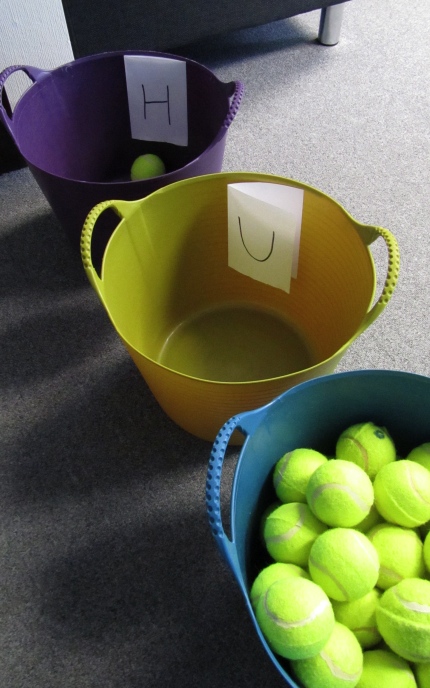
    Exactly – why not go low-tech and do it with balls. Tennis balls, that is.

    Every day as employees leave work they drop a ball into either the “Happy” or “Unhappy” basket. The balls are counted and the daily and weekly results are displayed on a monitor in the office:
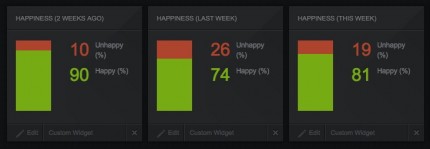
    Yup – that’s all it takes. It’s simple, so it actually gets done and it’s almost real-time because it presents daily data. An additional benefit is that it gives employees a chance to reflect every day on their happiness at work, which is also a good practice. Kudos!

    Have you tried something similar in your workplace? Would this work for you?

    Related posts

  • Yes, performance reviews still suck

    Samuel Culbert is not a fan of performance reviews:

    To my way of thinking, a one-side-accountable, boss-administered review is little more than a dysfunctional pretense. It’s a negative to corporate performance, an obstacle to straight-talk relationships, and a prime cause of low morale at work. Even the mere knowledge that such an event will take place damages daily communications and teamwork.

    Culbert is a professor of management at the UCLA Anderson School of Management in Los Angeles and author of the excellent book Get Rid of the Performance Review!: How Companies Can Stop Intimidating, Start Managing–and Focus on What Really Matters.

    In this excellent article, he sums up his main arguments against performance reviews, which include:

    • The mind-sets held by the two participants in a performance review work at cross-purposes.
    • It’s a myth that performance determines pay.
    • They disrupt teamwork.

    I agree completely. Waaaaay back in 2008, I wrote about my top 10 reasons why performance reviews suck.

    Culbert even offers an alternative – the performance preview:

    The alternative to one-side-accountable, boss-administered/subordinate-received performance reviews is two-side, reciprocally accountable, performance previews.

    The boss’s assignment is to guide, coach, tutor, provide oversight and generally do whatever is required to assist a subordinate to perform successfully. That’s why I claim that the boss-direct report team should be held jointly accountable for the quality of work the subordinate performs. I’m sick and tired of hearing about subordinates who fail and get fired, while bosses, whose job it was to ensure subordinate effectiveness, get promoted and receive raises in pay.

    Holding performance previews eliminates the need for the boss to spout self-serving interpretations about what already has taken place and can’t be fixed. Previews are problem-solving, not problem-creating, discussions about how we, as teammates, are going to work together even more effectively and efficiently than we’ve done in the past. They feature descriptive conversations about how each person is inclined to operate, using past events for illustrative purposes, and how we worked well or did not work well individually and together.

    The preview structure keeps the focus on the future and what “I” need from you as “teammate and partner” in getting accomplished what we both want to see happen. It doesn’t happen only annually; it takes place each time either the boss or the subordinate has the feeling that they aren’t working well together.

    What a fantastic idea!

    Your take

    What do you think – do you personally find, that performance reviews make you happier and more effective at work? Is it a process you actively enjoy? Please write a comment, I’d love to hear your take.

    Related posts