There are four different kinds of motivation. Only one of them works and unfortunately, many managers focus exclusively on the other three. Kinda silly, huh?
Many people don’t feel motivated at work, and there’s a very simple explanation for this: The motivational techniques used by most managers don’t work.
In this video I show why most bosses fail to motivate staff and what actually does work.
More and more CEOs are hell-bent on forcing employees back to the office full time.
For a long time I have been really confused about why, but now a brand new study reveals the answer – and it is NOT any of the reasons they normally give like productivity or collaboration – it is something much more sinister.
There haven’t been a lot of positive outcomes from the COVID pandemic but the widespread flexibility to work from home is one. Maybe the only one.
Workers love it because they experience more flexibility, better work-life balance and higher productivity but over the last couple of years, a growing number of CEOs have been doing their best to roll it back and force everyone back into the office full time.
Well, now for the first time we have data! A fascinating new research article just gave the answer: It’s about protecting and boosting the egos of narcissistic CEOs.
In this video I go through the results of the study and how it applies in our workplaces.
I once did a workshop for a client in Copenhagen whose main problem was that they were just way too busy.
They’re a trade union and new legislation meant that they got an influx of new government-mandated tasks but budget constraints meant they couldn’t hire more people.
That meant they were increasingly falling behind on their work, through no fault of their own. They have an internal IT system that tracks every open case and they were currently 3.000 cases behind.
Even though this was due to circumstances outside of their control, knowing that they were behind made everybody stressed and irritable. They also felt a responsibility towards their members – every late case meant that one of their union members was waiting for an important answer or potentially weren’t being paid money they were owed.
This situation is becoming familiar in many workplaces where there is simply more work than resources. Typically management will bombard employees with information showing the current lag, which only serves to make people frustrated and unhappy at work.
So what can you do instead? Here’s what we did in our workshop with this client.
I pointed out the fact that they were currently behind by 3,000 cases. Everybody had heard that number – it had been sent out en emails and mentioned in countless meetings. I then gave the group 30 post-its notes and told them that each post-it represented 100 open cases.
I asked them to stick those post-its on the wall. It looked like this:
I asked how looking at that made them feel and they said things like “I feel hopeless,” “I feel like we’re failing our members,” and “I don’t see how we can ever catch up.”
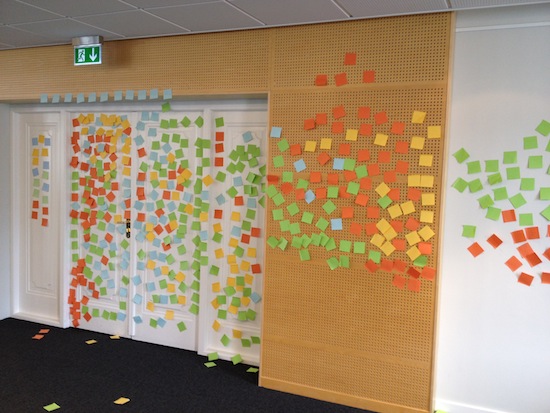
Then I gave them 900 more post-it notes and asked the group to stick them on the wall next to that. It looked like this:
I told them that I’d checked their IT system and in the last 12 months they had completed 90,000 cases. Each post-it represents 100 cases – hence 900 post-its.
I asked how they felt looking at this and they said things like “I feel proud,” “I feel like we’re making a difference,” and “I feel hopeful.”
Interestingly, the year before that they’d processed 73,000 cases so they had actually become much more productive, but had never focused on that. Instead their focus was only ever on how much they were falling behind.
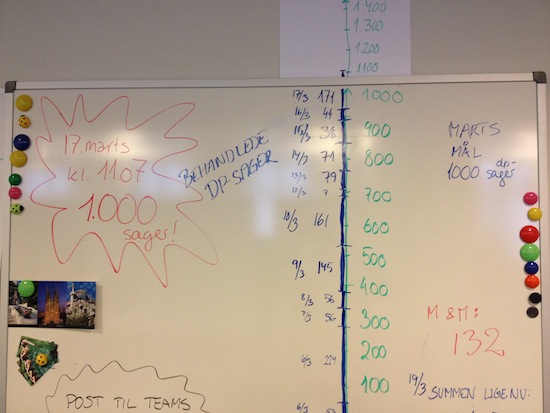
This gave them renewed energy to tackle their increased case load. They also came up with their own way to track progress, using a whiteboard in their cafeteria:
They use it to track monthly completed cases. They’d set a goal for March of 1,000 cases – and reached it on March 17th. Note how they had to extend the scale upward with a piece of paper because they completed much more work than planned.
In short, focusing on the work they completed (instead of how much they were falling behind) allowed them to catch up over a period of a few months.
And crucially, they were ably to catch up without feeling stressed or hopeless along the way.
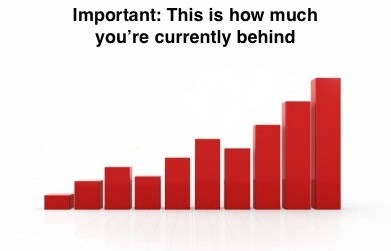
Sadly, many workplaces do the exact opposite. When teams fall behind, they are constantly told exactly how much. I’ve seen workplaces send out weekly emails with red graphs showing the current lag. I’ve seen the same graphs hanging in offices, cafeterias and being presented in every department meeting.
The problem is of course that this makes employees frustrated, hopeless and unhappy. The work of Harvard professor Teresa Amabile has shown that the most important factor that makes us happy at work is perceived meaningful progress in our work and that the absence of progress makes us unhappy.
And of course we know from the research that happy employees are more productive, creative and resilient.
In short, this means that many workplaces set up a vicious cycle:
There’s too much work compared to the available resources
Employees are constantly told that they’re falling behind
Employees become unhappy at work
Employees become less productive
Less work gets done
Back to 1
So that’s my challenge to your workplace: How can you highlight and celebrate the work that gets done, instead of only feeling bad over the work that’s not yet completed?
Many CEOs are are currently nixing work-from-home programs and forcing all of their employees back into the office full time.
And without fail, they all seem shocked and appalled when employees dare to question their decision.
Jamie Dimon, the CEO of JP Morgan Chase, in particular was just outraged that thousands of his employees spoke against it and signed a petition to preserve flexible working. He went on an angry rant full of curse words in a town hall meeting where he claimed that being together in the office is the ONLY way to be creative and productive because there you can communicate and collaborate in person.
He said that he didn’t care how many people signed the petition and added things like:
Don’t give me this s— that work-from-home-Friday works. I call a lot of people on Fridays, and there’s not a goddamn person you can get a hold of.
A lot of you were on the f— Zoom…and you were sending texts to each other about what an a— the other person is.
Most recently, Danish pharma giant Novo Nordisk announced not only a massive round of layoffs but also that all office workers must be in the office full time going forward. This triggered a lot of pushback from employees because Novo has had a very flexible policy of letting people work from home when it makes sense for them and the team.
So I thought I should do a public service for all of these CEOs and try to help them understand why their employees don’t just accept it and knuckle under when their freedom to work from home is taken away.
There are three main reasons why.
1: Loss aversion
The work of Daniel Kahneman and many others has proven that we humans hate losing stuff. Taking something away from us – even stuff we don’t necessarily value very highly – can trigger intense negative feelings.
If employees currently have the freedom to work from home, taking it away from them will absolutely trigger loss aversion.
2: Working from home is amazing
People who have the flexibility to work from home at least part time love it. Research shows that it has a large number of positive effects, including:
Productivity – people get more work done, partly because they experience fewer interruptions than in the office.
Better work-life balance – it’s easier to handle all of your responsibilities outside of work when you can work from home. You also spend less time commuting.
Feeling of trust – employees feel trusted by the company and therefore more loyal and engaged.
Of course they don’t want to lose all of this and of course they’re going to push back against any decision that would make their work lives significantly worse.
3: Forcing people back to the office is meaningless
If the company could demonstrate conclusively to employees that the only way the company can move forward and be successful is by stopping working from home, then I think people would accept it.
For instance, if my job changed from an internal role to a customer facing role that required me to be physically present in a location, then it’s clear why I can no longer work from home and that decision would have a legitimate purpose to back it up.
But companies never do that. Instead they make a lot of noise about “fostering collaboration” or “making faste decisions” or “strengthening the culture” while never actually demonstrating why that can’t be done while still giving employees the option to work from home some of the time.
And here’s another thing: Even on days where people are in the office, a large percentage of the work or the coordination they perform is still digital through email, chat or video meetings. Even more so, if the company has people in different locations.
You don’t go to a coworker’s desk and interrupt their workflow every time you need help with something. You don’t call a meeting every time you have a question. You don’t go to your manager’s office every time you need to make a decision. Or at least, I really, really hope you don’t!
If 50% of your work day in the office is virtual anyway, you’ve gotta ask yourself why you couldn’t have spent 50% of the week working from home.
And that’s why employees will see the decision to force them back into the office and thereby make their work-life significantly worse as a bad and meaningless decision.
The upshot
My video on how to make remote workers productive and happy.
All of this of course also means that if the company doesn’t listen and reintroduce flexible working, employees are going to vote with their feet and go find better jobs. And who’s going to go first? The most qualified people as always will find it easiest to get new jobs. That leads to brain drain.
Some people see this as a good thing. Just today I heard the dumbest argument I have ever heard for forcing people back to the office: It will help the company identify who is not committed to being in the office full time.
Wow. Just wow. That rationale could be used to justify any mistreatment of employees; anyone who speaks out is just not committed to the organization!
The good news is that many companies are deliberately choosing to be remote, like Spotify, Canva and Atlassian.
Even Dimon has since apologized for his rant. Not for maligning his remote workers. Not for claiming that they’re all slacking when they work from home. No – he apologized for cursing.
Jamie, Jamie, Jamie… the problem was not you dropping some F-bombs. The problem was your complete inability to trust your employees and to recognize that there are more ways of working effectively than the one you prefer.
Everybody makes mistakes at work. But many workplaces pretend like that’s not the case and tend to punish any mistakes in various ways.
That is destined to fail. When mistakes are punished, employees don’t stop making mistakes, they just hide the mistakes they do make or try to push the blame onto others. Or else, everyone starts playing it really safe and never take any chances or try new solutions and approaches for fear of getting it wrong.
In this free webinar we showed how companies can instead CELEBRATE mistakes. It sounds crazy but it’s a brilliant tool to boost creativity and learning.
Content includes:
Why punishing mistakes never works
How celebrating mistakes unlocks creativity, innovation and learning
How to celebrate mistakes at work
Great examples from happy workplaces around the world
No workplace is perfect. Even the happiest workplaces in the world have problems. But great workplaces are good at finding and solving their problems.
If we want to build happy and successful workplaces, we can’t only focus on doing good things for employees, we need to be focused and strategic about identifying and fixing any problems employees see.
In this free webinar we showed how to do it. Content includes:
Why it’s not just enough to do more good things for employees – we need to address their problems too
How to identify and solve problems in the workplace
How to handle problems without losing sight of the good things in the workplace
Great examples from happy workplaces around the world
It seems like the world is facing more and more threats and crises.
On the one hand, this is absolutely a tough situation for many workplaces around the world in all kinds of industries. On the other hand, instability and uncertainty have become more the norm than the exception here in the 21st century where it feels like the business world lurches from one massive crisis to the next: The dot-com bust, the financial crisis and Covid just to mention a few.
Which raises the question: How does a company best weather a storm?
And it’s clear what companies normally do: Slash costs and lay off staff. Until the crisis is over and the numbers look more reassuring, all talk of being a good workplace is put on hold and no jobs are safe.
The economic downturn we may be entering is setting off alarm bells and panicked responses in many leaders. If you can keep your head on straight, you have a unique chance to steer clear of three classic blunders that many of your competitors are planning to commit.
Blunder #1: “Times are tough, so we’re cutting back on all expenses on employees!”
You start by decimating the education budget and then you continue by cutting social events, the free coffee, and everything else that is seen as “superfluous luxuries.”
A Danish company decided to cancel the annual company Christmas party due to tough times. They saved about 100 bucks per employee, but it cost them dearly – very dearly – in hassle, negativity and trouble from employees who had been looking forward to the party. It is not difficult to calculate how much money the company saves by cancelling a party or the free coffee. But have you calculated what it might cost?
And if you are forced to save money, it does not have to be worse because it is cheaper. Accenture Denmark had a tough year in 2003 and was forced to rethink the annual company summer party. Normally it was a big affair held at some fancy restaurant or hotel. That was completely out of the question in 2003, so what could you do?
They held the party in the office instead and had the brilliant idea of having the company’s partners (i.e. co-owners) staff the bar. At first, the partners weren’t very keen on it. They were known more for their long work hours, dark suits, and business manners than for their abilities as party animals.
The party committee cornered a few senior partners and got their support, which convinced the others to give it a try. The party was a hit! Not only was it more fun than traditional parties, but suddenly the partners were available to all the employees who could just go up to the bar and order a gin and tonic from them. The employees loved it and, perhaps most surprisingly, the partners loved it. They had to be forced out of the bar when their shift was over!
So it can actually be an advantage to have to save money – as long as you put good ideas and creativity into making sure that it is still fun for your employees to go to work.
Crisis blunder #2: Layoffs
The other classic crisis blunder is mass layoffs. In the early 2000s Southwest Airlines was the third largest airline in the world and the most profitable. After September 11, 2001, the entire travel industry was extremely hard hit, and many airlines quickly laid off 20% of their staff.
This presented Southwest with a challenge. They had never had a mass layoff in the company’s history, and they would go to great lengths to avoid one. Top management held an emergency meeting at their headquarters in Dallas, where they drank buckets of coffee and analyzed potential cost-cutting plans. They first scrapped a number of growth plans, deliveries of new aircraft and a renovation of the headquarters. But they rejected any idea of mass layoffs.
Their then-CEO James F. Parker said, “We are willing to suffer damage, even to the stock price, to protect the jobs of our employees.” The result was that Southwest was the only airline in the industry to emerge from 2001 with a profit. At the same time, they created an unprecedented level of loyalty, motivation and job satisfaction among their employees, which continues to give them a competitive advantage.
Frederick Reicheld confirms this line of thinking in his book The Loyalty Effect, where he states, among other things, that mass layoffs “only deepen the crisis. They destroy employee trust, repel customers, and slow down growth.”
Southwest Airlines has since turned into a poor example. A capital fund bought a significant number of shares in the company, put their representatives on the board of directors and have now forced the company to do their first layoffs ever with totally predictable results: Employee engagement is gone and even many loyal customers are abandoning the airline.
In many companies, it’s a pure reflex: The crisis is coming, so they get rid of some people and cut back on everything that’s fun. It feels really good here and now because it gives the illusion of action, but in the long run it hurts the company’s competitiveness and the bottom line.
In this video I go over all the research on why layoffs actually make a company take longer to recover from a crisis.
Of course, sometimes a company is in such dire straits that layoffs are unavoidable. Then what do you do?
Hal Rosenbluth had made a provocative decision: As CEO of Rosenbluth International, a corporate travel agency employing 6.000 people, he decided that his company would put the employees first. Where other companies aim first to satisfy customers or investors, Rosenbluth made it their first priority to make their employees happy.
The results were fantastic. Record growth, record profits and, most importantly, customers raved about the service they got from Rosenbluth’s happy employees. Hal Rosenbluth explained the company’s approach in a book whose title elegantly sums up his philosophy: “Put The Customer Second – Put Your People First And Watch’em Kick Butt”.
A company’s commitment to its values is most thoroughly tested in adversity and Rosenbluth hit its share of adversity right after 9/11. Overnight, corporate travel was reduced to a fraction of its former level and it recovered more slowly than anyone predicted.
Rosenbluth tried everything in their power to avoid layoffs. They cut expenses. Staff took pay cuts and so did managers and executives. But in the end they had to face it: Layoffs were inevitable and they decided to fire 1.000 out their 6.000 employees. How do you handle this situation in a company that puts its people first?
In his book’s most moving chapter, an epilogue written after 9/11, Hal Rosenbluth explains that though layoffs don’t make employees happy, not doing the layoffs and then going bankrupt at a later date would have made even more people even more unhappy.
Hal Rosenbluth recounts how he wrote a letter to the organization explaining the decision and the thinking behind it in detail. The result was amazing: People who’d been laid off streamed into Hal’s office, many in tears, telling him they understood and thanking him for their time at the company.
Rosenbluth’s letter also contained a pledge: That those remaining at the company would do everything they could to bring the company back on track so they could rehire those who’d been laid off. Six months later, they’d hired back 500 out of the 1.000 and the company was solidly on its way to recovery.
Blunder #3: Giving up on employee happiness
Crisis blunder number 3 is very simple: Giving up. Many people believe that when a crisis hits a company, it becomes impossible to create job satisfaction.
Don’t fall into that trap. It’s precisely when a crisis hits that your company needs everyone to do their best, and studies document that happy employees are more innovative, efficient, loyal, and motivated. So cut back on everything else, but don’t cut back on employee happiness.
Of course it’s easier to be happy when everything is going swimmingly, but people can still be happy at work in a crisis. It takes determination and focus, but it can be done. Surprisingly, a crisis can make people happy at work, provided that it becomes a reason for people to focus and pull together – rather than an excuse to give up.
How do we create employee happiness in a crisis?
Economist Paul Romer has wisely said that “A crisis is a terrible thing to waste.” Companies that can maintain their focus on employee happiness in hard times can not only weather a storm better, they can come out of tough times stronger and with even higher levels of productivity, innovation and employee engagement.
1: Create and maintain positive workplace relationships
Good workplace relationships are the foundation of happiness at work and in hard times we need more than ever to feel that the people we work with see us, support us and care about us.
We know from a tremendous amount of research than when people feel alone and isolated, it really hurts their mental health, happiness and resilience.
So in hard times it is especially important for managers to take time to check in with their employees, listen to them, help them and generally show them that they are valued.
2: Appreciate employees for the great work they do
In tough times, individual employees and teams are still doing their best and working hard. Company results are down because of the latest global crisis, not because of a lack of effort from employees.
And managers should recognize those efforts and clearly
If employees experience that their hard work goes unnoticed and unappreciated because the company is not achieving its financial goals (due to the market, not due to their work), they quickly lose all motivation and pride in their work.
3: Communicate, communicate, communicate
Employees deserve to know exactly what’s going on – the good and the bad. Leadership
That’s exactly what they did at Xilinx when they were facing the company’s biggest crisis ever.
CEO Wim Roelandts organized meetings with his entire management staff and the managers below them as well. He knew, that when employees had questions, they wouldn’t come to him or the VPs, they would come to the managers closest to them, so it was important that they knew what was happening and remained optimistic.
This is not easy, as Wim readily admits. “I didn’t know any more than anybody else what was coming and so the tendency is to close your office door and don’t talk to anybody because if you talk with someone, they can ask questions that you don’t know the answers to.
But that’s actually the wrong thing to do, you have to get out there. You have to talk with people and even more important you have to force your management to get out and talk, talk to people, tell them when you don’t know but also tell them all the things you know and good friend to give people some hope that things will get better soon.”
Incidentally, these types of events also help maintain workplace relationships because they give people a chance to connect and talk openly.
The upshot
Every single company in the world is going to face tough times. And not just once but again and again.
And when that happens, most companies fall into crisis mode and abandon all attempts to be good workplaces.
This is a mistake. Not only does that hurt employees, research shows that it actually makes the company recover more slowly. Or not at all. Losing employee loyalty and innovation can absolutely kill a workplace.
The best workplaces on the other hand find a way to keep employees happy and productive in tough times and they can not only survive a crisis, they can emerge stronger, more profitable and with more loyal and engaged employees than before the crisis.
That’s what happened at Xilinx. I asked CEO Wim Roelandty what his proudest moment in the whole process was and he said that one day, about two years after the crisis when Xilinx was back on track, Wim was just arriving at the office when he was approached by a female employee who happened to arrive at the same time.
She told him this story:
“My husband got laid off and so yesterday evening we had a family meeting with the children. We had to tell them that their father had been laid off and that we had to do some savings and had to be very careful how we spend money, to make sure that we get through this tough time until dad finds a job again.” One of my children asked ‘but mom what is going to happen if you get laid off’. and I was so proud to say that I work at Xilinx and Xilinx doesn’t lay off people.”
Your take
What do you think? How is your workplace handling the current uncertainty? Is there any attempt to keep employees happy and productive or has that been left by the wayside?
How do we make remote work work? What are the specific, effective ways to ensure that employees can still do great work and connect with each other even though they’re not in the office in person all the time?
And how do we convince company leadership that remote work is good for business in a time where many companies are forcing people back to the office? We’ll reveal all about that in our next free webinar. Content includes:
The most relevant research around remote work and employee happiness and productivity
How to define and preserve the company culture when people are not in the office full time
5 innovative tips that make remote work work
Great examples from happy remote workplaces from around the world
Time: Wednesday April 2nd 2025, 3PM CET / 9AM ET.
We’ll keep the whole thing snappy, informative and fun and be done in just half an hour. Read more and sign up here.
Jamie Dimon became the latest billionaire to CEO to rail against remote work and seek to force employees back into the office full time.
He went on an angry rant in a JPMorgan Chase town hall meeting where he claimed that being together in the office is the ONLY way to be creative and productive because there you can communicate and collaborate in person.
He also rejected a petition signed by thousands of his employees looking to preserve hybrid work, saying that he didn’t care how many people signed it and adding this:
Now, you have a choice. You don’t have to work at JP Morgan. So the people of you who don’t want to work at the company, that’s fine with me. I’m not mad at you. Don’t be mad at me. It’s a free country.
But here’s what Jamie’s ignoring: While there are definitely some advantages to in-office work he’s completely forgetting that even when employees are physically present in the office, most coordination and collaboration still happens over virtual channels like email, chat, phone calls, discord, slack, zoom or whatever.
You don’t go to a coworker’s desk and interrupt their workflow every time you need help with something. You don’t call a meeting every time you have a question. You don’t go to your manager’s office every time you need to make a decision. Or at least, I really, really hope you don’t!
So when some people rail against remote work arguing that there’s just no way people can collaborate well and be productive, they’re completely ignoring just how virtual the physical office already is.
The most hilarious part of Dimon’s rant is that he has since apologized for it. Not for maligning his remote workers. Not for claiming that they’re all slacking when they work from home. No – he apologized for cursing.
Jamie, Jamie, Jamie… the problem was not you dropping some F-bombs. The problem was your complete inability to trust your employees and to recognize that there are more ways of working effectively than just yours.
Become a certified Chief Happiness Officer
June 1-4 2027 in Copenhagen
The Chief Happiness Officer Academy is our most in-depth 3-day training where we share everything we know about creating happier workplaces. You get a comprehensive understanding of the latest research, tons of effective practical tools and learn how to use them in your own business.