Category: Best of site

The very best from the site

  • How to deal with a bad boss

    Bad boss
    The uncontested, number-one reason why people are unhappy at work is bad management. Nothing has more power to turn a good work situation bad than a bad boss. Sadly there are quite a lot of them around. A recent British study accused 1 in 4 bosses of being bad, while a Norwegian study said 1 in 5.

    According to workplace researchers Sharon Jordan-Evans and Beverly Kaye, when people quit, they don’t leave a company, they leave a bad boss. Surveys show that up to 75% of employees who leave their jobs do so at least in part because of their manager. In the exit interview dutifully performed by HR, employees may say that they got a higher salary or a shorter commute out of the switch, but in anonymous surveys the truth comes out: My bad boss drove me away.

    The reason that having a bad manager is so bad for us is that managers have power over us. Managers can change our work situation, give us good or bad tasks, and, ultimately, fire us. This power imbalance is why a good relationship with your manager is so important.

    The good news is that you are not powerless. You don’t need to quietly accept a bad boss – quite the contrary. If your boss is not treating you and your co-workers right, you have a responsibility to do something! And in many, many cases, bosses long for feedback from their employees – they want to know what they can do better.

    Here are the steps you must take, to deal with a bad boss.

    1: Assume no bad intentions.

    While some of the things your boss does may make you unhappy at work, it is probably not why they do it. Until proven otherwise, assume that they mean well and are simply unaware of the effects of their actions.

    2: Classify your boss

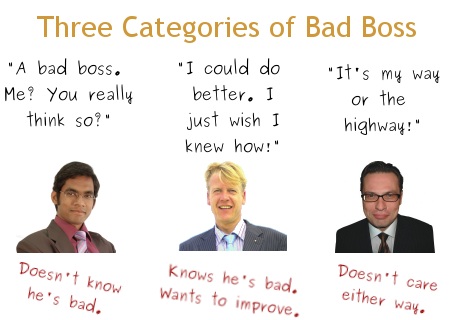
    Which of these three categories does your bad boss fall into?

    1. Doesn’t know he’s bad.
    2. Knows he’s bad and wants to improve.
    3. Doesn’t want to know he’s bad or doesn’t care.

    Most managers who make their employees unhappy are simply unaware of this fact—nobody has ever told them that what they do isn’t working. Some managers know that what they’re doing is wrong and are trying to improve—these people need our support and good advice in order to do better.

    Paul’s new boss was constantly critical and never showed any appreciation for a job well done. In weekly status meetings, he would only comment on deviations from the budgets and demand explanations and actions plans.

    Well, Paul doesn’t stand for that kind of thing. He kindly but firmly let his new boss know that in order to be motivated he also needed positive recognition for the things he did well. The result: Over the course of three months, the boss has come around and now freely and happily comments on the great results Paul is getting. At their last status meeting before Christmas, the boss even spent five minutes praising Paul’s department for the work they’ve done and the results they’ve achieved.

    But this may not always work.

    I used to be the Public Relations Coordinator and Editor for a local non-profit organization. A couple of months before I threw in the towel my grandmother became very ill. After a phone call from a family member I was told to come to her bedside, as death was imminent.

    I told my boss that I needed to leave for a family emergency and explained the situation and how close I was to my grandmother. My boss replied, “Well, she’s not dead yet, so I don’t have to grant your leave.  And, I was told to complete my workday. Suffice to say I did not finish my workday. (source)

    There’s also the third category of boss: Those who steadfastly refuse to acknowledge that they’re bad leaders, or who revel in the fact that they make people unhappy at work. These managers are usually beyond helping and may never learn and improve. Get away from them as fast as you can.

    3: Let your boss know what they could do better

    Presuming your boss is in category 1 or 2, you must let them know what they can improve. This can be scary because of the power imbalance between managers and employees, but it needs to be done. Managers aren’t mind readers, and they need honest, constructive feedback.

    4: Do it sooner rather than later.

    If you have a bad relationship with your boss it’s vitally important that you do something about it as soon as possible. It can be tempting to wait, thinking that it might get better on its own, or that your boss might be promoted, transferred or leave. Don’t wait – sooner is better.

    5: Choose the right time to talk.

    In the middle of a meeting or as a casual hallway chat are not the best ways to approach the subject. Make sure you’re in a quiet undisturbed place and have time to talk about it fully.

    6: Explain the effects on you and the effects on your work.

    Be specific and tell your manager, “When you do X it makes me do Y, which results in Z. If you can show how his actions reduce motivation, hurt business, or increase expenses, you’re more likely to convince him that this is a serious issue.

    7: Suggest alternatives.

    If you can, explain what they could do instead and why that would be better. Suggesting specific alternatives makes it easier to make positive changes.

    8: Make a plan and follow up.

    Agree to follow up at a later date, to evaluate the new situation.

    9: Praise your manager when he gets it right.

    When your boss gets it right, remember to praise them. Many managers never receive praise because people mistakenly believe that praise should only flow from managers to employees.

    You may be nervous about approaching your manager and giving them advice, but good managers are truly grateful for constructive, useful feedback, and will appreciate any opportunity they get to learn how to do a better job.

    10: If all else fails: Get out of Dodge

    If you’ve tried to make it work and can’t, it’s time to get away. You can go for another job inside the company (with someone you know to be a great boss), or you can quit and go work somewhere else.

    And you?

    What about you? Have you ever dealt with a bad boss? How did you do it? Write a comment, I’d really like to know!
    This post is an excerpt from my book Happy Hour is 9 to 5, which is all about making yourself, your co-workers and your workplace happy.

    Related posts

    If you enjoyed this post, I’m pretty sure you’ll also like these:

  • If you ever find yourself saying…

    Inspiring words

    There are some negative phrases we’ve heard so often at work, that we may suddenly find ourselves saying them. They represent a frame of mind that is cynical, despondent, helpless and victimized.

    Research shows that what we say reinforces what we think. Say something often enough, and it becomes how you see the world. That’s why we have to watch out for these pessimistic phrases. If you ever find yourself saying them, stop and ask yourself if it actually represents the truth or if maybe it’s more of an automatic verbal uttering.

    Some pessimistic phrases to avoid

    Here’s a partial list of phrases to watch for. Do you know any that belong on the list?

    “It’s not my dream job, but it’s only for a year…”
    ONLY A YEAR? Don’t you realize that a year is 12 months? 200 working days? 1600 hours?

    Say this instead: “It’s not the ideal job, so I didn’t take it.”

    “He’s a jerk, but he gets results!”
    Yeah, HE gets results – everybody else gets demotivated, bullied, harassed and stressed. Go read The No Asshole Rule by Bob Sutton. And his excellent blog.

    Say this instead: “He’s a jerk, so we fired him!”

    “Anything that can go wrong will go wrong.”
    Murphy’s law. The safe haven for pessimists everywhere. Too bad it ain’t true.

    Say this instead: “Things may go wrong – then we fix them!”

    “My boss doesn’t motivate me.”
    Listen: No boss ever motivated a single employee in the history of employment. Motivation is an emotion – your motivation exists inside you, and you’re in charge of it.

    Say this instead: “I motivate me.”

    “I hate my job – but so does everyone else.”
    Hating your job may be a common enough thing today – but so is adult onset diabetes. That doesn’t mean you don’t do something about it!

    Say this instead: “I hated my job. So I got a new one.” or “I hated my job, so I fixed it.”

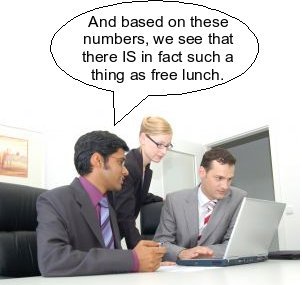
    “There’s no such thing as a free lunch”
    Except that there is. Plenty. The world is a generous, forgiving and nurturing place, and sometimes you get exactly what you need exactly when you need it.If you’re open to it, that is.

    Say this instead: “Can I buy you lunch?”

    “What’s wrong with people today?!”
    If every single person you interact with seems incredibly annoying… the problem may be you.

    Say this instead: “Hmmm… I seem to be easily annoyed today.”

    “I’m stuck in a dead-end job.”
    Riiight. You’re stuck. There’s no way out. Because three men in ski-masks show up every morning and force you to go to work at gunpoint.

    Say this instead: “I am where I’ve chosen to be! And if I want, I can choose to be somewhere else.”

    “Let’s not get carried away!”
    WHAT?! There is nothing better than being carried away by a great idea, nice people, a fun meeting or a good conversation.

    Say this instead: “This is wonderful!”

    “It’s too good to be true!”
    Funny how you never hear people saying “This is too bad to be true.”

    Say this instead: “This is great. I love it!”

    “What’s the catch?”
    Sometimes there just ain’t no catch.

    Say this instead: “Thank you!”

    “You can’t trust people.”
    Nonsense. Most people are nice, honest and loyal. Are you gonna treat them badly because of the tiny percentage of cheaters?

    Say this instead: “People are great!”

    The worst thing about these sayings, is that if you keep repeating them, you make it so. If that is how you see the world, then your choices, your speech and your actions will reinforce this view. That’s why it’s worth replacing them with something more true.

    What about you – got any more pessimistic workplace sayings we can flush out and replace?

    If you enjoyed this post, I’m pretty sure you’ll also like these:

  • How to find a job you’ll love

    Choose a job that will make you happy

    Is your new years resolution to find a new job? Congratulations, you’re not alone! According to statistics, around 15% of the population switch jobs annually. At any given time, over half of the workforce are more or less actively looking for new work.

    This means that many, many people are facing an interesting question: How do I pick my next job? Which factors should matter? Which should I forget about?

    Many make the decision based mostly on salary, titles and responsibilities. That’s a mistake.

    Instead ask yourself this: Will your next job inspire you, energize you and allow you to do great work? Will you be working with nice, talented people and managers? Will your job help people out and make the world a better place?

    In short, make sure that your next job is one that will make you happy at work. Here are the steps you should take to make sure that your next job will be just that amazingly great!

    1: Decide to switch sooner rather than later

    No one has ever told me “I quit Company X in June, that was a mistake. I should’ve stuck around longer.” The vast majority of people who quit, only wish they’d done it sooner.

    It’s highly tempting to hang around in the old workplace waiting for things to get better. Don’t! If it’s time to go – make that decision and start actively looking for something else. The longer you stay in a bad job, the more it eats away the energy and self-confidence you need to find a new one.

    2: Give yourself time to find your new job

    The very first job you look at may be just the right one… or it may be the 20th.

    Give yourself time to actively look for something better and don’t let economic pressure, peer pressure or uncertainty force your hand.

    3: Focus on what you like at work, not on what you hate

    Many people switch jobs to get away from a bad situation. However, when you’re picking a new job, it’s not enough to look at all the things you want to avoid. Partly because there are an infinite number of things to avoid. But mostly because even if you avoid every single bad thing, that can only guarantee that you won’t be unhappy. To be happy at work, you also need good things, not just the absence of bad.

    The best way to find out what you want at work, is to look at what has previously made you love your job. Here’s how you do it:

    1. Think back to some specific situations, where you’ve been happy at work.
    2. Ask yourself what made these situations possible.
    3. Find out what will give you more of these great experiences in the future.

    If you want to do examine this in more detail, page 3 of this workbook has a worksheet for doing just that.

    4: Ignore salary

    Most people think that having a higher income would make them happier. They’re wrong! That is the conclusion of a study by Two Princeton professors, economist Alan B. Krueger and psychologist and Nobel laureate Daniel Kahneman. They say this:

    The belief that high income is associated with good mood is widespread but mostly illusory. People with above-average income are relatively satisfied with their lives but are barely happier than others in moment-to-moment experience, tend to be more tense, and do not spend more time in particularly enjoyable activities.

    I don’t mean to ignore the economic necessities we all face but they should not determine what work we take. What is a 25% raise worth, if it means being stressed, frustrated and unhappy 40/60/80 hours a week?

    5: Ignore other irrelevant details

    Some people choose their new job because of:

    • The title. “They want to make me First Assistant Manager.”
    • Perks. “They’re giving me a new car and use of the executive bathroom.”
    • Status. “I get 8 direct reports. Today I only have 5.”
    • Peer pressure. “If I take this job my husband/wife/friends/dad will be really impressed.”

    None of these factors will make you happy! Forget about them.

    6: Ask for what you want

    It’s a lot easier to get what you want if you actually ask for it. In your job interviews, let them know that being happy at work matters to you, and tell them what it takes to get you to love work.

    It’s true that asking for these things may mean not getting the job, and that’s precisely the point! If that job won’t make you happy, you don’t want it!

    7: Make that job great

    It’s up to you to find a good job, and then it’s up to you to make it a great job!

    You can sit passively on your butt and wait for your co-workers and your manager to make you happy – but that means nothing will ever happen. It’s your responsibility to:

    1. Know what makes you happy at work
    2. Tell others about it
    3. Do something about it

    8: Make yourself free to leave

    A bad job is bad. A bad job that you can’t get out of is excruciating. In fact, knowing that you’re free to leave can make it easier to make a job great, as I wrote about in a previous post.

    Also, reducing your expenses can be a great way to give yourself more leeway at work.

    The upshot

    Forget about salary, perks, titles and status. Choose your next job based on one, single consideration: Will it make you happy? Will it make you go “Yes, it’s Monday, I get to work!”

    Do this and you’re sure to enjoy your job more, enjoy life more AND be more successful at work.

    If you enjoyed this post, I’m pretty sure you’ll also like these:

  • Why “Motivation by Pizza” Doesn’t Work

    Motivation

    My store manager implemented an embarrassing (and happily short-lived) safety incentive: Employees caught violating safety procedure were immediately given a two-foot rubber chicken on a string to wear around their necks–in front of customers. To get rid of the chicken, an employee needed to catch another employee behaving “unsafely.”

    The practice quickly descended into a game of hot potato, with employees chasing one another around the store in search of the slightest violation to rid themselves of the safety chicken.

    Source: workingamerica.com’s MyBadBoss contest.

    Many people don’t feel motivated at work, and there’s a very simple explanation for this: The motivational techniques used by most managers don’t work.

    While few companies use rubber chickens (fortunately), most of the standard motivational tools like promotions, bonuses, employee of the month awards, pep-talks and free-pizza-nights are downright harmful to the drive, energy and commitment of employees. It only leaves them feeling manipulated, cynical and demotivated.

    The result: According to one Gallup study 60-80% of workers are not engaged at work. They feel little or no loyalty, passion or motivation on the job. They’re putting in the hours, but they’re not doing a great job and they’re certainly not happy at work!

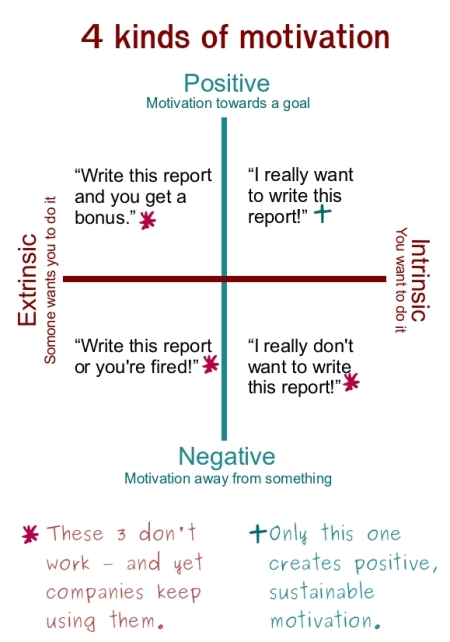
    As the illustration above shows, there are four different kinds of motivation. Only one of them works and unfortunately, many managers focus exclusively on the other three. Kinda silly, huh?

    These are the four different kinds of motivation:
    (more…)

  • Do not – I repeat – DO NOT like your job

    Liking vs. loving your job

    With thanks to Kathy Sierra for letting
    me borrow her visual style for a blogpost.

    Except of course that her stuff looks much better :o)

    After one of my recent speaking gigs about happiness at work, one participant told me this story:

    I work as a programmer in a major bank. I used to go in every week, work my 40 hours (more like 50, but hey) and get paid a nice salary. It was a nice job in a good company, my boss was a good guy, my co-workers were neat people and the work was OK.

    But as time passed, I felt like something was missing. Work was comfortable and secure, but I felt that there were sides of me that I never really got to use. I wanted to do work I could really feel proud of. I wanted to make more of a difference. And mostly, I was never really excited about work.

    So I asked myself what it would take to improve things. I came up with three things:

    1. Being more creative and working on more varied projects, as opposed to only maintaining the bank’s internal programs.
    2. More fun at work. The mood in the department was very serious and professional, to the point of being boring.
    3. Learning some new professional skills.

    I asked my boss about this and he was very supportive. We drew up a plan for some courses and certifications and found some new tasks that I could work on. We recruited some like-minded allies in the group and worked on lightening the mood in the group together.

    To my surprise, this didn’t just change my work life a little, it made a big difference. With my new skills, new projects and a more positive mood at work, I went from feeling OK about my job to feeling really great about it.

    I do much better work as well. Partly because I’ve increased my skills and increased my work experience but mainly because I feel so much more enthusiastic about work now. The difference between being OK with my job and being happy about it has been huge for me.

    Most job satisfaction surveys can divide people into three groups:

    • People who HATE their jobs. Usually around 10%
    • People who like their jobs. Around 70-80% of us.
    • People who LOVE their jobs. Usually around 10-20%

    This may sound strange coming from me, but I’m deadly serious here: Do not like your job.

    Liking your job is nice. It’s comfortable. It’s safe. It’s OK. When you like your job you’re pretty efficient. You’re fairly satisfied. You can get by for years on liking your job.

    But when you LOVE your job – MAN, what a difference that makes.
    (more…)

  • “Make Love, Not War” In Business

    Business as war

    When Kai-Fu Lee, a key Microsoft employee, decided to leave to go work for one of their competitors he had an… interesting experience:

    Prior to joining Google, I set up a meeting on or about November 11, 2004 with Microsoft’s CEO Steve Ballmer to discuss my planned departure… At some point in the conversation Mr. Ballmer said: “Just tell me it’s not Google.” I told him it was Google.

    At that point, Mr. Ballmer picked up a chair and threw it across the room hitting a table in his office. Mr. Ballmer then said: “F*cking Eric Schmidt [Google’s CEO] is a f*cking pussy. I’m going to f*cking bury that guy, I have done it before, and I will do it again. I’m going to f*cking kill Google.”

    Source: John Batelle’s blog

    I don’t know about you, but I’m getting really, really tired of the “business as war” approach. I’m sick of hearing about the market as a battlefield, competitors as enemies who should be killed and employees as foot soldiers.

    Executives who buy this kind of thinking can be found looking for business advice in Sun Tzu’s “The art of war”, Clausewitz’s “On War” or even Machiavelli’s “The Prince”. A recent business book called “Hardball” praises companies who are “ruthless”, “mean”, “willing to hurt their rivals” and “enjoy watching their competitors squirm”.

    But war is a terrible metaphor for business. It locks a company into an adversarial approach in which almost everyone becomes an enemy. It means spending time looking for ways to defeat your enemies, rather than making your own business great. It leads to zero-sum thinking, in which others have to lose, in order for you to win.
    (more…)

  • How to procrastinate effectively

    Procrastinate effectively

    Search for procrastination on google and you’ll find a massive number of articles on how to stop procrastinating and get stuff done.

    They will tell you that there is only one reliable way to get stuff done:

    1. Check todo-list for next item
    2. Complete item no matter what it is
    3. Go to step 1

    They’ll tell you that if only you had enough willpower, backbone, self-control and discipline this is how you would work too.

    Well guess what: Most people don’t work that way. Sometimes you’re in the mood for task X and doing X is ridiculously easy and a lot of fun. Sometimes doing X feels worse than walking barefoot over burning-hot, acid-covered, broken glass and forcing yourself to do it anyway is a frustrating exercise in futility.

    Sometimes procrastinating is exactly the right thing to do at a particular moment. This is largely ignored by the procrastination-is-a-sign-of-weakness, the-devil-finds-work-for-idle-hands crowd.
    (more…)

  • Business lessons from the Nintendo Wii

    Wii

    The new Nintendo Wii game console that just came out breaks the mold. Where the competing Microsoft Xbox 360 and Sony Playstation 3 machines are just more of the same (only faster and with better graphics) the Wii has broken new ground both with the product itself but also in the development process and in their marketing.

    Nintendo are on to something here and the buzz right now seems to favor them over the competition, which of course begs the questions “How did they do it?” and “What can other businesses learn and steal borrow from them?”

    Read on to see my favorite business lessons from the Nintendo Wii.
    (more…)

  • Top 5 myths about workplace stress

    Myths of stress
    Here’s some typical thinking on workplace stress:

    • Mike is getting stressed at work, but that’s just natural these days.
    • In fact, if Mike isn’t stressed, it probably means that he’s not really crucial to the organization.
    • The solution is to let Mike work less and with fewer responsibilities for a while until he recovers.
    • Or to let Mike work more for a while until he’s no longer falling behind and getting stressed over that.
    • And of course to send him on a stress management course to teach him all about stress.

    Wrong. Wrong, wrong, wrong.

    Yes, workplace stress is a serious problem. Yes, the cost to people, businesses and society is enormous. Yes we must do something about it.

    But some myths exist around stress that mean, that most of what we do about it isn’t working. Often, it even makes things worse.

    Here are the top 5 myths about workplace stress.

    Myth #1: Stress is normal – it means you’re important and it’s even good because it pushes you to perform

    Some people seem to think that if you’re not too busy, you’re not really crucial to the organization. These people revel in having full schedules, long working hours and too much work.

    But stress does not mean you matter. It either means that somethings wrong at work or that you’re not doing a good enough job of matching your tasks to your time. Worse, it also means that you get less work done, because stressed people are less efficient, worse communicators and worse at making good decisions.

    To accept stress as a normal condition of work is bad for people and bad for business!

    Myth #2: Stress is caused by working too much

    But then why do some people work 80 hours a week and feel great, while some people work 30 and get serious stress?

    Here’s why: Stress has nothing to do with the number of hours you work, and everything to do with how you feel during those hours.

    If you work 100 hours a week feeling great, doing something meaningful to you, having fun, feeling supported by you boss and co-workers and taking pride in what you do, you won’t be stressed. If you work 30 hours a week feeling inadequate, bullied or unappreciated you will be stressed.

    Myth #3: Stress is cured by working less

    Most workplaces react to stress by reducing employees’ workloads, responsibilities or working hours and in serious cases by giving people long sick leaves. According to Danish medical researcher Bo Netterstrøm who has studied workplace stress for 30 years, this is a mistake.

    People hit by stress need to increase their capacity and confidence at work, and while time off from work can be necessary to treat the immediate symtoms of stress, a long absence from the workplace does exactly the opposite. When people return to the workplace, they’re even more vulnerable than before. Worse, some never return to work at all.

    Also, reducing work or leaving work remporarily doesn’t fix any underlying problems. When employees return to work or to “normal” work conditions, nothing has changed and the stress returns quickly.

    Myth #4: Stress is cured by working more

    “Yes, I’m a little stressed at work right now because we’re falling behind. If I work really hard for a while I’ll catch up and it will go away.”

    No it won’t. For three reasons:

    1. Workplace stress does not come from falling behind at work. It comes from how you feel about falling behind.
    2. In most businesses, people will always be behind. There is simply too much work and finishing all your tasks simply means getting assigned more work.
    3. Working more hours often means getting less work done thus falling further behind. Here’s why.

    A temporary push to reduce a pile of work or meet a deadline is fine. But all too often that temporary push becomes the new standard.

    So the solution to stress is not to work harder to catch up because in most workplaces this is impossible. The solution is to feel good about the work you finish and not to get stressed about the work you don’t finish. It’s not that you should stop caring, it’s just that you should remember that being stressed makes you less productive, which means you get less work done and become more stressed. That’s a vicious circle right there and we need to break it.

    Myth #5: Stress is cured by focusing on stress

    I’ve seen a lot of the literature and training about workplace stress, and the typical content is:

    • What is stress
    • Symptoms of stress
    • Health implications of stress
    • How to fight stress

    This is often presented by a stress consultant. Here in Denmark that consultant may even come from the rather unfortunately named Center for Stress (shouldn’t that be against stress?)

    A recent study showed that people who return from anti-stress training felt more stressed than people who didn’t attend. No wonder, because focusing on stress is not the way to remove it – it’s a great way to create more stress. Instead, you must focus on what gives you peace and energy. Here’s a great way to do that every day at work.

    The truth about stress

    Repeat after me: Work does not give you stress. Feeling bad about work gives you stress.

    This means thant changing your workhours, your responsibilities, your priorities or your work environment is meaningless, unless it also changes the way you feel at work.

    Those stress management courses will not do the trick either, unless they can achieve just that.

    If you’re stressed, you must take charge and make whatever changes are necessary to go from feeling anxious, inadequate or drained at work to feeling appreciated, proud and energetic.

    Which will not only remove workplace stress, but will also make you more efficient, creative, successful and happy at work.

    Related posts

  • Podcast about motivation

    PodcastThere is a lot of talk about motivation in the workplace these days. Both from managers complaining that their employees aren’t motivated and from employees complaining that their managers don’t know what makes them tick.

    And frankly, it’s no wonder, because there are some fundamental misconceptions about motivation in the business world. There are four different kinds of motivation, only one of them works, and businesses and managers rely almost exclusively on the three that don’t.

    That is the topic of my first podcast, which you can download here. It’s 23 minutes long and will take up 7 Mb on your computer.

    Please let me know what you think. Is the sound OK? The content? What do you like about it? What can I do better? What great podcasts should I listen to, and get inspiration from? This is my first podcast, but all the cool kids have’em and I wanted one too :o)