More and more CEOs are hell-bent on forcing employees back to the office full time.
For a long time I have been really confused about why, but now a brand new study reveals the answer – and it is NOT any of the reasons they normally give like productivity or collaboration – it is something much more sinister.
There haven’t been a lot of positive outcomes from the COVID pandemic but the widespread flexibility to work from home is one. Maybe the only one.
Workers love it because they experience more flexibility, better work-life balance and higher productivity but over the last couple of years, a growing number of CEOs have been doing their best to roll it back and force everyone back into the office full time.
Well, now for the first time we have data! A fascinating new research article just gave the answer: It’s about protecting and boosting the egos of narcissistic CEOs.
In this video I go through the results of the study and how it applies in our workplaces.
I once did a workshop for a client in Copenhagen whose main problem was that they were just way too busy.
They’re a trade union and new legislation meant that they got an influx of new government-mandated tasks but budget constraints meant they couldn’t hire more people.
That meant they were increasingly falling behind on their work, through no fault of their own. They have an internal IT system that tracks every open case and they were currently 3.000 cases behind.
Even though this was due to circumstances outside of their control, knowing that they were behind made everybody stressed and irritable. They also felt a responsibility towards their members – every late case meant that one of their union members was waiting for an important answer or potentially weren’t being paid money they were owed.
This situation is becoming familiar in many workplaces where there is simply more work than resources. Typically management will bombard employees with information showing the current lag, which only serves to make people frustrated and unhappy at work.
So what can you do instead? Here’s what we did in our workshop with this client.
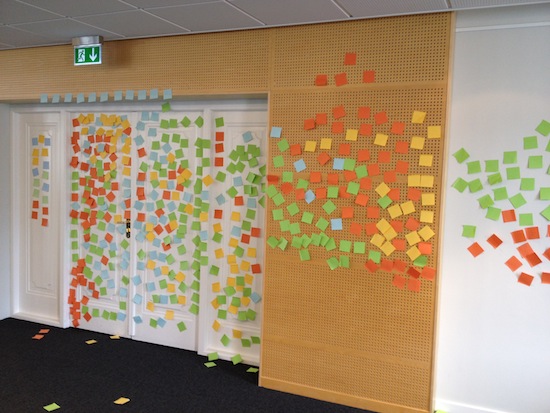
I pointed out the fact that they were currently behind by 3,000 cases. Everybody had heard that number – it had been sent out en emails and mentioned in countless meetings. I then gave the group 30 post-its notes and told them that each post-it represented 100 open cases.
I asked them to stick those post-its on the wall. It looked like this:
I asked how looking at that made them feel and they said things like “I feel hopeless,” “I feel like we’re failing our members,” and “I don’t see how we can ever catch up.”
Then I gave them 900 more post-it notes and asked the group to stick them on the wall next to that. It looked like this:
I told them that I’d checked their IT system and in the last 12 months they had completed 90,000 cases. Each post-it represents 100 cases – hence 900 post-its.
I asked how they felt looking at this and they said things like “I feel proud,” “I feel like we’re making a difference,” and “I feel hopeful.”
Interestingly, the year before that they’d processed 73,000 cases so they had actually become much more productive, but had never focused on that. Instead their focus was only ever on how much they were falling behind.
This gave them renewed energy to tackle their increased case load. They also came up with their own way to track progress, using a whiteboard in their cafeteria:
They use it to track monthly completed cases. They’d set a goal for March of 1,000 cases – and reached it on March 17th. Note how they had to extend the scale upward with a piece of paper because they completed much more work than planned.
In short, focusing on the work they completed (instead of how much they were falling behind) allowed them to catch up over a period of a few months.
And crucially, they were ably to catch up without feeling stressed or hopeless along the way.
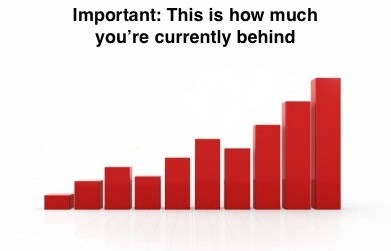
Sadly, many workplaces do the exact opposite. When teams fall behind, they are constantly told exactly how much. I’ve seen workplaces send out weekly emails with red graphs showing the current lag. I’ve seen the same graphs hanging in offices, cafeterias and being presented in every department meeting.
The problem is of course that this makes employees frustrated, hopeless and unhappy. The work of Harvard professor Teresa Amabile has shown that the most important factor that makes us happy at work is perceived meaningful progress in our work and that the absence of progress makes us unhappy.
And of course we know from the research that happy employees are more productive, creative and resilient.
In short, this means that many workplaces set up a vicious cycle:
There’s too much work compared to the available resources
Employees are constantly told that they’re falling behind
Employees become unhappy at work
Employees become less productive
Less work gets done
Back to 1
So that’s my challenge to your workplace: How can you highlight and celebrate the work that gets done, instead of only feeling bad over the work that’s not yet completed?
Many CEOs are are currently nixing work-from-home programs and forcing all of their employees back into the office full time.
And without fail, they all seem shocked and appalled when employees dare to question their decision.
Jamie Dimon, the CEO of JP Morgan Chase, in particular was just outraged that thousands of his employees spoke against it and signed a petition to preserve flexible working. He went on an angry rant full of curse words in a town hall meeting where he claimed that being together in the office is the ONLY way to be creative and productive because there you can communicate and collaborate in person.
He said that he didn’t care how many people signed the petition and added things like:
Don’t give me this s— that work-from-home-Friday works. I call a lot of people on Fridays, and there’s not a goddamn person you can get a hold of.
A lot of you were on the f— Zoom…and you were sending texts to each other about what an a— the other person is.
Most recently, Danish pharma giant Novo Nordisk announced not only a massive round of layoffs but also that all office workers must be in the office full time going forward. This triggered a lot of pushback from employees because Novo has had a very flexible policy of letting people work from home when it makes sense for them and the team.
So I thought I should do a public service for all of these CEOs and try to help them understand why their employees don’t just accept it and knuckle under when their freedom to work from home is taken away.
There are three main reasons why.
1: Loss aversion
The work of Daniel Kahneman and many others has proven that we humans hate losing stuff. Taking something away from us – even stuff we don’t necessarily value very highly – can trigger intense negative feelings.
If employees currently have the freedom to work from home, taking it away from them will absolutely trigger loss aversion.
2: Working from home is amazing
People who have the flexibility to work from home at least part time love it. Research shows that it has a large number of positive effects, including:
Productivity – people get more work done, partly because they experience fewer interruptions than in the office.
Better work-life balance – it’s easier to handle all of your responsibilities outside of work when you can work from home. You also spend less time commuting.
Feeling of trust – employees feel trusted by the company and therefore more loyal and engaged.
Of course they don’t want to lose all of this and of course they’re going to push back against any decision that would make their work lives significantly worse.
3: Forcing people back to the office is meaningless
If the company could demonstrate conclusively to employees that the only way the company can move forward and be successful is by stopping working from home, then I think people would accept it.
For instance, if my job changed from an internal role to a customer facing role that required me to be physically present in a location, then it’s clear why I can no longer work from home and that decision would have a legitimate purpose to back it up.
But companies never do that. Instead they make a lot of noise about “fostering collaboration” or “making faste decisions” or “strengthening the culture” while never actually demonstrating why that can’t be done while still giving employees the option to work from home some of the time.
And here’s another thing: Even on days where people are in the office, a large percentage of the work or the coordination they perform is still digital through email, chat or video meetings. Even more so, if the company has people in different locations.
You don’t go to a coworker’s desk and interrupt their workflow every time you need help with something. You don’t call a meeting every time you have a question. You don’t go to your manager’s office every time you need to make a decision. Or at least, I really, really hope you don’t!
If 50% of your work day in the office is virtual anyway, you’ve gotta ask yourself why you couldn’t have spent 50% of the week working from home.
And that’s why employees will see the decision to force them back into the office and thereby make their work-life significantly worse as a bad and meaningless decision.
The upshot
My video on how to make remote workers productive and happy.
All of this of course also means that if the company doesn’t listen and reintroduce flexible working, employees are going to vote with their feet and go find better jobs. And who’s going to go first? The most qualified people as always will find it easiest to get new jobs. That leads to brain drain.
Some people see this as a good thing. Just today I heard the dumbest argument I have ever heard for forcing people back to the office: It will help the company identify who is not committed to being in the office full time.
Wow. Just wow. That rationale could be used to justify any mistreatment of employees; anyone who speaks out is just not committed to the organization!
The good news is that many companies are deliberately choosing to be remote, like Spotify, Canva and Atlassian.
Even Dimon has since apologized for his rant. Not for maligning his remote workers. Not for claiming that they’re all slacking when they work from home. No – he apologized for cursing.
Jamie, Jamie, Jamie… the problem was not you dropping some F-bombs. The problem was your complete inability to trust your employees and to recognize that there are more ways of working effectively than the one you prefer.
Some people want you to believe that quitting is weak and for losers. They’re lying and we need to normalize leaving jobs that are not good for us.
In this video we take a deep look at what happens when you’re unhappy at work, how you can know it’s time to quit and how you can support others who need to get away from a bad job.
Content:
(00:00) 1: Frogs aren’t idiots (01:01) 2: Introduction to quitting
(03:45) 3: How hating your job hurts you
(06:56) 4: Exposing the anti-quitting propaganda
(18:05) 5: The excuses people make for not quitting
(27:23) 6: Should you quit?
(32:47) 7: 21 perfectly valid reasons for quitting
(40:21) 8: What if you can’t quit
(46:24) 9: How to quit
(47:39) 10: Should you always find a new job first before you quit?
(49:42) 11: We should celebrate quitters
(59:22) 12: I quit!
I think that’s complete nonsense! I know – what a shocker :) But worst of all it’s poorly reasoned nonsense that relies on a string of terrible arguments and deliberate ignorance of the research in the field.
Here are the top 5 fails from DeBrarander’s article and why you should most definitely seek work you’re passionate about.
1: He blames the long US working hours on people’s passion for their jobs
The United States offers a curious paradox: Though the standard of living has risen, and creature comforts are more readily and easily available — and though technological innovations have made it easier to work efficiently — people work more, not less.
Why is this?
One theory is that Americans have come to expect work to be a source of meaning in their lives.
There are no studies showing that people who find work meaningful work more hours than those who don’t.
If you want to actually know why working hours are still on the rise in the US, I think it makes much more sense to look at some of these factors:
Bad management practices
Workplace cultural norms
Economic insecurity caused by a hugely challenged middle class that are one pay check away from financial disaster.
The high cost of college educations and the huge amount of debt that many young people graduate with – meaning that they absolutely must work or face personal bankruptcy.
Put people with huge financial insecurity in a workplace that expects and demands 60, 70 or 80-hour work weeks, and they most often have no option but to go along and work themselves to death.
2: Being passionate about your work means that you experience constant bliss
Most people are certainly guaranteed to fail in this pursuit [of passion at work]. Even people who love their jobs will report they must do thankless tasks from time to time. Few, if any, experience nonstop bliss, where sheer passion sustains them through long hours on the job.
Notice what DeBrabrander did there? He just redefined being passionate about your work to mean that you experience nonstop bliss and sheer sustained passion.
This is what’s known as a strawman argument, where you exaggerate, misrepresent, or just completely fabricate someone’s position, to make it easier to attack.
Just to be clear: Being passionate about your job does not mean that you experience nonstop bliss. Everyone has bad days at work – and that’s perfectly OK. And of course every job contains a mix of tasks that you enjoy and tasks that suck – and that’s OK too.
3: Young people burn out because they seek passion at work
There is plenty of evidence that our high-octane work culture has serious consequences. It is at least partly responsible for high levels of burnout among millennials.
And while there definitely is an increase of stress, burnout, depression and mental problems among young people, it’s intellectually lazy to just conclude that it’s caused mainly – or even partly – by their search for passion and meaning at work.
Young people are also facing many other pressures, including a global climate disaster that no one is doing much about, while they are of course the ones who will have to live with the consequences of that inaction. Might that be a source of stress for them? No, says DeBrabrande – their real problem is that they expect their jobs to be meaningful.
4: If you seek passion in your work, you will fail
A recent study of priorities among young people found that achieving one’s career passion ranks highest of all… Finding a fulfilling job is almost three times more important than having a family, teenagers in the study reported.
It is daunting to contemplate. Most people are certainly guaranteed to fail in this pursuit.
Got that? If you seek passion at work, you are almost guaranteed to fail. Really? How would he know? Of course, he’s previously redefined passion at work to mean constant bliss and if that’s your goal, of course you will fail.
And just to make it worse, the study he links to in support of his claim is not even about passion at work. The actual finding is that 95% of US teenagers surveyed say that “having a job or career they enjoy” is important to them.
5: Passion means that work is the ONLY source of meaning in your life
We might begin by rejecting the notion that work should consume our lives, define and give meaning to them…
Again, the article dishonestly redefines passion to mean that work consumes your life and gives meaning to it.
In reality, passion for your job simply means that you are passionate about the work you do – not that it’s the only thing are passionate about.
Why you absolutely should seek work you’re passionate about
This kind of attack on happiness at work is nothing new. Many serious people are coming out of the woodwork to declare that happiness at work is stupid, impossible, naïve, silly, manipulative and/or bad for you. In the video above we cover their 20 most used objections to workplace happiness and why they’re wrong.
DeBrabrander’s analysis is poorly argued and of course also wrong. Everyone should absolutely seek work they’re passionate about. There are many reasons why, but the most important are these:
It will make you happier at work
It will make you happier in life
It will make you more successful at work
It will protect you from doing harmful work – whereas not trying to find meaning at work makes it more likely that you will end up doing work that exploits or harms others
Work is where you will spend many of your waking hours – of course you should spend that time doing something you care about
Work is where you will invest most of your energy, skills and competencies – all of that effort should be invested in the service of a cause you care about
Paradoxically, I actually think DeBrabrander agrees! When he talks about approaching work as duty rather than passion, he bases this on an understanding of duty that comes from stoic philosophy. I have many, many issues with stoic philosophy – not least that it is based on the idea that we are all subjects to a predetermined fate – but it has recently become very fashionable, especially among silicon valley tech bros.
In the NYTimes pice, DrBrabrander recounts The advice of Seneca, one of the most prominent stoics to define duty like this:
Seneca’s advice to Serenus is to focus on doing his duty. He must perform the job he is best disposed and able to perform, as determined by his nature, and the needs of those around him. And he must forget about glory or thrill or personal fulfillment — at least in the near term. If he performs his duty, Seneca explains, fulfillment will come as a matter of course.
Duty, in this definition, is not just about having a “Shut up and do your job” approach. It’s about doing work that you’re good at and which meets the needs of those around you.
In the “calling” orientation, people are working not for career advancement or for financial gain, but instead for the fulfilment or the meaning that the work itself brings to the individual. People who see their work more as a calling see the work as an end in itself that is deeply fulfilling and regardless of the kind of work they’re doing, they tend to see the work as having a societal benefit.
It’s ultimately about working for something bigger than yourself.
The upshot
This opinion piece is poorly researched and dishonest – so of course the advice it gives is bad.
Seeking passion and meaning at work is the path to more career happiness and success and less stress and burnout. It’s also one way you can help create a better world, by making sure that all of your professional skill and energy is spent in the service of something that you can clearly see is making the world a better place, rather than in just obtaining a pay check or career advancement.
I have to say, if you make your career choices with no consideration for where your passions lie, I honestly pity you.
In dancing – just as in business – there are leaders and followers. But if you think this means that “The leader always leads and the follower does what they’re told” then you’re very wrong.
Miranda van Wonterghem is an international swing dance teacher and in this amazing talk from our International Conference On Happiness at Work, she revealed the three main things business leaders should learn from dancers to create happier and more effective leadership – AND demonstrated it with dancing.
Sure, it has its problems. Any time you measure anything, you run the risk of getting bad data, the wrong data or making bad decisions based on the data.
But it still makes sense for two main reasons.
First and most obviously, if you measure employee happiness right, it can actually guide efforts to improve the workplace by identifying organizational problems and strengths.
Also, most business leaders are highly results oriented and data driven and find it hard to value things they can’t put a number on. Tracking employee happiness with hard numbers in some way can bolster organizational commitment to happiness initiatives.
So what can you measure? This can go way beyond just an annual job satisfaction survey. It’s essential to find the metrics that are relevant to your employees, your customers and your organization.
Here are all the potential ways we’ve come up with to measure employee happiness. Did we forget any? Write a comment if you have one we didn’t include.
Measure employee mood
If you want to know how happy your employees are, you can quite simply ask them. The traditional way is of course to run annual satisfaction surveys but I’m very skeptical about that approach.
You can measure things like:
Happiness
Satisfaction
Engagement
Well-being
Psychological capital
You can conduct the measurement using surveys, apps, mood boards or even just tennis balls.
Other employee metrics
Two other obvious employee-related metrics are:
Absenteeism
Employee turnover
Each of these have a direct bottom line impact and are directly correlated with employee happiness.
Hiring
Happy organizations also attract more and better new hires. That means that you could also measure on metrics like:
Applications received per opening posted
Time to fill positions
Rate of acceptance of job offers
Rate of successful hires (how many new employees stay at least x months)
This will be especially relevant in fast-growing workplaces or in industries where there is strong competition for the best talent.
Customer metrics
We know that happy employees make the customers happy. Some potential metrics are:
Customer happiness / satisfaction
Customer loyalty / repeat business
Brand perception
Employee performance
We also know that happy employees do a better job, so measuring happiness could also mean tracking metrics like:
Productivity
Quality / errors
Workplace safety / accidents
Success rate of innovation / change projects
Negative behavior
Given that happy employees are less likely to engage in bad behavior at work, we could also track metrics like:
HR complaints
Fraud / stealing
Physiological measures
This area is a little more speculative but some people have suggested measuring things like:
Cortisol in saliva samples
Blood pressure
Sleep time and quality
These do raise some ethical issues around privacy and bodily autonomy.
The upshot
Measuring employee happiness can help efforts to improve a workplace and strengthen leadership’s focus and commitment to these efforts.
While traditional satisfaction surveys have a long list of problems, there are many other metrics you can look at.
No workplace should measure all of these metrics. Depending on the industry, situation and type of employees only a small subset of these will be relevant. It’s up to each workplace to define which are the most relevant and to find a good way to track and act on these metrics.
Jack Ma, the billionaire founder of Chinese tech company Alibaba, has come out in favor of the so-called 996 rule, i.e. that you should work from 9am to 9pm 6 days a week if you want to have a successful career. For anyone doing the math that’s 72 hours of work a week. Add a 1 hour commute on top of that and there’s very little time left for your family, kids, hobbies, exercise and life in general.
His belief in this is unshakeable:
“I personally think that 996 is a huge blessing,” hesaid. “How do you achieve the success you want without paying extra effort and time?”
He also added that you can only achieve business success through suffering and sacrifice.
I realize I may be wasting my time here by going up against a belief that is so prevalent among business leaders, but there’s no way I can let that kind of nonsense pass and not point out exactly why it’s wrong. Here are 5 quick reasons:
1: Pointing to successful people that achieved success by working 72 hours a week proves nothing. What about all the people that worked just as hard but failed?
2: Many of the mental qualities that make a person successful at work are lost when people are overworked, tired, stressed and unhappy, including networking, creativity and effective decision making.
So permanent overwork does not lead to increased results and success – in fact it hurts people AND profits.
It’s easy to point to Alibaba and say “But they work really long hours and the company is successful. Check mate!” But that’s just correlation; where is the proof that they are profitable BECAUSE OF the long working hours? Maybe they would’ve been even more profitable if their employees were happy, relaxed and had lives outside of work too? The research certainly indicates that.
So why do so many people still believe this nonsense? As the psychologist Daniel Kahneman noted, it’s difficult to change people’s minds. Look at this picture:
Every horizontal line is perfectly straight. Don’t believe me? Hold up a ruler to your screen and check. OK, now that you know the horizontal lines are straight, what does your mind see? Bendy lines.
So here’s a simple tip you can try very easily: Open your next meeting with a round where each person shares something positive. You can pick one of these questions and let everyone share:
Name one thing you’ve accomplished since the last meeting that you’ve been proud of.
Name a person who has helped you since the last meeting.
Mention one thing you’re looking forward to at work in the coming week.
What’s the funniest thing someone has told you in the last week?
Mention something interesting you’ve learned in the last week.
Don’t spend a lot of time on this, just give each participant about 30 seconds to share something positive. If the group is bigger than 10-12 people, let people share in pairs and then let 3 or 4 people share with the whole group so it doesn’t take more than a few minutes.
It really works wonders for a meeting. One person told me this after trying it out:
Hi Alexander,
I have been reading your work for a few days now, and I cannot get enough.
We have 4 analysts on our team, who touch many if not all groups in our company. Our role often means our view is black and white in order to deliver results, which is often received in a bad light.
So, I tried starting a meeting with something positive. It was like the Jedi mind trick for convincing others to lobby for our interests!
My Sr Analyst was struggling to keep her jaw from dropping. No more than a simple ask of what is the funniest thing your kids have said to you lately. Everyone had a story, and we all laughed for a quick 2 minutes before getting to the agenda.
Just wanted to say, “Thank you,”
All the best,
-Grant
And it’s not only fun, it will also make your meeting more effective as this experiment shows:
Psychological experiments can be very devious, and this one was certainly no exception. The focus was meetings and the format was simple: Groups of people were asked to discuss and reach consensus on a contentious topic.
Here’s the devious bit: Unbeknownst to the other participants one member of the group was an actor hired by the researchers. The actor was told to speak first in the discussions. In half the experiments he would say something positive while in the other half he would start by saying something critical. After that he simply participated in the discussion like the other group members.
The experiment showed that when the first thing said in the meeting was positive, the discussion turned out more constructive, people listened more and were more likely to reach consensus. When the first statement was negative the mood became more hostile, people were more argumentative and consensus became less likely.
The researchers concluded that the way a meeting starts has a large impact on the tone of the discussion and on whether or not the group will eventually reach consensus.
I met a manager recently who claimed in no uncertain terms that companies should forget all about employee happiness and focus only on engagement. He argued that people can be happy at work without performing well, whereas employee engagement leads directly to better performance.
I’ve actually heard this claim a few times recently, but it is still wrong. In this article we’ll look at why.
But first let’s define the two terms. Both can be defined in many different ways, which will confuse any discussion, so here are the definitions I will base my argument on.
This is the first result that comes up when you google “employee engagement definition”:
Employee engagement is the extent to which employees feel passionate about their jobs, are committed to the organization, and put discretionary effort into their work.
And this is the definition of happiness at work that we use:
Happiness at work is the extent to which employees feel good about their jobs.
Both are clearly emotional at their core (the word “feel” appears in both) but the key difference is that engagement is more about the work and less about the person. It’s not really about how you feel in general, it’s how passionate you feel about your job, how committed you are to the workplace and how much extra effort you put in.
Happiness at work, as we define it, is how work makes you feel more broadly. It’s not about feeling good every second of every work day, but it is about experiencing mostly positive feelings about your job.
Just to make it clear: We think employee engagement is a useful concept and we are not arguing against it. We just want to argue that of the two, it is much more effective for a company to focus on making their employees happy than on making them engaged. Here are the four main reasons why.
1: Happiness is easier to sell to employees
Whether you’re looking to create employee happiness or engagement, you need your employees to be active partners in the process. This is not something you can do to them without their active and willing participation or (even worse) against their will.
Employee engagement, being directly related to commitment and effort, is a very easy sell to managers and companies. Every manager wants employees who are passionate about their work and go above and beyond to do a better job.
But seen from the employee side, it’s a much harder sell. When a manager states that they want their employees to “be more engaged in their work” or “give more discretionary effort” it can easily come off as if they are simply demanding more passion and work from people, without giving anything back.
On the other hand, when a manager sets a goal to create a happy workplace, the benefits are immediately clear to employees and it’s much easier to engage them in the process.
Ironically, happiness can be a harder sell towards managers, many of whom are skeptical of “all that happiness crap”. This video covers their most common objections and why they’re wrong:
2: Engagement without happiness is unsustainable
How engaged can someone really be if they’re unhappy at work?
Having worked in a number of charities, non-profit orgs and social enterprises, I can tell you that most of these employees are passionate and committed about their org’s cause but unfortunately a lot of the orgs don’t have a very happy work environment and it’s not uncommon at all to find super engaged yet super unhappy employees working in these orgs.
This is something I talk a lot about in my discussions with potential clients. I myself have been in this circumstance a number of times, being super engaged but miserable. And while I performed satisfactorily, had I been happy I would have blown the job out of the water.
A person can be incredibly passionate about their work and totally committed to the workplace, but still be miserable at work. I’ve seen this happen for instance when people are treated badly by their coworkers or manager or when they can’t do their job in a way that satisfies their own professional standards.
In this case, two things can happen:
The employee’s unhappiness can leech away any feeling of engagement, leaving the person not caring about their work.
So even if you want an engaged workforce, you still need to focus on making them happy because engagement without happiness is not sustainable.
3: Ultimately, it’s about performance – and happiness drives better performance
As I stated above, some fans of engagement argue that it matters more because it directly drives effort and performance. They also argue that employees can be happy but not productive. Both of these arguments reveal a poor knowledge of the research in happiness at work.
Sure, engagement leads to better performance – but given the definition above that includes commitment and extra effort, that’s almost a tautology.
Furthermore, we know from a large amount of research, that happy employees perform much better. Ed Diener, one of the world’s leading happiness researchers summed it up like this:
In the workplace we know that happiness causes more-productive and more-creative workers.
If you know academics, you know how careful they are about using the word “causes.” In this case, we know that happiness at work causes higher:
Productivity – happy people get more work done with the same resources.
Creativity – feeling good makes your mind more able to think of new ideas and approaches.
Intrinsic motivation – happy people don’t need constant external motivators like bonuses or threats; they want to do good work.
Loyalty – happy employees care about the company and stay longer in their jobs.
Discretionary effort – employees who like their jobs go above and beyond for the customers, their co-workers and the workplace.
So employee happiness has been shown to directly cause increased performance.
4: Happiness causes engagement
You’ll notice that both loyalty and discretionary effort were part of the definition of engagement that we presented above.
Given that (as we saw in the previous section) happy employees are more loyal and are more likely to go the extra mile, it’s clear that happiness doesn’t only cause better performance – happiness also directly causes engagement.
Of course, the effects are circular and engagement and happiness will cause each other. But given the results above as well as the fact that engagement cannot last in the absence of happiness, it seems clear to me that happiness causes engagement more than engagement causes happiness.
Gallup does a lot of great work on employee engagement and their Q12 survey is one of my favorite metrics. They also acknowledge that many factors play into engagement, including happiness / well-being, writing:
Leaders have to think about everything from culture to well-being to purpose and meaning — and make it all come to life in a personalized way for employees.
The upshot
Engagement is a great concept but ignoring employee happiness in the pursuit of engagement makes no sense.
At the very least, sustainable engagement requires happiness at work, meaning you can’t ignore the happiness aspect.
When do people feel “passionate about their work, committed to the workplace and give discretionary effort?” When they’re happy at work!
So if you want engaged employees, focus on making them happy and engagement will follow.
The Chief Happiness Officer Academy is our most in-depth 3-day training where we share everything we know about creating happier workplaces. You get a comprehensive understanding of the latest research, tons of effective practical tools and learn how to use them in your own business.