Category: Leadership

Leadership is an insanely important discipline. Here you’ll find the thought, tools and tricks of the trade of great leaders.

  • Performance reviews are a big fat waste of time

    Performance Review

    Welcome to your annual performance review.

    In the next 90 minutes we will:

    • Review your performance over the last 12 months
    • Follow up on the goals from last year’s review
    • Set new goals for your professional development and career
    • Handle any problems you might have had in the last year
    • Fill out this 8-page form required by HR
    • Coach you to better performance
    • Get your totally open and honest feedback to my leadership

    And of course, we will both pretend that the results of this little chat will not in any way influence the salary adjustments coming up in two months.

    Now… any questions?

    It seems that no one likes performance reviews. Joel Spolsky, the CEO of Fog Creek Software certainly doesn’t:

    At two of the companies I’ve worked for, the most stressful time of year was the twice-yearly performance review period.

    For some reason, the Juno HR department and the Microsoft HR department must have copied their performance review system out of the same Dilbertesque management book, because both programs worked exactly the same way.

    First, you gave “anonymous” upward reviews for your direct manager (as if that could be done in an honest way). Then, you filled out optional “self-evaluation” forms, which your manager “took into account” in preparing your performance review.

    Finally, you got a numerical score, in lots of non-scalar categories like “works well with others”, from 1-5, where the only possible scores were actually 3 or 4.

    Managers submitted bonus recommendations upwards, which were completely ignored and everybody received bonuses that were almost completely random.

    The system never took into account the fact that people have different and unique talents, all of which are needed for a team to work well.
    (source)

    Almost every medium-sized or large company does performance reviews. Everybody does it – and I think it’s time to stop!

    Performance reviews are fundamentally broken. Managers hate them and fear them and resent the drain on their time.

    Employees often leave reviews demotivated, cynical and with no clear idea of how well they’re doing and how to improve:

    Research into British workers found a quarter of respondents thought managers simply regarded the reviews as a “tick-box” exercise, while one in five accused their bosses of not even thinking about the appraisal until they were in the room.

    Almost half (44 per cent) did not think their boss was honest during the process, 29 per cent thought they were pointless, and a fifth felt they had had an unfair appraisal, according to the YouGov poll of 3000 workers.

    Only a fifth believed their manager would always act on what came up during the review and 20 per cent said their boss never bothered to follow up any concerns raised.
    (source)

    There is a lot of advice out there on how to fix performance reviews but in my opinion, performance reviews would still be worse than uselss, even if we could fix everything that is currently wrong about them and the very fact that companies fell the need to have them, shows that something is seriously broken in our workplaces.

    Here’s why performance reviews and appraisals are such a waste of time and why our workplaces would be better off without them.

    1: Everybody hates them

    Managers actually cite performance appraisals or annual reviews as one of their most disliked tasks (source) and as we saw above, employees dislike and distrust the process too.

    Performance reviews are supposed to be about giving people feedback on their past performance and setting goals for the future. This is impossible in a format that people dislike this intensely.

    Studies show that if you’re in a bad mood (and lots of people are during their review meetings), you’re not open to criticism and suggestions. You’re also almost certainly not in the mood to make big plans for your future growth and development

    2: They try to do too much

    Tom Coens and Mary Jenkins in their 2000 book called “Abolishing Performance Appraisals: Why They Backfire and What to Do Instead” argue that employee reviews take on too many tasks at once. They’re about communications, feedback, coaching, promotion, compensation and legal documentation. Good luck doing all of that in an hour or two!

    3: They become an excuse for not talking for the rest of the year

    “Yeah, I know that Johnson in accounting is lagging a little and seems dissatisfied, but his performance review is coming up in 4 months – we’ll handle it then.”

    No. No, no, no!

    In fact, If you have good, open, honest communication between managers and employees, if people constantly know what they do well end where they can improve then you have no need for a formal review process.

    4: They are too structured and formal

    Many companies have noticed that formal reviews are not working and the response, overwhelmingly, has been to formalize them more. There are now more questionnaires to fill out before, during and after for both employees and managers. More boxes to tick. More ratings on a 1-5 scale More time spent preparing.

    But here’s the thing: This actually detracts from the value of the conversation you will have. The more you structure the conversation, the less likelihood that you will actually get to talk about what’s important.

    The more boxes to tick, the more likely it is that it will get treated as an exercise in “filling in the blanks.”

    5: They focus too much on the quantifiable

    Joel Spolsky has another good example:

    …one friend of mine was a cheerful catalyst, a bouncy cruise director who motivated everyone else when the going got tough. He was the glue that held his team together. But he tended to get negative reviews, because his manager didn’t understand his contribution.

    Many of the most valuable and important things we contribute to the workplace do not fit into those little check boxes. If a manager doesn’t understand this during the year, he will most certainly not get it in the performance review.

    6: They may not be formally connected with promotions and salary negotiations – in reality everyone knows they are

    A lot of companies have noticed that performance reviews go even worse when they also double as negotiations about salaries and promotions.

    Consequently they have separated these two processes and will first have appraisals and then later on salary negotiations.

    Riiiiiight. Does anyone expect this to work? Will managers forget everything they said in the appraisal when setting salaries later on? Will employees fall for this and be more honest, rather than try to make themselves look good?

    Of course not. But trying to pretend that’s the way it works just adds another layer of deception to the whole sorry mess.

    7: No one says what they really think

    Managers can hold back from offering negative feedback because they fear conflict.

    Employees often don’t offer honest criticism of managers and workplaces out of a fear of offending and the knowledge that, regardless of formal policies, the content of this talk will affect your salary.

    In short, everyone is on the defensive from the beginning.

    8: They take a LOT of time

    Everybody’s busy these days, and on top of your regular tasks, once a year you have to find time to prepare for, execute and follow up on the performance reviews. To make matters worse, very few companies factor in this time in peoples’ schedules and give them a lighter workload during those weeks.

    This means that rather than doing it right, many people focus on doing it fast and just getting it over with, making the whole process worse than useless.

    9: They become a crutch for bad managers

    If you’re not capable of giving your employees regular, specific, timely and relevant feedback (good and bad) – you should not be a manager at all.

    And formal performance reviews are not the solution! The managers who actually do manage to give worthwhile performance reviews are invariably also those who don’t need to have them because they already excel at providing regular, constructive feedback.

    What to do instead

    A 2006 Harvard Business Review article talks about how to fix employee reviews by doing things like:

    • Have them more often than annually
    • Make their purpose clear
    • Give continuous feedback
    • Add forced ranking of employees (worst idea ever!)

    But I think the solution is a lot simpler: lose’em. Stop having formal employee reviews, whether annual, semi-annual or quarterly. They’re not only a waste of time, they’re actively harmful to motivation and happiness at work.

    As Peter Block says in the foreword to the Abolishing Performance Appraisals book mentioned above:

    “If the appraisal process is so useful, we should consider using it in our personal lives. Would we say to our spouse, significant other or intimate friend, ‘Dear, it is time for your annual performance appraisal. For the sake of our relationship and the well-being of the family unit, I want you to prepare for a discussion of your strengths and weaknesses and the ways you have fallen short of your goals for the year.

    ” ‘Also, honey, I would like for you to define some stretch goals for the coming year.’
    (source)

    Good luck with that :o)

    Your take

    What do you think? Do you know of companies that have abolished performance reviews? Do you know of any that have them and do them well? What happened at your last performance review? Please write a comment, I’d really like to know.

    Related posts

  • Quote: Numbers don’t lead

    FiveNumbers and money follow; they do not lead.
    From the Quicken Loans web site

    That is absolutely brilliant – and beautifully phrased.

    If you let the numbers lead you end up with management by spreadsheet in which all decisions are made for short-term gains with no regards to the fact that workplaces rely mostly on the thoughts, feelings and reactions of human beings who are inexplicably difficult to get to follow the stats.

    Humans lead. Numbers follow. I like it.

  • Quote

    QuoteCreating peak experiences for employees and customers is a no-brainer. You gotta do it.
    Chip Conley

    I agree – it’s a total no-brainer! It’s also easy. And cheap. And companies who do it find that it makes them a LOT of money.

    Of course my interest is in creating peak experiences for employees – moments where you just go “MAN, I love working for this company!”

    Have you had one of those? What happened – what was the peak experience? How can your workplace give you a WOW moment?

  • Designing democratic workplaces

    WorldBlu ListOver at the WorldBlu blog, Traci Fenton has another great post – this one on how we design our organizations.

    Traci does amazing work in creating democratic workplaces, and she increasingly sees companies introducing democracy in the workplaces:

    …entrepreneurs and business leaders take note — you need to spend as much energy and time thinking about the design of your employee experience as you do about your next big idea.

    When I talk about good workplace design I’m not talking about open floor plans in offices or traditional this-is-what-makes-a-great-place-to-work programs. I’m talking about designing an employee experience that engages people body and soul in meaningful interactions and meaningful work. The traditional design of business — call it command-and-control, authoritarian, hierarchal, etc. – can’t, by design, achieve this goal. But workplace democracy does, which is why I believe democratically designed organizations are future of work.

    Democracy at work! I love it! If democracy is so great in society, then why are many businesses still run like third-world dictatorships?

    But what is democracy at work? Here’s a quote from Traci’s recent op-ed article in the Christian Science Monitor:

    What is a democratic workplace? It’s one that uses freedom rather than fear, peer-to-peer relationships rather than paternalism, engagement rather than estrangement. Beyond giving employees a vote, it’s about giving them a real voice in the decisions that impact their job and the organization.

    This isn’t some keep-your-fingers-crossed-and-hope- they-make-the-right-choice way of working; it’s understanding that democracy is the way you tap the full creative potential of your employees to solve the problems you created your organization to fix. It’s understanding that the traditional hierarchical workplace structures that operated on disengagement and the delusion of control are now a recipe for defeat in today’s collaborative world.

    Go check out WorldBlu some more and seriously consider whether your company should be on the WorldBlu list of democratic workplaces.

  • Quote

    Following - not leading

    Here’s a great quote, that goes to the very heart of leadership:

    I start with the premise that the function of leadership is to produce more leaders, not more followers.

    – Ralph Nader

    I could not agree more: good leaders create devoted followers, but great leaders create more leaders. Lao Tzu spoke to the same thing 2500 years ago when he said:

    A leader is best when the people are hardly aware of his existence,
    not so good when people stand in fear,
    worse, when people are contemptuous.

    Fail to honour people, and they will fail to honour you.

    But a good leader who speaks little,
    when his task is accomplished, his work done,
    the people say “We did it ourselves.”

    Have you known a leader, whose leadership style naturally created more leaders around him or her? What did that leader do?

    Related post:

  • Loyalty and happiness at work

    Chip ConleyChip Conley, the CEO of the Joie de Vivre chain of hotels, has a great blog post about loyalty in the workplace and how to inspire loyalty in employees, customers and investors. He takes his inspiration from Maslow’s hierachy of needs:
    What Abe Maslow helped me realize is that a great business leader deeply understands the motivations of their employees, customers, and investors. And, from that I started to realize that there was a Hierarchy of Needs pyramid for employees, customers, and investors.

    But, unfortunately, most companies get so caught up with the base survival needs in these relationships that they lose track of the higher needs of each of these three groups. Business has a natural tendency toward the tangible which impedes many companies from moving to the priceless (to use a MasterCard word) intangible elements at the peak of the employee, customer, or investor pyramids.

    This is not just a lot of fun, it’s also darn good business:

    [one study] found that a 5 percent increase in customer retention rates led to increased profits between 25 and 95 percent depending upon the industry.

    Also Joie de Vivre has an employee turnover rate that is one-fourth the hospitality industry average – imagine how much money that saves them in recruitment and training costs.

    One way Chip creates loyalty is to look at the ratio between positive and negative interactions:

    Psychologist John Gottman created a landmark study on marriage and found that successful relationships averaged a 5 to 1 ratio of positive to negative interactions. Other studies in the business world have put this ratio at 3 to 1 with respect to what drives productivity in employees. If your workplace is more focused on giving feedback only when something is going wrong, as opposed to celebrating what’s going right, you may end up with a high divorce rate with your employees…

    These same ratios can also apply to your relationships with your customers, and, miraculously to your investors too (although I know many of you don’t believe a human Hierarchy of Needs may have anything to do with the Return on Investment Robots we call investors).

    Another is to create peak experiences for employees and customers – or even for complete strangers. In another great post, Chip explains how his company invited a bunch of strangers to a party:

    …recently, we created a peak experience for a bunch of strangers – albeit strangers who had something in common with each other and the company. To celebrate the 20th anniversary of Joie de Vivre, we invited 10,000 people (I’m assuming mostly women) from the state of California with the name “Joy” to a JOY PARTY at our luxurious Hotel Vitale on San Francisco’s waterfront.

    we ended up with a roomful of joy (or Joys) — 125 women sharing the name with dozens and dozens of husbands, significant others, friends, children and even a few media there to capture the occasion.

    How cool is that! It’s an expression of joy, it’s quirky, it fits great with the company’s brand AND it’s a wonderful example of the abundance mentality at work.

    I stand in awe of this approach to running a business – and it only confirms what I always say: That happy companies are way more efficient than unhappy ones. Their ability to inspire loyalty in employees, customers and investors is just one reason.

    And that’s why the future belongs to the happy!

    Chip has explained his ideas in his new book Peak: How Great Companies Get Their Mojo from Maslow, which went into my shopping basket at Amazon… [click] …right then.

    A great big thank you to Simon White for telling me about Chip’s excellent posts!

    Related:

  • Quote

    QuoteThe most dangerous leadership myth is that leaders are born — that there is a genetic factor to leadership. This myth asserts that people simply either have certain charismatic qualities or not. That’s nonsense; in fact, the opposite is true. Leaders are made rather than born.

    – Warren Bennis

    I could not agree more. Good leadership is about making your people happy and while that certainly comes easier and more naturally to some people, almost anyone can learn.

  • How leaders motivate – or not

    Motivation

    Here’s a great quote that speaks to the true nature of good leadership:

    Leadership is the art of getting someone else to do something you want done because he wants to do it.

    – Dwight D. Eisenhower

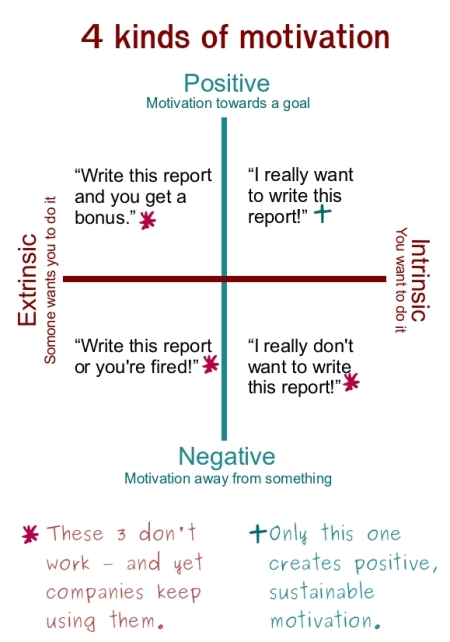
    The key here is “because he wants to do it.” This is called intrinsic motivation, and it’s the only type of motivation that works reliably and in the long term.

    Companies who practice this find that they no longer need to struggle to motivate people and light their fire – people motivate themselves. They approach work with zest, creativity and energy because what they want to do matches what the company wants them to do.

    You don’t need to whip them with an endless succession of bonuses, prizes, thinly veiled threats, cheap corporate tchotchkies or meaningless awards to get them to perform. And anyway, there’s no way any of that can ever match the results people create when they’re simply happy at work.

    Peter Block and Peter Koestenbaum put it like this in their excellent book Freedom and accountability at work:

    We currently act as if people are not inherently motivated, rather that they go to work each day and wait for someone else to light their fire.

    This belief is common among managers and employees alike…

    It is right and human for managers to care about the motivation and morale of their people, it is just that they are not the cause of it.

    True motivation can only come from inside yourself – in life and at work. Goals that others set up for you, with no regard for your wishes can never truly motivate, no matter what punishments or rewards are held up before you.

    So: What motivates you at work? What tasks do you approach with relish? What parts of your work fill you with energy and a natural desire to do a great job? Please write a comment, I’d really like to know.

    I previously explored motivation here:

  • The radical company

    Go radical

    Sally Hogshead has a great post called How to be an anarchist that opens with these words:

    They’re lighting the town square ablaze, running amok through the embassies, yanking down statues and looting the stores.

    Who? Your consumers. And if you’re smart, you’ll grab a torch and join them.

    Sally’s post is mostly about anarchy in media – about:

    …the power shift from established forms of information to consumer-directed content. From encyclopedias to Wikipedia. From publishing to blogs. From movie theaters to iPod screens. From retail locations to pop-up stores. And in case you hadn’t noticed, from traditional paid media to all those new forms of digital media spawning like bunnies.

    But I believe business anarchy has a much wider scope, and that it’s time for us to break away from the old mental model that defines a company as a way to control employees.

    The time has come for the radical company.

    What does that mean? To paraphrase Paolo Freire:

    The radical company, committed to human liberation, does not become the prisoner of a “circle of certainty” within which reality is also imprisoned. On the contrary, the more radical the company is, the more fully it enters into reality so that, knowing it better, the company can better transform it.

    This company is not afraid to confront, to listen, to see the world unveiled. This company is not afraid to meet the people or enter into dialogue with them. This company does not consider itself the proprietor of history of all people, or the liberator of the oppressed; but it does commit … to fight at their side.

    Freire was talking about the radical human – I’ve rewritten his quote to talk about the radical business and it still makes perfect sense. To make a company happy you must be willing to be radical, to commit the company to the employees’ freedom.

    Also, you must be willing to do this against business tradition and against the advice and recommendations of people who just don’t get it.

    My good friends at WorldBlu make a living teaching organizations to be more democratic and they recently published their 2007 list of most democratic companies. This list shows that companies that are run democratically, with few remnants of the old, military-style, hierarchical, command and control structures perform better and more efficiently today.

    They’re also happier workplaces because we like freedom. We like being able to take responsibility, make decisions and grow into leadership as fits us. On the other hand, we hate being stuck in bureaucracy, red tape, meaningless rules and endless power struggles.

    A horrible case: Alabama A&M University who has this policy in case of a death in an employee’s family:

    Staff members shall, upon request, be granted up to three (3) days annually of bereavement leave for the death of a parent, spouse, child, brother or sister, grand parents [sic], grand parents-in-law, grandchild, son or daughter-in-law, mother-in law, father-in-law, brother-in-law, sister-in-law, step children, children-in-law, aunts, uncles, nieces, nephews, and first and second cousins. Other relationships are excluded unless there is a guardian relationship. Such leave is non-accumulative, and the total amount of bereavement leave will not exceed three days within any fiscal year. If additional days of absences are necessary, employees may request sick or annual leave, after providing an explanation of extenuating circumstances.

    (Via Gruntled Employees, who has some pointed words about this case :o)

    A good case: Nordstrom’s, who only give their employees one rule:

    Rule #1: In all situations, use your good judgement

    In the excellent book The Second Cycle – Winning the War Against Bureaucracy, Lars Kolind wrote about how easy it is for companies to get stuck in a bureaucratic, controlling mindset – especially as they grow older, bigger or more successful. He also outlines his recipe for breaking out of this mindset, which includes A Collaborative Organization, i.e. one where leadership is distributed as much as possible.

    Luckily, more and more companies are starting to realize that command and control style leadership:

    • Is less effective
    • Creates more stress
    • Creates more bureaucracy and red tape
    • Reduces creativity and innovation
    • Makes employees cynical and disengaged

    My favorite example of a radical organization is still Semco in Brazil where (just to mention a few examples):

    • Employees set their own working hours
    • Employees choose their own salaries
    • All meetings are voluntary and open to everyone
    • Employees hire their own bosses
    • Employees choose which leader they want to work under

    Radical companies give their employees more freedom and find that people become happy at work, and consequently are more engaged and productive. This also makes the company more profitable, which Semco has certainly found.

    So making your company radical is not only fun it’s also good business.

    And there has never been a better time for it. We’re richer, more educated and better informed than ever before in the history of mankind. We have the knowledge, the means, the tools and the drive to finally change business for good.

    Our reward will be companies that are:

    • More robust – because people who can lead themselves respond more effectively to crises
    • More productive – because you don’t get bogged down in red tape
    • More nimble – because the company will be able to change faster when employees have more responsiblity
    • More fun – because this is closer to how we really work as human beings

    And to anyone who thinks “yeah, nice idea sure. Too bad it’s impossible” I refer you to this quote.

    What do you think – would you like to work in a radical company? Have you tried it already? What was it like?

  • An underpaid CEO? How radical!

    Jim SinegalIn my last post I wrote about how Costco treats its employees better than their competitors, get huge profits as a result – and catch flack for it from stock analysts who want them to spend less money on their people. Go figure.

    So here’s a good question… considering that Costco spends 40% more on their employees than their closest competition, how well is Costco CEO Sinegal himself paid?

    Despite Costco’s impressive record, Mr. Sinegal’s salary is just $350,000, although he also received a $200,000 bonus last year. That puts him at less than 10 percent of many other chief executives, though Costco ranks 29th in revenue among all American companies.

    “I’ve been very well rewarded,” said Mr. Sinegal, who is worth more than $150 million thanks to his Costco stock holdings. “I just think that if you’re going to try to run an organization that’s very cost-conscious, then you can’t have those disparities. Having an individual who is making 100 or 200 or 300 times more than the average person working on the floor is wrong.”

    So here’s a company that pays its employees more than average – and its CEO waaaay less. I like it!

    This also contributes to making people happy at work. While I always say that money can’t make us happy at work, a salary that’s too low or blatantly unfair (say one that is 200 times smaller than the CEO’s) can definitely make us unhappy.