Category: Leadership

Leadership is an insanely important discipline. Here you’ll find the thought, tools and tricks of the trade of great leaders.

  • Ask the CHO: How do you run a business without managers

    Dilbert bossRobert asked this question in a comment on a previous post:

    If I remember correctly Alexander, I read on your site here that one of your companies did not have any managers? Do you elaborate on that anywhere and if not could you?

    It seems that a lot of the problems seem to come from low to middle management and as someone who is looking to start my own software company I don’t want this to happen in my organization. A no managers approach seems pretty appealing.

    You’re right Robert. In Enterprise Systems, the IT company I co-founded back in 1997, we decided not to have any managers. We wanted plenty of leadership, but we wanted dynamic leadership that could change as the situation warranted.

    So rather than have presidents, vice presidents and managers, all employees had an equal say in running the company. This was backed up by the fact that all employees were also co-owners, every new hire being offered a stake in the company after six months on the job. While I and my two co-founders retained a majority of the shares, this gave us no greater power in making day-to-day decisions.

    So how did we make decisions? We had two major structures in place:
    Areas of responsibility
    We sat down and made a list of all the categories of tasks we had in the company. Sales, finance, intranet, our website, personnel, etc. There were around 20 in all. Then instead of appointing managers responsible for each of these, we asked who in the company would like to do it, and let people choose for themselves where they wanted to be involved. Interestingly, everyone signed up for at least a couple of these and every single task got at least one person assigned to it.

    The result was that all these tasks were done by people who liked doing it – and who therefore invariably did a great job.

    The people who took on such an area of responsibility were responsible for making a lost of all tasks, for making a budget if required and for making sure that everything worked as it should.

    Company meetings
    Every two weeks we had a company meeting for all employees. This was also important because many of us didn’t work out of the office but at a customer’s site. At these meetings, we made larger decisions or any decisions that didn’t readily fall under one of the established areas of responsibility. When we voted, it was one man, one vote, regardless of seniority or number of shares.

    So how did this work in practice? Here’s an example: When it looked like we needed a new and larger office, we raised the issue at a company meeting. Did we need new offices? Yes! What were our preferences for size, price, location, etc.? Discussion ensued.

    We then appointed a task force and asked them to go look at offices and return with some options. Who was in the task force? The people who volunteered to be, of course. The group came back with some ideas, and we all voted on which one we preferred. We had ourselves a new office. The task force went on to find us a designer to spruce up the place and some cool furniture. This being a major(!) expense, the budget was approved at another company meeting.

    The advantages of this model are:

    • Ownership. Everyone is as involved as they want to be. No one is sulking because a decision was made over their head.
    • Motivation. People are insanely motivated, because they’re a part of running the company – they don’t just work there.
    • Implementing decisions. Because people are involved in making decisions, it becomes much easier to implement them. You don’t have to sell decisions to reluctant employees.

    The disadvantages are:

    • Time. Sometimes it takes time to arrive at a decision. This was never a problem for us, but if your business climate requires constant quick leaderhip decisions, this may not be the right model.
    • Petty discussions. If you’re not careful, meetings can devolve into endless, petty talk about mindless minutiae. In this case it’s important to stop and delegate or to trust someone who cares to make a good decision.

    The proudest moment for our model came in the company’s darkest hour. We were never a dotcom company, but when that era ended, we were in trouble too. Suddenly about half our customers were no longer buying from us, and we were in deep trouble. Basically we were out of money and it didn’t look like new customers were coming in.

    In a traditional company this is where the CEO steps in and makes the tough decisions needed, and I have to tell you, we were sorely tempted to offload this decision onto one person who could then call the shots. Luckily we held onto our process and in a series of company meetings that ranged from playful to painful we talked about how we would handle it.

    We narrowed it down to two choices: Taking a 25% pay cut or firing 5 people. Discussions raged. I, for one, held out for the pay cuts. That became a unanimous decision. And a good one too – just 6 months later we had signed new customers, and every single consultant was back in business. If we had fired people back then, we would have missed them sorely.

    I realize that this experiment worked for an IT company of just 20 people and that you can’t possibly generalize from that to larger companies in other fields. And yet I believe that this is certainly a viable way to go. That what companies really need is leadership that is dynamic, distributed and entirely voluntary. Leadership that switches from person to person, depending on who has the will and the energy, rather than what it says on somebody’s business card.

    Here’s some more reading on the topic:

  • Ask the CHO: Motivation for production workers?

    HappinessAs I wrote about previously, my post on motivation was translated into Chinese by Robin at lifebang.com. Even the diagram is in Chinese :o)

    Robin then emailed me with the following question:

    From my point of view, your thinking about the motivation is exactly what I am seeking in my job. I believe that most of the companies using the false ways for motivation is also true in China. To understand the need of their employee costs much more effort of managers. Managers are human so they tend to use the most simply ways even they only work in short term.

    Someone left a comment on the post and mentioned that the positive and intrinsic way for motivation is more suitable for brain intensive work than labor intensive work. What do you think of it?

    That is a great question. Is motivation only for creative types and less suitable for blue collar workers? Let me tell you a story.

    Solange de Santis is a journalist who’d never held a blue collar job in her life. She wondered what it would be like, so she took a job as a factory worker at a GM van plant. For a year and a half! Now that’s commitment.

    She wrote about her experience in the excellent book Life on the Line and the major lesson I take from that book, is that the stereotypical view of factory workers as wage slaves is dead wrong.

    Many of the people she met at the plant were dedicated, hard working, highly skilled and creative. But the way they worked offered them no opportunity to use those sides of themselves. They were locked in a tight battle between management and unions that actually had them cheering whenever mistakes caused production to stop, giving them an unexpected break. This is not what they’re naturally like – it’s a reaction instilled in them by an inhuman system.

    If the company had listened to these people, it would have discovered that they’re innovative, skilled individuals that have many ideas to offer to make production more efficient. But as things are, they end up using all their considerable creativity to cut corners and cheat the system instead.

    American Airlines discovered this a while back:

    Two mechanics didn’t like having to toss out $200 drill bits once they got dull. So they rigged up some old machine parts – a vacuum-cleaner belt and a motor from a science project – and built “Thumping Ralph.??? It’s essentially a drill-bit sharpener that allows them to get more use out of each bit. The savings, according to the company: as much as $300,000 a year.

    Another organization that gets this right, is the Brazilian company Semco which has a large proportion of blue collar workers. They give their workers an unusually large degree of freedom and responsibility, including letting them plan production, set their own work hours and choose the sites and designs for the factories they work in. As a result they’re very profitable, workers regularly develop and implement ideas for new products or for improving existing processes and annual employee turnover hovers around 1%. You can read more about Semco in the excellent book The Seven-Day Weekend.

    So just to make it perfectly clear, my point is that:

    1. Blue collar workers shouldn’t be treated as mere wage slaves – they can be motivated and happy at work.
    2. When they are, the company can expect higher productivity, more innovation, higher quality and better worker relations. In short, the company will make more money!

    How does that sound? What is your experience? Do you agree that production workers can be motivated and happy and that this makes a difference to the bottom line?

  • Journey into leadership: Tough decisions

    New leaderThis post is part of a series that follows A.M. Starkin, a young manager taking his first major steps into leadership. Starkin writes here to share his experiences and to get input from others, so please share with him your thoughts and ideas.

    If you have forgotten me completely – or if this is the first post of mine you read, I have recently been given my first profit/loss responsibility – in the task of turning a round a badly managed, loss-giving, small company with low morale. You can find the back story here.

    I started by giving away my authority to each individual employee – a thing which paid off very well on the motivation scale – and I was and am still hoping for the rest to follow. My personal problem is time constraints – I am allowed only 1 day per week on this task as I have plenty of other priorities.

    The whole of December I did not post – here is what happened:
    I usually don’t agree with people who make the manager’s job difficult. I tend to believe that managing is only difficult if you are an authoritarian control-freak, because in that case you more or less have to do all the thinking of your whole team – which is really difficult.

    Normally I think the really difficult thing in a manager’s job is everything that does not pertain to being a people manager, but which pertains to business mechanics, operational processes, building client relations etc.

    But December has been tough. Luckily I just began following some martial arts training which gives me quite a morale and energy boost – otherwise this post would have featured a worn out Starkin ready to be thrown on the scrap heap. The manager is often an employee himself, and this employee here became sick and tired of working for other than myself.

    My boss disallowed me more time for the small company I am trying to save – the subject of this series – and I felt so unable to help, since most of the urgencies I simply have to leave as they are with the time I have available. It might be a wise decision for some greater good, but having to leave a house burning because I am trying to build another is a strange feeling.

    + I tried to get help from the mother company on HR, Finance and legal issues but got nothing but trouble out of that.

    And our new malfunctioning IT system created a vicious spiral of frustration which made our recent success seem vanished. [insert ad-lib whining here].

    Then I remembered: This is the environment in which I have to create my successes! To me that is a golden thought when motivation is low. Last month definitely showed me that a manager has to manage himself too and take some important inner decisions in order to stay motivated about his job.

    January began with two things:
    Number one: A nice graph showing me that we modestly surpassed our budget, with our sales surging the last few months of the year. I would like to think that it is due to what we did during the fall.

    In order to make that curve keep rising I need to begin doing some manual sales myself – as mentioned before our corporate sales will not deliver. I don’t have any time though, so luckily I have been able to hire a trainee from this month, and time will show whether she is woman enough to run fast enough to help me there.

    Number two: A report that my deputy reported sick while I was away on holiday – a report which implied that she was cheating. As you might recall, she has been strongly disloyal but greatly improving since last. My superiors are regularly asking me whether we should fire her.

    This will be my call, and there is both business and ego at stake here: I have invested a lot of time in her and seen results, so I want to keep believing that I am doing the right thing by coaching her. But I seem to be the only person on the planet who believe in her, and how much can my credibility afford to suffer here?

    A third thing I need to work with is my ops manager. After we recently took a session to define his job, he has been holding my hand tightly, and I have been pushing him to gradually begin taking decisions, analyzing and coming up with new ideas. I am sure and certain that he has the potential, but he is simply brought up in the company with a handicapping respect for authorities.

    I will have a meeting with him this week to see how far he has advanced a plan we made to trim the workflow a little, use our systems in a better way, etc.

    So: Should I keep believing in my unpopular deputy? Will I be able to sell anything? Never tried. And will my operations manager finally begin taking initiative?

    This is what I am looking forward to finding out after my well-deserved Christmas vacation. Do you have some advice for me? Write a comment here.

    AM Starkin

    Previous posts by A.M. Starkin.

  • Quote

    Best BuyIf you’re going to turn on an innovation engine, a lot depends on whether managers listen for the brilliance in their employees’ ideas that they can then help test, or whether they listen for what’s wrong and why it won’t work.

    – Shari Ballard, Executive vice president of human resources and legal for Best Buy. Source.

  • “Make Love, Not War” In Business

    Business as war

    When Kai-Fu Lee, a key Microsoft employee, decided to leave to go work for one of their competitors he had an… interesting experience:

    Prior to joining Google, I set up a meeting on or about November 11, 2004 with Microsoft’s CEO Steve Ballmer to discuss my planned departure… At some point in the conversation Mr. Ballmer said: “Just tell me it’s not Google.” I told him it was Google.

    At that point, Mr. Ballmer picked up a chair and threw it across the room hitting a table in his office. Mr. Ballmer then said: “F*cking Eric Schmidt [Google’s CEO] is a f*cking pussy. I’m going to f*cking bury that guy, I have done it before, and I will do it again. I’m going to f*cking kill Google.”

    Source: John Batelle’s blog

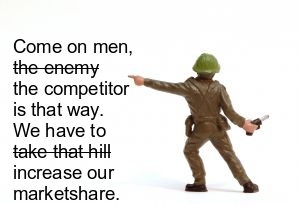
    I don’t know about you, but I’m getting really, really tired of the “business as war” approach. I’m sick of hearing about the market as a battlefield, competitors as enemies who should be killed and employees as foot soldiers.

    Executives who buy this kind of thinking can be found looking for business advice in Sun Tzu’s “The art of war”, Clausewitz’s “On War” or even Machiavelli’s “The Prince”. A recent business book called “Hardball” praises companies who are “ruthless”, “mean”, “willing to hurt their rivals” and “enjoy watching their competitors squirm”.

    But war is a terrible metaphor for business. It locks a company into an adversarial approach in which almost everyone becomes an enemy. It means spending time looking for ways to defeat your enemies, rather than making your own business great. It leads to zero-sum thinking, in which others have to lose, in order for you to win.
    (more…)

  • A challenge to all managers (rerun)

    How happy?

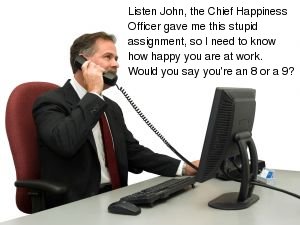
    I’m going to risk provoking business leaders everywhere and state that any leader worth her salt knows how happy her people are at work. This is a leader’s most basic responsibility. You shouldn’t need to see a pie chart – you should know already.

    The question of “How happy are people in our organization??? is typically handed over to HR who can then distribute a job satisfaction survey that results in a lot of statistics which can then be sliced and diced in any number of way to produce any number of results. You know – “lies, damned lies and statistics???.

    I’m not saying these surveys are worthless. Wait a minute: I am saying they’re worthless. They’re a waste of time and money because they very rarely give a company the information or the drive necessary to make positive changes.

    As I said, you as a leader/manager shouldn’t need a survey to know how your people are doing so I challenge you to a simple exercise. It goes like this:

    Read the rest of this entry »

    (This is a rerun of a previous article, while I’m in London on holidays)

  • What I wish I knew 20 years ago

    StonesHere’s a great article by Peter Grazier who has worked with employee involvment for 25 years:

    When I began working with employee involvement concepts in 1980, I was unbelievably ignorant of the human dimension of organization performance. As a degreed engineer, most of my training had been in the “hard” sciences and left little time for other subjects. I did attend some of the required courses in the humanities such as History of Art, but never in six years of higher education did I receive training in what I call Human Dynamics.

    My education finally came with my entrance into the world of employee involvement. And, to say the least, my beliefs about how organizations operate (or should operate) have changed significantly.

    He goes on to his three key learning points:

    1. Everyone has something to contribute…and will if the environment is right.
    2. The human element of performance is more important than the technical element.
    3. Most decisions can be significantly improved through collaboration.

    I like it, and I agree completely! Not only will this get people involved – it will also make them happy at work.

  • Journey into leadership: Bullet points!

    New leaderThis post is part of a series that follows A.M. Starkin, a young manager taking his first major steps into leadership. Starkin writes here to share his experiences and to get input from others, so please share with him your thoughts and ideas.

    This will be the Great Starkin Bulletpoint Post – I simply want to say too much.

    By the way, as mentioned in a comment, I am HAPPY to see people wanting to think and comment on what I am writing here. My primary reason for posting is to let thoughts on practical leadership evolve and mutate, so the more the better! So far it’s mostly all about helping me, and that is totally completely outstandingly fantastic! Each comment makes me think, and I should probably feed a lot more back if I had the time.
    (more…)

  • Podcast about motivation

    PodcastThere is a lot of talk about motivation in the workplace these days. Both from managers complaining that their employees aren’t motivated and from employees complaining that their managers don’t know what makes them tick.

    And frankly, it’s no wonder, because there are some fundamental misconceptions about motivation in the business world. There are four different kinds of motivation, only one of them works, and businesses and managers rely almost exclusively on the three that don’t.

    That is the topic of my first podcast, which you can download here. It’s 23 minutes long and will take up 7 Mb on your computer.

    Please let me know what you think. Is the sound OK? The content? What do you like about it? What can I do better? What great podcasts should I listen to, and get inspiration from? This is my first podcast, but all the cool kids have’em and I wanted one too :o)

  • Work less, do more

    ClockHere’s a quote from the horrible book “You Can’t Win a Fight With Your Boss” by Tom Markert, the global chief marketing and client service officer at ACNielsen. Markert says:

    You can forget lunch breaks. You can’t make money for a company while you’re eating lunch . . . if you don’t put in the hours, someone just as smart and clever as you will. Fact of life: the strong survive.

    [If you ignore this] you might just end up as roadkill – lying dead by the side of the corporate highway as others drive right past you.
    I have always made a habit of walking around early and late to personally see who’s pumping it out. If they are getting results and working harder than everyone else, I promote them.

    Riiiiiight. Remind me never to go work for this guy!

    Here’s how you do it instead, from a comment from Sarah S. on this post about implied overwork:
    (more…)