 I have yet another question for ya: What three tips would you give your boss? What would you like him or her to do, stop doing, change, say, not say?
Write a comment, I’d really like to know!
Leadership is an insanely important discipline. Here you’ll find the thought, tools and tricks of the trade of great leaders.
I have yet another question for ya: What three tips would you give your boss? What would you like him or her to do, stop doing, change, say, not say?
Write a comment, I’d really like to know!
 Danish newspaper Jyllandsposten had an article last week about career surfers. In it they describe how employees today often decline job offers or promotions that a company offers them.
Professor Henrik Holt Larsen of the Copenhagen Business School says:
It’s harder than ever for businesses to attract and retain employees who not only possess the required skills but who can also be emotionally bound to the company. People tend to focus more on their own desires and needs and therefore to surf between multiple career paths.
We don’t know enough yet about this narcissistic personality.
You know, Henrik, you say that like it’s a bad thing :o)
I have two comments on this. First, I find it incredible that someone would cast this tendency for people to choose career paths for themselves in a bad light. This is not narcissistic, it’s common sense. I choose my career path based on what’s good for me, not on what’s good for the company.
Secondly, if companies want to “bind their employees to them emotionally”, as Larsen puts it, this bond needs to go both ways. In short, the company must be prepared to offer it’s employees more than just a paycheck. If a company wants it’s employees to feel something about the company, the company must be prepared to feel back. To value it’s employees as people, not just as resources.
And this means yout won’t fire people, just to get a 5% increase in stock price. This means that you won’t carelessley reassign people to a department they don’t want to work for. This means leaders will do everything in their power to make their people happy at work.
The equation is simple:
Want your employees to care about the company?
Start by having the company care about them. Not as employees but as human beings.
 Vetle from Norway sent me a link to an article about how bad management is making norwegian employees unhappy at work and costing business tons of money.
From the article:
22% of employees surveyed consider their immediate manager so weak, that maybe that person shouldn’t be a manager at all.
…
There is a clear connection between good managers, satisfied employees and profits. Happy employees create happy customers – and better results for the business. According to our research, happy employees mean a 40% increase in profits.
Also one in three rate their manager as technically competent but a bad leader.
The question is: Is this a norwegian phenomonon or is this true in your country too? What do you think?
 One large company finds that many of their top performers are absconding:
It’s like clockwork. Every year a portion of our top talent decides it’s time to move on. Once those bonus or holiday checks are cashed, the flood gates open and the resignation letters start flowing in.
They’ve done an exit survey among the top performing employees leaving the company:
Of the 178 files, 83 people listed money as a reason for leaving. 62 listed it as the only reason.
Their conclusion: They must adjust salaries and compensation. My conclusion: They’re wrong. Here’s why.
(more…)

Here’s a scary tale from the real world:
When I was just starting out as a legal secretary, I worked for two lawyers who I referred to as Good Boss and Evil Boss.
Evil boss would never look for a file – he would yell for me to immediately find a particular FILE – which would be on his desk where he kept all of his working files.
In addition he would go through my in-box after I had left the office and rearrange the stack, move his work up and add new post-it notes with different deadline dates.
Three drafts to any document was the absolute minimum, and he often wanted to see the previous drafts for him to check my work. Consequently, my wastepaper basket was very organized.
The old leadership style of “I’m the boss, you must do whatever I say” is being challenged by a different style which is more about supporting people to let them create results.
While the old leadership style reminds me mostly of a prison warden, exercising absolute power over his wards, the new leadership role is completely different. It’s about making people like their jobs. It’s about realizing that people are in fact free to leave at any time.
In short, the new leadership style reminds me much more of the host of a party. Here’s how the two roles compare:
(more…)
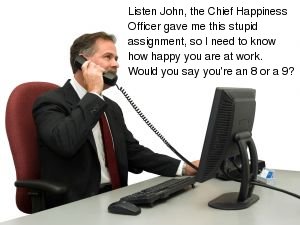
I’m going to risk provoking business leaders everywhere and state that any leader worth her salt knows how happy her people are at work. This is a leader’s most basic responsibility. You shouldn’t need to see a pie chart – you should know already.
The question of “How happy are people in our organization??? is typically handed over to HR who can then distribute a job satisfaction survey that results in a lot of statistics which can then be sliced and diced in any number of way to produce any number of results. You know – “lies, damned lies and statistics???.
I’m not saying these surveys are worthless. Wait a minute: I am saying they’re worthless. They’re a waste of time and money because they very rarely give a company the information or the drive necessary to make positive changes.
As I said, you as a leader/manager shouldn’t need a survey to know how your people are doing so I challenge you to a simple exercise. It goes like this:
(more…)
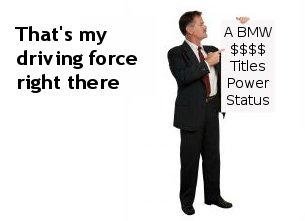
As a leader, manager or executive, what is your driving force in business?
Think about it for a second. What gets you out of bed in the morning and makes you take that drive to work? What is behind the choices you make? How do you set your goals and ambitions?
There are many possible answers. Ask a thousand people and you’ll get a thousand different answers. Money would probably show up quite often. So would power, influence, getting ahead, recognition, security and success.
But I believe that there is one underappreciated driving force in business. One force that spurs people on to stellar results, wise decisions and strong business relationships. One strong force that, when harnessed in your work life, will make you more efficient and let you enjoy work more.
One that all business leaders everywhere need to know about and build into their businesses at the most fundamental level.
Curious yet?
Here it is: The strongest driving force in business is happiness! Yes, happiness at work.
(more…)

It ain’t what you don’t know that gets you into trouble.
It’s what you know for sure that just ain’t so.
– Josh Billings
Much well-known business advice is sadly obsolete but can still be found in articles, business books and, not least, in daily use in the workplace. It seems that some companies are still guided by thinking that is sadly out of date – if it was ever true to begin with.
The worst of these old maxims are not only wrong, they’re bad for people and bad for business. Businesses who use them are making their employees unhappy and are harming the bottom line.
I recently wrote a post about the Top 5 Business Maxims That Need To Go, listing 5 horrendous examples. I also asked people to contribute the maxims they would like to get rid of, and got some great suggestions, so here are 5 more pieces of bad business advice that are making people unhappy at work and harming the bottom line.
(more…)
A reader sent me this question:
The company I work at “went global”. That means horrible things like many people fired and so. Thus, people are afraid to lose their job, even when I directly asked a manager I trust and he said that “no one from your department will lost his job”. People don’t trust management. Some are cynical, some are afraid, but I think, at different levels, all are unhappy with the situation. I like these people very much, and I would like to do something to confort them, but so far, listening was the only thing I was able to do.
Additionally, the people from another site are also unhappy, because even when most of them are very capable professionals, they are being threated like… uhm.. incapable kids (not to mention the fact that they know that they were hired because they are “cheaper”).
Any suggestions to improve the situation?
First of all thanks for a great question which describes a situation that is found in many workplaces today: A workplace goes through large-scale changes and people wonder “what will it mean for me?” Management may or may not try to create some certainty, but may fail because of a lack of trust.
(more…)

The executives in your company may be paid way more than they’re worth, but don’t worry – it’s for your own good.
That’s the point of a recent Forbes article defending overpaid executives which contains the single most disingenuous and illogical argument it has ever been my misfortune to see in a business context. From the article:
The ugly truth is that your boss is probably overpaid–and it’s for your benefit, not his. Why? It might be because he isn’t being paid for the work he does but, rather, to inspire you. In other words, we work our socks off in underpaying jobs in the hope that one day we’ll win the rat race and become overpaid fat cats ourselves. Economists call this “tournament theory.”

June 1-4 2027 in Copenhagen
The Chief Happiness Officer Academy is our most in-depth 3-day training where we share everything we know about creating happier workplaces. You get a comprehensive understanding of the latest research, tons of effective practical tools and learn how to use them in your own business.