Category: Leadership

Leadership is an insanely important discipline. Here you’ll find the thought, tools and tricks of the trade of great leaders.

  • Jerks at work – and five ways to deal with them

    Guard dog

    CEO Hal Rosenbluth was once about to hire an executive with all the right skills, the right personality and the perfect CV. His interviews went swimmingly and he’d said all the right things, but something about him still made Rosenbluth nervous, though he couldn’t put his finger on just what it was.

    His solution was genius: He invited the applicant to a company softball game, and here he showed his true colors. He was competitive to the point of being manic. He abused and yelled at both the opponents and his own team. He cursed the referees and kicked up dirt like a major league player.

    And he did not get the job.

    (From Hal Rosenbluth’s excellent book The Customer Comes Second).

    Jerks at work and how to lose them

    Let’s make one thing perfectly clear: The vast majority of people in any given business are nice. They’re helpful, sympathetic, likable and quite simply good people. Only a tiny, tiny minority are consistently unpleasant or abrasive.

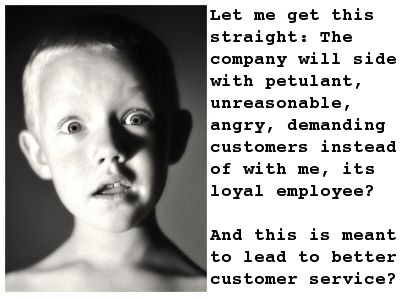
    You sometimes hear in business that “nice guys finish last” ie. that in a cutthroat, dog-eat-dog (hence the picture above) business climate you need to be something of a jerk to get results. Consequently people with difficult or abrasive personalities are tolerated (or even celebrated) in many organizations because “they may not be likeable but they get results”.

    I beg to differ. Jerks have no place in the modern business world and cause much more damage than they’re worth. This is not a matter of namby-pamby, soft-shoe “why can’t we all be nice” thinking; it comes down to the fact that jerks are bad for the bottom line! Luckily, many people and companies are starting to realize this and are doing something about it.

    This blogpost presents five different anti-jerk approaches that every workplace might consider.
    (more…)

  • Quote

    Work had to be enjoyable on a daily basis. We all had to come to work on the balls of our feet and go up the stairs two steps at a time. We needed to be surrounded by people who could dress whatever way they wanted, even be barefoot. We all needed to have flextime to surf the waves when they were good and take care of a sick child. We needed to blur that distinction between work and play and family.

    – Yvon Chouinard, founder of Patagonia, in his excellent book Let My People Go Surfing

  • Does he or doesn’t he?

    Lazy dog

    Some of Fred Gratzon’s readers refuse to believe his claim that he’s the laziest man in North America. If he is, then how could he have created two successful multi-million dollar businesses? Fred’s answer is classic:

    I did not do it with hard work. I did not do it by busting my butt. I did it by having fun – so much fun that people were attracted to that fun. I then picked the most competent attractees to be on my team and off we went. Whatever “hard work??? there might have been, I had long since turned into a game and we had fun “playing??? it.

    Read Fred’s post – it’s excellent.

    That’s a blueprint for happiness at work and success right there! I agree 100% and wrote a post a while back on why laziness is the major force behind my success and happiness. Also read my review of Fred’s brilliant book The Lazy Way To Success.

  • Top 5 reasons why “The Customer Is Always Right” is wrong

    The customer is always right?

    When the customer isn’t right – for your business

    One woman who frequently flew on Southwest, was constantly disappointed with every aspect of the company’s operation. In fact, she became known as the “Pen Pal” because after every flight she wrote in with a complaint.

    She didn’t like the fact that the company didn’t assign seats; she didn’t like the absence of a first-class section; she didn’t like not having a meal in flight; she didn’t like Southwest’s boarding procedure; she didn’t like the flight attendants’ sporty uniforms and the casual atmosphere.

    Her last letter, reciting a litany of complaints, momentarily stumped Southwest’s customer relations people. They bumped it up to Herb’s [Kelleher, CEO of Southwest] desk, with a note: ‘This one’s yours.’

    In sixty seconds, Kelleher wrote back and said, ‘Dear Mrs. Crabapple, We will miss you. Love, Herb.’”

    The phrase “The customer is always right” was originally coined by Harry Gordon Selfridge, the founder of Selfridge’s department store in London in 1909, and is typically used by businesses to:

    1. Convince customers that they will get good service at this company
    2. Convince employees to give customers good service

    Fortunately more and more businesses are abandoning this maxim – ironically because it leads to bad customer service.

    Here are the top five reasons why “The customer is always right” is wrong.

    (more…)

  • What makes people unhappy at work

    Unhappy at workWe’ve looked at what we think makes us happy at work but doesn’t. We’ve looked at what actually does work.

    But what actively makes people unhappy at work? What are the most important things to avoid? Let’s take a look at that.
    (more…)

  • Organizational Democracy primer

    Traci FentonMy good friend Traci Fenton gave a talk at Harvard Law School on Organizational Democracy. You can hear the talk here and David Weinberger live-blogged it. Check it out, it’s a great primer on the concept of democratic organizations.

  • Happy at work at Motek

    I met Motek’s CEO Ann Price at the 2006 WorldBlu Forum on democractic organizations, and her story of how they work at Motek was tremendously inspiring.

    Motek make warehouse administration software and here’s some of the great things they do according to this excellent article in American Way Magazine:

      Parasol

    • Price offers her employees a $5,000-a-year travel benefit for flights, tours, cruises, you name it – but only if they take at least a three-week paid vacation. She gives employees another two weeks off for paid holidays throughout the year and leases luxury automobiles for any employee who has worked at the company for at least 10 years. Then there’s the fact that Price sends employees home at five p.m. sans laptop and locks the doors on the weekend.
    • …every Motek employee has a designated backup available to provide cover while they’re out of the office. The only requirement is to check with the backup to make sure he or she is around before the employee leaves.
    • The company keeps a single to-do list… Anyone can enter an item, including customers and vendors. The list can include everything from ordering ink cartridges to customizing a specific function for a customer. Motek divvies up the tasks at meetings and teams don’t pay any attention to who entered particular items.
    • Price doesn’t cut any corners when it comes to bonding with customers. She designates individuals – from top executives to line workers – heroes for their roles in effecting change at a company that uses Motek’s software. Then she sends out a professional photographer who shoots for Fortune magazine – at somewhere between $8,000 and $15,000 a shoot – to snap their photo, which she then posts on the Motek website. There, you can read all about the person’s achievements and how they were able to deliver superior results.
    • For Price, the endgame isn’t to earn money at any cost. And it isn’t about ruling the software industry. No, Price has bigger ambitions: She hopes to change the world.

    The result: Happiness and profits. Eighty percent of the technical team has been with the company for at least 10 years, compared to an industry average employment span of 18 months. In 2005, Motek’s revenue per employee topped $217,000. Competing firms’ revenue typically ranges from $150,000 to $200,000.

    This is a wonderful story of great, unconventional leadership focused on making employees and customers happy rather than on growth and profits. With growth and profit as the results.

  • The need for structure

    Structure?

    My recent post on how not to manage geeks has sparked a lot of interest and a lot of great comments.

    Right now there’s a very interesting debate going on in the comments about the need for structure in small or large organizations. This debate is great because it goes right to the core of the central dilemma of new leadership and employee empowerment.

    Here are some of the key arguments that have come up:

    Elling writes: I think you’re attacking structures which you can do without in a small company… In a large company there’s a NEED for the structures…

    Jeremy writes: I can anticipate some of this need – the need to account for diverse costs accurately and thoroughly, the need to maintain a standard of output for workers in an organized, fair fashion, etc. – but these play to the weaknesses of large organizations. In other words, large organizations SHOULD be at a disadvantage, and the structures we’re proposing tearing out actually add value only in the sense that MegaCorp is inherently inefficient and out of scale with the market.

    Numeeja writes: …there is NEVER a ‘NEED’ for self-serving, ‘personal progression over departmental improvement’ style work places and managers.

    Thad writes: The place where I work is managed by good people who don’t want to be bureaucratic jerks, but they can’t grasp one simple concept: they are giving me money in exchange for doing something I love–they don’t have to shackle me with schedules and policies to get me to produce! I will be here working my little heart out because *I want to be*. I try to block out the memos and TPS reports and remind myself that those things aren’t really changing what I get to do here, but damn, every time the red tape is thrust in my face it just deflates me and I don’t even feel like trying to design or build something.

    Elling writes: If you have 20 people which you want to pull in the same direction, you NEED to have a manager who’s job it will be to try and ensure that the people in the group DO pull in the same direction… On the other hand, I do realize that there ARE idiot-bastard-managers out there. And I’m not defending them.

    Cityzenjane writes: …small tech teams in my experience – when left to their own devices do a GREAT job of pulling in the same direction, getting behind technical strategic priorities that they have been part of developing.

    First let me say thanks to all who’ve commented. THIS is what blogging is all about – one post sparking many great contributions. I feel lucky to be hosting this dialogue.

    But which is it? Do companies need structure or don’t they? Is less management better than more management? Is management a necessary evil or simply evil? :o)

    Niels Bohr, the Nobel Prize-winning physicist once said:

    The opposite of a correct statement is a false statement. But the opposite of a profound truth may well be another profound truth

    and that’s exactly what I think we’re dealing with here. Whenever I’m faced with one of these either-or questions, I try to loook beyond the immediate choice, to see if there might exist an answer that transcends the dilemma and includes both. Can we have both personal freedom and structure at work?

    The answer is not only that it can be done, but that many highly succesful companies are actively doing it. The truth is that there needs to be structure for personal freedom to even be possible. But we are talking a different kind of structure. Where the “old” structures are often opaque, rigid and top-down we can instead create new structures that are the exact opposite but perform the same function of coordinating and streamlining people’s efforts. These new structures are transparent, dynamic and participatory.

    Southwest AirlinesCompanies that have done this include business school case classics like Semco, Oticon, Southwest Airlines and GE Aviation. None of them are doing too shabby (understatement alert), and people are really happy at work there. Herb Kelleher, ex-CEO of Southwest, was once asked how he could maintain control when his employees had so much freedom. His answer is classic:
    Control? Never had it. Don’t want it.

    I think we can move forward most efficiently if we shift away from choosing between freedom and structure, and work from the assimption that it’s about choosing both and thus creating a new kind of structure.

    Let me hit you with one last Niels Bohr quote (Yes I’m a fan, dammit):

    How wonderful that we have met with a paradox. Now we have some hope of making progress.

  • Happy At Work at IKEA

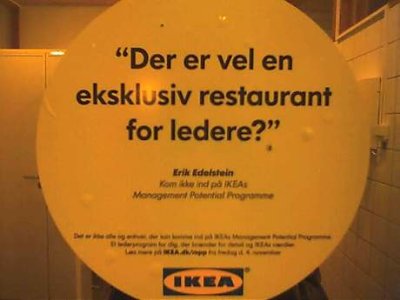
    I spotted this sign in the men’s room of our local IKEA:

    Equality at IKEA

    For those (unfortunate few, I’m sure) of you who don’t read Danish, it says:

    I assume there’s an exclusive restaurant
    for managers only?

    Erik Edelstein did not make it into IKEA’s
    Management Potential Programme

    Heh! So if you’re the kind of manager who believes it is your god-given right to eat your lunch in a special, exclusive restaurant seperate from the employees, then you’re not going to manage at IKEA.

    Which makes excellent sense for three reasons:

    1: Facetime is important for happiness at work

    Managers must spend time with their employees and lunch may be the best time for it! How else are manager’s going to know what’s going on? And one thing that makes employees happy at work is a manager who has time for you and understands you.

    2: Management applicants self-select

    When IKEA promote their management programme in this gutsy way they are making sure that they weed out applicants with the wrong attitudes from the very beginning.

    3: It matches IKEA’s brand

    It also speaks to me as a loyal IKEA customer and it blends perfectly with the principles of democracy and equality that their brand of cheap but well-designed furniture stand for.

    So: Management development, brand development and happiness at work all in one. Not bad, huh?

    Previously: BMW brand themselves againt bureaucracy.

    I’m adding “management-only restaurants” to my list of vampire ideas.

  • Book review: The Seven-Day Weekend

    Ricardo Semler: The Seven-Day WeekendYou should know one thing before you read my review of Ricardo Semler’s excellent book The Seven-Day Weekend: He’s my idol.

    I’ve read his books and followed his work and I’m a fan. Completely, unashamedly, unreservedly, probably in the same way that 14-year old girls are fans of Justin Timberlake. If he ever comes to Copenhagen to give a speech, I’ll be in the front row, screaming my little lungs out.

    Ahem. I deeply admire Ricardo Semler. He’s the CEO of the Sao Paulo, Brazil-based company Semco, and his vision of leadership has been the driving force behind an organization so different, so innovative and so successful that the business world has been forced to sit up and pay attention.

    That’s admirable but it’s not the most important reason why Ricardo is my idol. The core reason is this: Semler has chosen happiness as his driving force in business.

    He enjoys life and he wants Semco’s employees, customers, suppliers and community to be happy as well. That is the real motivation behind Semco. Not growth. Not profits. Not power. Not status. But happiness.

    This is why Semco has chosen to do things… somewhat differently. At Semco:

    • Employees set their own working hours
    • Employees choose their own salaries
    • All meetings are voluntary and open to everyone
    • Employees hire their own bosses
    • HR has been almost abolished, because leaders need to be able to treat their employees right themselves
    • All employees rate their bosses twice a year and all ratings are published
    • Employees choose which leader they want to work under
    • Employees choose which Semco office they want to work out off
    • Employees can take early retirement, meaning they get one day a week off in return for working one day a week after they retire.

    Etcetra, etcetera, et-fricking-cetera… It’s hard to find a single aspect of traditional organization and management that Semco hasn’t either blown up, reinvented, abolished or turned upside down. I like it!

    Semler first described his vision in the aptly titled book Maverick (also an excellent read). The Seven-Day Weekend was written about ten years later and goes even further.

    The title references Semler’s belief that life cannot be divided into work and free time any more. If you can answer business-related email on a sunday evening, why can’t you go to the movies on a wednesday morning? Semco wants employees who are 100% themselves on the job or off it. Consequently, they treat employees as adults who are capable of making decisions for themselves. In return, people respond by honoring that trust and delivering fantastic results.

    The book is full of stories from Semco’s everyday existence, and these stories are a joy to read. Time and again these stories illustrate, that Semco does not choose the easy way out. The easy, safe and comfortable way is to fall back on well-known, hierarchical control structures. Semco consistently resists this temptation and instead chooses to believe in its people and its corporate values.

    As a result, on of Semco’s top management’s most important leadership tools is… inaction. Not to do anything. To not interfere and to let the organization work out an issue on its own. To trust the process they’ve defined and see where that takes them.

    Not out of a laissez-faire management style or a fear of conflict (if anything, Brazilians seem to relish conflict), but out of a realization that every time top executives step in and mandate a solution, they rob the rest of the organization of initiative and the will to act.

    This is without a shadow of a doubt the best and most important book on leadership I have ever had the pleasure to read. This book quite simply rocks, and any leader who reads it will be able to pluck dozens of useful, practical and innovative ideas from it’s pages.

    It’s an easy, fun read, the stories are told amazingly well and the book is 100% free of MBA-jargon.

    Read it!!!

    If you liked this post I think you might also enjoy these: