Category: Leadership

Leadership is an insanely important discipline. Here you’ll find the thought, tools and tricks of the trade of great leaders.

  • Hiring in your own image

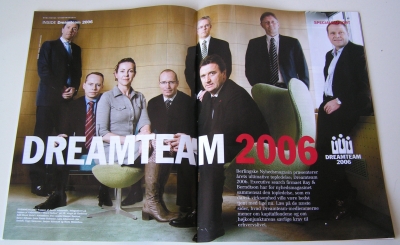
    Danish business magazine Berlingske Nyheds Magasin did an article recently picking their management dream team, naming executives from various organizations to the positions of CEO, CTO, CFO, chairman of the board, etc…

    This is their dream team:

    Dream team

    What is this, the Borgs? You must assimilate. Resistance is futile. You must become a man aged 35-50 and wear a dark suit and a tie.

    Why is no one wearing jeans and a T-shirt? Why are there no men with long hair or just a beard? Where are the ethnic minorities? Why only one woman? Where are the older people? Where are the people under 35?

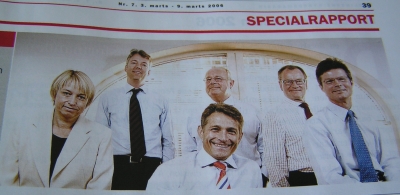
    I was wondering why this search for a dream team resulted in an ethnically homogeneous group of identically dressed, identically looking people of the same age, and I had to laugh when I saw this picture of the people who chose the dream team:

    Dream team pickers

    If ever there was proof of the temptation to hire in your own image, this is it right here. A group of corporate-looking men (and one woman) aged 35-50 choose a management dream team of corporate-looking men (and one woman) aged 35-50.

    My tip: When you hire people, be it employees or leaders, make sure to hire people who are not like you. After all, your company already has a you. People who are not like you are bound to make you a little uncomfortable and that’s fine. That just means that you’re not totally sure of what makes them tick. The’yre consequently more likely to surprise you and to contribute something new to the organization.

  • La-la-la-la – we’re not listening – la-la-la-la

    A Danish study published today shows that

    1. 56% of respondents believe that involving the organization is the second-most important factor for successful strategic development
    2. Only 4% of businesses involve all employees in strategic development

    Which made me think of this sign found in a barracks of the Israeli army:

    Privates will refrain from giving advice to officers.

    – From Leo Rosten’s Giant Book of Laughter

    Via Arun’s musings.

  • The new-skool workplace..?

    Yesterday I wrote about a new kind of school (well, new-ish, it’s been around for 35 years) where students and teachers make decisions democratically, there are no classes, students do whatever they want all day, and if they want to study something they have to find a teacher and arrange for it to happen.

    In the comments to that post, Danny Mydlack, the director of the video about the Fairhaven School, reminded me that the full video is available at newamericanschoolhouse.com.

    The father of one of the children in the school also commented:

    My son is one of those in the trailer, and in The New American Schoolhouse documentary, which I strongly recommend to anyone interested in this topic.

    Because of my son’s six years at Fairhaven, or perhaps *inspired* by those six years, he is an original. He is himself, crafted by himself over 13-19, hanging out and doing what he wanted. Six years during which he took no classes, but had the opportunity to excel in the ways he found, and wanted, to excel, in an honest and functional educational community.

    On the standardized SAT he took pre-college, he got a 99th percentile on the verbal, and upper-third on the math. He got a scholarship as a consequence. More importantly, he is someone who can make choices on his own, can make eminent sense in any public setting, makes evidence-based decisions, knows what he thinks, and is a pleasure to talk to.

    That sounds absolutely wonderful!

    Now this blog is not really about schools, it’s about happiness at work. I just got so excited about the concept that I had to share it :o)

    But here’s a question for ya: What if we organized our workplaces in the same way as these schools? What if people came to work and could spend their time doing whatever they wanted? What if the company was run not by a few executives, but democratically by everybody in the company?

    Conventional wisdom says that it could never work, but that wouldn’t exactly be the first time that conventional wisdom turns out to be dead wrong. It was certainly wrong about these new-skool schools.

    Here’s what I believe: Not only would it work, it would blow traditionally-run competitors out of the water.

    What do you think?

  • Quote

    One day early in this journey it dawned on me that they way I’d been running Interface is the way of the plunderer. Plundering something that is not mine, something that belongs to every creature on earth.

    And I said to myself “My goodness, a day must come where this is illegal, where plundering is not allowed. I mean, it must come.”

    So I said to myself “My goodness, some day people like me will end up in jail.”

    – Ray Anderson, CEO of Interface, the world’s largest carpet manufacturer

    In this quote from the interesting documentary The Corporation, Ray Anderson explains how Interface started the journey towards sustainable productions. Articles on it here and here.

  • Happy at work at Microsoft

    Michael Brundage has written a very interesting piece on what it’s like to work at Microsoft.

    The good includes personal freedom, the top leaders, free soft drinks and the fact that Microsoft contrary to popular belief is not evil. For instance:

    Microsoft gives software developers a lot of personal freedom over both the work and the work environment. I order my own supplies, customize my office as I see fit, schedule my own trips and meetings, and select my own training courses. I choose when I show up for work and when I leave, and what to wear while I’m there. I can eat on campus or off, reheat something from home in the kitchen or scavenge leftovers from meetings. I can even work remotely from home (within reason).

    The bad: mid-level managers, internal “cults” and bad work-life balance.

    Compare this with Paul Thurrott’s highly critical analysis of Microsoft’s failure to deliver Windows Vista on time or even with all the feature they promised.

    Two and a half years later, Microsoft has yet to ship Windows Vista, and it won’t actually ship this system in volume until 2007… Microsoft’s handling of Windows Vista has been abysmal. Promises have been made and forgotten, again and again. Features have come and gone. Heck, the entire project was literally restarted from scratch after it became obvious that the initial code base was a teetering, technological house of cards. Windows Vista, in other words, has been an utter disaster. And it’s not even out yet. What the heck went wrong?

    It almost seems like Microsoft is an example of a company that has a huge, tremendously talented and motivated staff, but still manages to create enormous problems for itself. Does this contradict my claim that a happy organization is also a successful one?

    UPDATE: John Dvorak weighs on on the issue.

    All of Microsoft’s Internet-era public-relations and legal problems (in some way or another) stem from Internet Explorer. If you were to put together a comprehensive profit-and-loss statement for IE, there would be a zero in the profits column and billions in the losses column—billions.

    So they’re happy at Microsoft but they make really bad top-level decisions..?

  • The cult of overwork

    Tired

    Some years ago CNN asked 12 well-known leaders including Carlos Ghosn of Nissan, Marissa Mayer of (then) Google and Wynton Marsalis how they manage their time and stay efficient.

    My favorite answer is this one:

    I know that it’s expected of executives to start the day extremely early, but frankly I feel I make better decisions and relate better to people when I’m well rested. So I usually get up around 8 after a good night’s sleep.

    I also make sure to almost always work a standard 40-hour week and never work on the weekends. This is important to me for two reasons. First of all, I have a life outside of work. I have a family who likes to have me around and friends and hobbies that I also want to have time for. I find that the time I spend outside of work recharges my batteries, expands my horizons and actually makes me more efficient at work.

    Secondly, if I’m always seen arriving at the office at 6 in the morning and leaving at 9 in the evening, not to mention taking calls and writing emails late at night and all weekend, it’s sure to send a signal to my employees that this is what the company expects, that this is “the right way”. But it isn’t.

    It’s a simple fact that for most leaders and employees, the first 40 hours they work each week are worth much more to the company than the next 20, 30 or 40 hours. But those extra hours spent at work can harm your private life, your family and your health. Which in turn becomes damaging to the company.

    Frankly, if you can’t structure your time so your work fits inside a 40-hour week, you need to get better at prioritizing and delegating.

    Refreshing words. Guess which of the executives said that?

    Come on, take a guess!

    NONE OF THEM! Not one.

    Instead, there’s a lot of “I get up at 5 and arrive at the office at 6” and “I work 16 hours a day” and “I take a lot of calls on the drive in to the office” and “I usually leave the office at 7 and then work a few more hours in the evening at home.”

    I fully expected one of them to go “I get up at 4 in the morning, half an hour before I go to bed, and work a 27-hour day, only stopping for a 3-minute lunch break in which two assistants stuff food down my throat like a foie-gras goose.”

    I know it’s normal to view people working this hard as heroes of the organization, but still I think they would be more efficient and enjoy life more if they cut down their time at work. They may find that they become more open, less stressed, have more fun AND are better role models for their employees. This cult of overwork has got to stop.

    The school of “work your butt off, everything else comes second” is bad for business and bad for people. Can we please retire this tired idea once and for all?

    If you liked this post, I think you’ll also enjoy these:

  • Do you follow?

    Ducks in a row

    Are you the kind of person who always takes charge?

    Whether it’s the next crucial corporate project or just the sunday family barbeque, are you always in the thick of it, organizing, planning and making decisions?

    That makes you a natural leader, but how are you as a follower?

    Leaders can’t always lead. Once in a while we all need to take the backseat and let someone else drive. Their way.

    And here’s the thing: Good leaders can be true pests as followers. If they aren’t careful, they end up taking over. Of course, the real fun comes when there are two or more compulsive leader in a project, fighting each other to take over and do things their way.

    Apart from good leadership, leaders must display good followership when this is called for, which is difficult because it goes against their nature.

    Leaders who also know how to follow can use these situations to inspire followership in others by being good followers themselves, but it means that they must take extraordinary care to stay in the backseat and not inadvertantly take over. Here’s how to do it.

    Let them do it their way
    It may not be your way, but that doesn’t mean it can’t work. Hey, it may work even better than what you have in mind.

    Let them fail or succeed
    Remember that even when you’re 100% positively sure they’ll fail – they might still make it work.

    Accept their truth
    You may see the task differently, but you may be wrong. Wait and see who turns out to be right.

    Volunteer for the crappy tasks
    Andy Reid of What If Innovation, the highly successful London-based innovation agency, told me that their executives are not above doing menial office tasks like cleaning the toilets. This sends a powerful message, and raises everyones motivation to just get the boring stuff done – as opposed to having interminable office feuds over who should do it.

    Simply put, leaders should be even better than regular followers and take even more care not to lead too much.

    When leaders practice followership they also teach the people around them leadership (remember this simple formula), by giving them a real, un-interrupted chance to lead and learn.

    Great leadership requires great followership. And for most leaders, good followership takes practice.

  • The artist as a young geek

    A couple of weeks ago I posted this list of the top 10 mistakes managers of geeks make, which instantly became one of the most read posts on the site.

    Mike Wagner (of Own Your Brand) has a lot of experience working with geeks, and he emailed me his take:

    Some of the mistakes I remember making with Geeks or seeing others make are:

    1. Treating their work and its results like a hammer when Geeks see it as a work of art. Managers must respect the different perspective each brings to IT development. Business managers see it as a tool. Geeks see it as a work of art. This is one reason Geeks often feel undervalued in the corporate culture. Geek temperament is really an artistic temperament.

    2. Building on this; managers must understand the cynical feelings Geeks have towards commerce in general. Like artists who resent people putting a dollar value on their art, a Geek feels that all the business manager wants to do is make money. This is big time Geek turn off.

    3. Geeks respond to critique and suggested changes of their “creations/code” like an artist. When a manager or client says we want you to change the functionality or code – it is like saying “can’t the Mona Lisa have blonde hair instead? Blonde tested better with the focus group.”

    All of this can be worked with in a positive way IF the manager can practice empathic understanding – but if not, well…that’s the rub.

    Great insights, Mike! People are increasingly approaching their work as art. It’s not that their painting or sculpting at work, it’s just that the nature of work has changed, so that the way people approach work is looking more and more like the way an artist approaches art.

    This is true for geeks and for many other employee groups, and it profounfly changes the nature of work. Thanks Mike, for your great (as usual) input.

  • Links

    Even CNN says that you should take it easy, and not work to hard.

    Great website on strength-based leadership. I am deeply envious of a last name as cool as “Zinger”.

    Philip Greenspun has an excellent piece on early retirement. I say we should all do this intermittently, and work a couple of years, retire for a year or two and then stage a come-back. Semco’s part-time retirement scheme is also cool.

  • Make your business happy and rich

    Happy SprayIt pays to be happy. Studies show that businesses with happy employees consistently outperform their less happy competitors in the marketplace and in the stock market.

    Considering the challenges that modern organizations face, creating a happy organization is the number one strategic imperative and the only way to long-term success.

    This article will tell you why happiness is so important for businesses today, and how you can make your business a happy one.
    (more…)