Category: Leadership

Leadership is an insanely important discipline. Here you’ll find the thought, tools and tricks of the trade of great leaders.

  • Perks gone wild

    PianoIt started with free M&M’s. Now there’s a country club, on-site Montessori daycare, on-site doctors and nurses, 35-hour work week, live piano music during lunch, 50.000 square foot fitness center, swimming pools, no dress-code, masseur, on-site car detailing. And more. If you need assistance in adopting a child or finding a college for your child or a nursing home for a parent, they have people to help you with that too.

    SAS Institute’s perks are legendary, and the Software Company’s 9.000 employees certainly know they have it good. Normally IT companies have employee turnover rates of 20%. At SAS it’s 3% which saves them an estimated $80 million a year in recruting costs alone. Conservatively.

    Why do they do it? Are they naïve altruists? Jeff Chambers, director of human resources at SAS, puts it like this:

    No, we’re not altruistic by any stretch of the imagination. This is a for-profit business and we do all these things because it makes good business sense.

    There are four interesting points to notice about what SAS is doing:

    1: It works

    Their annual report for 2004 rightly brags about their 28th consecutive year of growth and prosperity, a record unmatched in the software industry. Their revenues in 2004 was $1.5 billion. That’s pretty impressive.

    2: It’s possible because they’re privately owned

    CEO Jim Goodnight refuses to take the company public because it might change the way employees are treated and destroy their ability to make long-term plans:

    You can’t just have a weak quarter and then all of a sudden start bailing out and cutting things. I am basically my own board. So, I don’t have to worry about pressure from the board or being fired if I don’t improve earnings.

    There’s no possible way I can tell you what my earnings are going to be to the penny each quarter. There’s only one way to get there to the penny — you have to cook the books.

    3: They’re committed to treating their people well

    Goodnight says it very simply:

    If the employees are happy, they make the customers happy. If they make the customers happy, they make me happy.

    4: It’s not the perks

    SAS employees are happy and stay at the company for years doing good, creative work. But that’s not because of the perks – because no amount of perks can make up for lousy leadership, a bad atmosphere or a lack of respect for employees.

    The truth is this: The perks, combined with Goodnight’s and the company’s attitude, make people feel valued – and that’s what’s making them happy.

    This is good news for companies that don’t have as much money in the bank as SAS. It’s not the (expensive) perks, it’s the commitment to your employees’ happiness that makes a difference. And that doesn’t take country clubs and Montessori schools but can be done on a much tighter budget.

    Most of the information in this post comes from the piece 60 minutes did on them back in 2003.
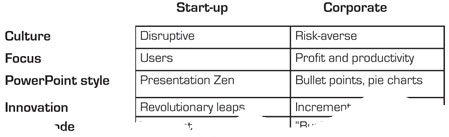
  • Startup vs. corporate

    Kathy Sierra nails it yet again with a laugh-out-loud funny list of differences between the startup and the corporate mindset.

    I added a few examples of my own in the comments:

    Startup Corporate
    When we screw up Admit it, apologize, fix it, compensate customers, move on. Hide it. When that fails, blame the customers.
    Meetings Fun, chaotic, everyone is heard. The boss talks, you listen.
    When you disagree with management You’re valued. You’re fired.
    Work-time Whatever works for you 9-5. On paper. In reality: 9-9.
    Having children Congratulations! Come back in 6 months. Or when you’re ready. Are you sure you want to jeopardize your career?
    When you succeed The whole company celebrates with you. “Employee of the month” certificate.
  • High CEO pay – low performance

    To get results you must get a really good CEO. To get a really good CEO, you must pay a very high salary. That’s established wisdom. And it’s wrong!

    James Surowiecki wrote the excellent book The Wisdom of Crowds that showed how heterogeneous groups of people can be better at making decisions than individuals or groups of experts, and now he’s taken a critical look at exhorbitant CEO salaries in this excellent article in the New Yorker. A quote:

    it’s becoming increasingly clear that, from a shareholder’s perspective, overpaid C.E.O.s aren’t just expensive; they’re downright destructive. One recent study of the market between 1992 and 2001 by economists at Rutgers and Penn State found that the more a C.E.O. was paid, relative to his peers, the more likely his company was to underperform in the stock market. The economist David Yermack, of N.Y.U., has found that companies that allow their C.E.O.s to use corporate jets for personal reasons fall short of market benchmarks by four per cent annually.

    There are myriad ways in which excessive or poorly designed pay packages can do damage. “Golden parachutes,??? which guarantee executives huge payoffs if their companies are acquired, may encourage them to sell out even when the company would be better off remaining independent. Conversely, according to a study by the finance professors Jarrad Harford and Kai Li, very highly paid executives are more likely than their peers to make acquisitions, and to receive major financial rewards for doing so, even when the acquisition ends up destroying corporate value. And there is evidence that overpaid C.E.O.s are more likely to commit fraud that props up stock prices—perhaps because the more you have to gain from criminal activity, the more likely you are to engage in it.

    We need to stop following the maxim that “A highly paid CEO is highly motivated to create results.” It may be true, but the question is: Results for who – the CEO or the company. Surowiecki clearly shows that high CEO compensations may be driving the wrong behavior.

    I have two more reasons why high CEO salaries are bad for a company:
    1: Company employees can hardly avoid comparing their salary to the CEO’s and ask “Is he really worth that much more?” It can lead to resentment towards top management.

    2: It may make the salary the main reason the CEO works there. I believe companies get better results from a CEO who feels a true commitment to the company instead of one who’s just there for the company jet and the stock options.

    Also, take a look at Alfie Kohn’s excellent book Punished by Rewards which shows that rewards (monetary or otherwise) don’t generate long-term, beneficial behavior.

    At the very least companies should publish top management salaries and explain to shareholders why that money was well spent.

  • Quote

    Control: Never had it, don’t want it.

    – Herb Kelleher. ex-CEO of Southwest Airlines

  • eXtreme Projects

    eXtreme Programming is a process used to structure software development projects. It is radically different from more traditional methods, in that it defers more of the detailed planning till later in the project. Most traditional methods try to answer all the big questions up front. This makes it less susceptible to changes that occur during the project – something that can otherwise seriously disrupt software projects.

    eXtreme Programming, or XP, is based on a set of principles that at first may seem awkward and counter-intuitive, but which actually support each other nicely, resulting in a process that is:

    • More efficient
    • More predictable
    • More flexible
    • More fun

    Since I switched from the IT business to making people happy at work, I’ve used some of the XP principles in many other situations, where they have proved to work just as well. Here is my list of which XP principles translate to non-IT projects, and how to utilize them:

    Frequent small releases

    Rather than spending a long time building up to one huge release, find a way to divide your project into several smaller releases. This means that your product makes contact with the real world sooner, and allows you to better incorporate feedback from actual customers/users. in XP, you want to release something every 2-3 weeks, which is certainly preferable to working on a project for 6 months, delivering it to the customer and THEN learning that it doesn’t fulfill their needs. And don’t tell me this never happens.

    Iteration planning

    This means breaking the current goals down into tasks that are small enough to be accomplished in 1-3 days. Based on these estimates, the teams decides which tasks to include for the next deliverable. This means that the work immediately ahead gets broken down into small, manageable pieces and you can easliy track progress.

    Move people around

    Rather than assigning fixed roles to each person, let people switch roles. This enhances knowledge sharing and learning and also helps avoid information bottlenecks. XP also lets people choose for themselves which part of the project they want to work on.

    Daily stand-up meetings

    You’ll be amazed how much faster meetings go, when people can’t sleep in their chairs. in XP projects every day starts with a stand-up meeting to coordinate the days work.

    The customer is always available

    That way you don’t have to guess what the customer wants/intends/needs. You can easily and quickly ask.

    Pair programming (or pair work)

    This means that no work is done by one person alone – each and every task is tackled by at least two people. This may seem inefficient at first, but experience shows that people do better work when working together and it also enhances cross-training and team-work.

    Simplicity

    Choose the simplest solution that could possibly work. Don’t get fancy when simple will do.

    Create spike solutions

    If you’re faced with a difficult choice, don’t analyse it to death, trying to look for the right solution. Instead create spike solutions – quick tests that allow you to try various possible solutions out. This gives you fast, specific, real-life data to let you choose and helps avoid paralysis by analysis.

    Collective code ownership (or collective project ownership)

    Everybody owns the whole project. This helps avoid bottlenecks and that unpleasant situation where people feel that they own a part of the project and seem reluctant to share knowledge or accept criticism on their “property”.

    No overtime

    Period!

    I believe that these principles can be applied to many kinds of projects and I have done so myself with considerable success. Are they always applicable? No. Read the XP entry on when to apply XP for some inspiration on when to use XP – and when not to.

  • Pixar gets it

    The Holllywwod way of organizing a movie is by using only contract labour. The vast majority of movie people, from grips and gaffers to high-paid actors, are in essence self-employed and are hired for one movie at a time.

    Pixar goes against this trend, by focusing on people:

    Contracts allow you to be irresponsible as a company. You don’t need to worry about keeping people happy and fulfilled. What we have created here – an incredible workspace, opportunities to learn and grow, and, most of all, great co-workers – is better than any contract.

    We’ve made the leap from an idea-centered business to a people-centered business. Instead of developing ideas, we develop people. Instead of investing in ideas, we invest in people. We’re trying to create a culture of learning, filled with lifelong learners. It’s no trick for talented people to be interesting, but it’s a gift to be interested. We want an organization filled with interested people.

    Says Randy S. Nelson, the dean of Pixar University.

    Among the advatages cited are:
    * People learn to work more efficiently together through long-term collaborations
    * People can better support each other through difficult creative processes
    * A culture of learning
    * People have more fun

    Also check out the amazing offices at Pixar.

  • Turkish Q&A

    I’m speaking at an HR conference in Istanbul next month, a leading turkish newspaper wanted to do an interview by email about happiness at work. They sent me some great questions, which I answered as best I could. The best part about great questions is that they leave you and the questioner wiser.

    Below are the questions and my answers, which contain some of our basic thoughts on happiness at work.

    (more…)

  • Dangerous ideas

    What is your dangerous idea?

    The brilliant minds of The Edge community have been pondering that question and have come up with no less than 117 essays.

    Here are a few of my favourites:
    Carolyn Porco: The greatest story ever told.

    At the heart of every scientific inquiry is a deep spiritual quest – to grasp, to know, to feel connected through an understanding of the secrets of the natural world, to have a sense of one’s part in the greater whole.

    And we don’t have one god, we have many of them. We find gods in the nucleus of every atom, in the structure of space/time, in the counter-intuitive mechanisms of electromagneticsm. What richness! What consummate beauty!

    These are reasons enough for jubilation … for riotous, unrestrained, exuberant merry-making.

    So what are we missing?

    Ceremony.

    We have no loving ministers, guiding and teaching the flocks in the ways of the ‘gods’. We have no fervent missionaries, no loyal apostles. And we lack the all-inclusive ecumenical embrace, the extended invitation to the unwashed masses. Alienation does not warm the heart; communion does.

    But what if? What if we appropriated the craft, the artistry, the methods of formal religion to get the message across? Imagine ‘Einstein’s Witnesses’ going door to door or TV evangelists passionately espousing the beauty of evolution.

    Could it work? Could we create institutions that filled the roles of religion but which were based on science rather than faith? That is one hell of a dangerous idea. Not to mention weird and wonderful.

    Philip Zimbardo: The banality of evil is matched by the banality of heroism

    This view implies that any of us could as easily become heroes as perpetrators of evil depending on how we are impacted by situational forces. We then want to discover how to limit, constrain, and prevent those situational and systemic forces that propel some of us toward social pathology.

    It is equally important for our society to foster the heroic imagination in our citizens by conveying the message that anyone is a hero-in-waiting who will be counted upon to do the right thing when the time comes to make the heroic decision to act to help or to act to prevent harm.

    This is a wonderful shift in thinking: Rather than thinking of people as potential nazis or executioners (common thinking has it, that under the right circumstances all of us could become either), think of people as potential heroes and foster that potential.

    Simon Baron-Cohen: A political system based on empathy

    What would it be like if our political chambers were based on the principles of empathizing? It is dangerous because it would mean a revolution in how we choose our politicians, how our political chambers govern, and how our politicians think and behave. We have never given such an alternative political process a chance. Might it be better and safer than what we currently have? Since empathy is about keeping in mind the thoughts and feelings of other people (not just your own), and being sensitive to another person’s thoughts and feelings (not just riding rough-shod over them), it is clearly incompatible with notions of “doing battle with the opposition” and “defeating the opposition” in order to win and hold on to power.

    Yes! I think more and more these days on how to create a better way of politics. This is an important insight.

    Also check out last year’s question: “What do you believe is true even though you cannot prove it?”

  • Imagination research

    The Imagination Lab Foundation is an independent, non-profit research institute founded in 2000 and operating from Lausanne, Switzerland.

    Its raison d’étre is to develop and spread actionable ideas about imaginative, reflective and responsible organizational practices. The Foundation’s underlying philosophy is to value imagination as a source of meaningful responses to emergent change and play as an effective way to draw on this human capacity.

    Go visit them and be sure to check out their amazing collection of articles. Grrrreat stuff!

  • Sharing the reins

    John Abrams, President of South Mountain Company, tells the story of how the company became employee-owned:

    In 1987 I sold my business, South Mountain Company, to my employees (and myself)… Shared ownership and control is our method at South Mountain. “Every employee, an owner” is our intention. More than half of our thirty employees are full owners. Each time another comes in, and each time a new management invention encourages more voices to be heard, we move steadily toward the goals of democracy, fairness, and transparency.

    Among the advantages: Commitment, effectiveness, productivity. Read the whole story here.