Archive for February, 2008

HP and I are making the UK happy!

Today I’m in Stratford-upon-Avon (birthplace of William Shakespeare) helping Hewlett-Packard promote their Happy People campaign to their UK channel partners.

I wrote about this campaign previously. The cool thing about it is that they’re using happiness at work to promote their products – and of course that they hired me for it :o)

As part of the campaign, they made this sweet little flash presentation:

Neat, huh?

And remember, if you work in the UK, there’s still a chance for your company to win a workshop with me. More information here:

Full disclosure: HP are paying me to participate in media activities related to this project and to do the workshops for the winning companies.

Comments (1)

An inspiring story

Here’s another great little video from youtube: My friend Stephen Hopson who is deaf from birth and a pilot and a professional speaker talks about a life changing moment.

Also, catch Stephen’s excellent blog at Adversity University (and isn’t that a great name).

Comments (2)

Eu-phoric and other -phorics

Johnnie Moore and Rob Paterson have come up with a podcast interview format they call phoric in which the interviewee picks three youtube videos to set a theme for the conversation.

I immediately jumped at the chance to participate, and here are my three clips:

The opening from Love Actually.


A fantastic Coca-Cola ad.


Randy Pausch’s last lecture.

Try and guess what my theme is :o)

You can hear the resulting conversation here – there’s a short 10-minute version and an extended director’s cut.

Comments (4)

Feliz en tu trabajo – my book is out in Spanish

Happy Hour is 9 to 5Yaaaaaay: My first book is now out in Spanish!!!! You can read it free online, or buy it on paper for 27 euros or as a pdf ebook for 17 euros.

You can read all about it at www.felizentutrabajo.com.

The title in Spanish is “La hora feliz es de 9 a 5 – Cómo adorar tu trabajo y tu vida y arrasar en tu empresa” and it was translated by María Rodríguez de Vera of Contentspanish.

But wait – there’s more: My book is also coming out in Danish in March which is really exciting and I’ve been talking to a Chinese publisher about a version in simplified Chinese AND to an Iranian about translating it to Farsi!

Comments (5)

Spotted on my travels

From a shop in Copenhagen:

Coffee

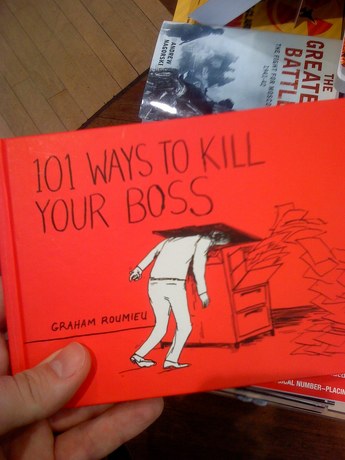
I spotted this one in the airport on my way to Austria:

101 way to kill your boss

And finally, this is what taxis look like in Sölden:

Taxi Quaxi

In Austria, they have frog taxis – Taxi Quaxi!

Comments (3)

Back from Austria

Skiing Sölden Austria

I’m back from snowboarding in Sölden Austria and it absolutely rocked. I was very curious how my new Ride Snowboard + Burton boots would work out and they were excellent. I have never ridden so fast. In fact, I managed to seriously scare myself a couple of times :o)

Steve RoeslerWhile I was gone Steve Roesler of the All Things Workplace blog did some excellent posts on change and happiness which I really enjoyed reading. My favorite has got to be the one on the backlash against happiness. Good grief!

That post also inspired some great comments, especially Kevin Carson’s on the unethical use of Fish and similar tools in the hospital where he works and Scott Nutter’s notion that it’s not about being happy but happier.

It’s interesting to notice that Steve’s style is more open and inquiring, where my blog posts tend to be more argumentative and “here’s what I think!”-like.

So thank you Steve for giving the blog a great peek into a very important topic and for introducing some great conversations.

To thank Steve for his help, I sent him a small present: a copy of my very favorite book on change. This is one book that changed me.

And if you want another look at what I was up to in Austria, here’s a POV video of me snowboarding some fresh powder, ending with a major crash :o) Man, I love falling in powder!

The video was taken with my new helmet-mounted video camera. Yes, I looove gadgets :o)

Comments (5)

Happiness, Satisfaction, & Change: Day 5

Meaning

Meaning, Wholeness, and Change

Galba Bright, EQ expert extraordinnaire and producer of Tune Up Your EQ, yesterday posed quite a question:

“Meaning is a peculiarly individual and subjective thing. I wonder, if every worker pursued their own notion of meaning, how would that affect the corporate world?

I believe that question is related to the success–or failure–of every change initiative. Whether it’s about a new benefits package, introducing new technology, or figuring out where the entire family will go on vacation, meaning is the core issue.

Why?

Because when we retain what is meaningful, we have a sense of wholeness. When we have a sense of wholeness, we can–by definition–bring all of ourselves to the game.

Conversely, if meaning is subverted in some way, so are we. Our enthusiasm and commitment diminish; only part of us is left, and it’s not the part that is ready to add value to the situation.

A Helpful Way to Think About Meaning, Worklife, and Change

Look. Corporations are in business to earn a profit. Without that, there wouldn’t be jobs or money for employees. Heck, there wouldn’t be employees!

However: without high-performing employees, there wouldn’t be highly profitable corporations.

Which means that both are giving and getting something out of the relationship. And that’s where I believe the frustration begins. The same people who would spend days, weeks, and months wining and dining a new love–gazing longingly into the other’s eyes–too often spend about 5 minutes sending out an email announcing a change that will impact work schedules, careers, income, and the well-being of families.

I’ve been involved in corporate life for more than 30 years. Most executives I know do acknowledge the personal difficulties inherent with change. But here’s where it gets icky: somehow, along the way, a particular defense mechanism has been allowed to serve as an acceptable “reason” for all kinds of behavior. And that is the phrase, “This is a business.”

When that is uttered, somehow everyone within earshot is supposed to nod knowingly, acknowledging that the business gods–wherever they are–deserve whatever sacrificial offering is required to keep them looking favorably upon that company’s shareholder value.

“This is a business.” Knock it off, we all know that. In fact, that’s why we’re all here!

But we’re all here for another reason.

This business allows us to fulfill some deeper sense of meaning and purpose in our lives. For some, it’s the work itself. For others, it may offer the means to buy a first home and start a much longed-for family. For still others, the location of the workplace may have meaning if one needs to care for elderly or suffering family members. And, yes, there are many who are working simply to have enough money to retire. They’ve decided that they’ll delay certain kinds of satisfaction so that they don’t need to worry during their later years.

They are all personal and all valid.

Meaningful Changes Mean Meaningful Conversations

My experience shows that this is the part that makes the biggest, positive difference but is most neglected. Now, follow me carefully, please.

Companies cannot satisfy all elements of the definitions of meaning that all of its employees bring to the table. In fact, none of us has the ability to satisfy all of the definitions of meaning that lie within our spouses, children, and closest friends.

Well, if that’s the case, what can you do?

You can start the right conversation and not let it finish until it’s finished. Here’s what I mean:

I recently had a chance to manage (vs. advise) a change project. It was a long-time client whose leader didn’t feel as if there was the right expertise internally to do this particular change (it involved a team that had had no manager for a long time. That’s another story).

After calling the group of 9 people together and announcing the upcoming work changes, I made this statement:

“The changes themselves aren’t negotiable (I explained why). However, how you can decide how best to organize and execute them . Why? Because you are seen as the experts when it comes to this function.

Before we do anything, I want to have a discussion about your initial reaction. What you see as immediately positive and why, what’s lousy and why, and how this will impact your life.”

And I just sat back until the first person started talking. It was fascinating. No one disagreed with the desirability of the changes and the fact that they were good for the long-term health of the company. What did emerge, quite emotionally, were the personal issues that would be created:

“How do you expect me to take my daughter to school if I have to come in at 7 a.m.?”

“I don’t know if I can learn the new technology. I don’t want to look like a fool or be considered ‘too old and set in my ways’ to try something new. That’s not it. I’m just scared. I work hard at what I do, but I’ve learned to do it well so that I don’t have to worry about people thinking I’m not a good worker.”

“This means I will have to have direct contact with the CEO once a week. I’ve never, ever been in a meeting with the CEO let alone have to meet with him and discuss issues. I don’t see myself as someone who works with a CEO.”

These are actual examples. There were many more.

Here’s what happened:

Over the course of three months, we met every other week. The process of getting things done had to be interrupted regularly to allow people to vent, rant, celebrate, nudge each other…you name it.

At month five, it’s obvious that this is working out well. But I still have to allow time for people to backtrack, backslide, vent about things from the first meeting, and then bring themselves back to the present moment.

What’s really happening here?

People had assigned a certain meaning to their work. Their work changed. They had to make sure that the core of their original meaning was intact. And the way they did that was to offer up how they actually felt, try out some changes, go backwards, offer up how they felt, go forward, and ultimately discover that they are still whole. But their wholeness was allowed to be seen as a result of them being allowed to be themselves. Who they are was never questioned. Being allowed to decide how they would work acknowledged their uniqueness and talent.

But they had to be allowed to have meaningful conversations, regardless of the feelings involved.

The outcome: The company saw it’s intent and meaning for this project realized; the team members did the same; the overall outcome created a new meaning in the depth of relationship between the corporate entity and the people involved.

Finally. . .

Alex should be back with some wonderful stories and in good form on Monday. I want to thank him for his trust here at the CHO blog and the chance to meet his regular readers through comments and e-mails.

Most of all, I hope that something in the conversation this week has created meaning for you.

Until we meet again. . .

Steve Roesler will now be re-learning Typepad as he returns to home base at All Things Workplace.

Comments (19)

Happiness, Satisfaction, & Change: Day 4.1

Happiness, Career Changes and Talent?

During my consulting career I’ve watched two things impact a person’s sense of “What should I be doing with my life?”

1. A job change initiated by an employer.This is usually a reorganization or layoff that causes people to evaluate what else might be a good fit within the existing company or what to focus on in the midst of a sudden job search.

2. A personal crisis: “What I’m doing at work isn’t satisfying. There must be more to my life than this!”

Both situations offer an opportunity to find more happiness, satisfaction, and contentment.

If you look around, you’ll find different approaches to career development. Some focus on one’s interests, others talk about skills; you’ll see tools that ask you to clarify your values (what’s really important to you); and finally there is, at last, a valid movement that addresses talents and giftedness.

Much of the work I do is with corporations and individuals involved in 1 and/or 2 above. Both involve having control over meaningful changes in one’s life.

Fortunately there are companies out there that offer support in the event of the first situation. (Unfortunately, there are many that do not, with the result being a lot of wasted talent that could have been used in ways never imagined).Talents

What I think I’ve learned is this: there are 3 key areas to focus on when you seek more congruency in your working life.

So I put together a little slide show that I hope will add some clarity to how you view your career. If you are a manager, think about how you might use this to view people’s potential a bit differently than you might be doing now.

This was my first go at putting together a presentation and uploading it, but I think it works OK.

Let me know what you think.(I normally use Typepad at the home blog and couldn’t figure out how to get the embedded code to work in Wordpress no matter how many different tutorials I followed:-)

Here’s the video link for Using Your Talents.

Steve Roesler of All Things Workplace continues searching Wordpress tutorials as the sun rises over the sylvan setting of Southern New Jersey.

Comments (7)

Happiness, Satisfaction, & Change: Day 4

What about Happiness and Career Changes?

Note: Something strange is going on with the formatting on today’s post. Can’t seem to fix it using the visual editor or normal html in the code window.  So I’ve left the video link and am completely re-creating another post. It will be up shortly. You can still watch the video link from the post: Careers and Change

 Steve Roesler of All Things Workplace is searching for Wordpress tutorials at 3 a.m. while the Chief Happines Officer is happily on holiday.


Comments (4)

Happiness, Satisfaction, & Change: Day 3

Sad

It Has Finally Happened. . .

There is a backlash against Happiness. Honest.

Coach, consultant, and prolific writer Peter Vajda, Ph.D.–see comments from yesterday–forwarded a Newsweek article titled:

Happiness: Enough Already

(If Alex sees this, he’ll be snowboarding directly into the Newsweek offices. Someone should warn the editors to look out for a Great Dane in a ski cap!)

I don’t know about you, but I confess I’ve never, ever heard someone say, “I’m tired of being happy. I want to work on some serious misery.”

Well, according to the article, apparently those wild-and-crazy Scots are the exception to the rule:

Psychologist Ed Diener, who has studied happiness for more that 25 years, visited Scotland recently. He explained to members of Parliament and business leaders that it would be valuable to add a national index of happiness to the usual measures of a country’s wealth. Professor Diener explained that such an index would measure things known to increase people’s sense of well-being, e.g., democratic freedoms, health care, the rule of law…

The Scots liked the idea of freedom, good health care, rule of law…but not because they make people happier.

According to Diener: “They said too much happiness might not be such a good thing. They like being dour, and didn’t appreciate being told they should be happier.”

Had the good doctor consulted with me, I would have shared one word which would explain the foundation of all Tartan psycho-social behavior:

Haggis.

Titles Sell, But Don’t Always Reflect the Real Story

The CHO is all about happiness. He’s also about being real. So let’s get to some of the key parts of that Newsweek article.

1. There is an inclination–at least by some in the U.S.–to treat normal sadness as a problem. Worse, there is a portion of the population that simply wants to treat it with drugs. Take a “happy” pill.

But there isn’t one. Yet.

However, young people are being urged by their parents to take anti-depressants although the young people themselves are keenly aware of the normalcy of their situation. That is, something sad happened–so they feel sad!

This is a bit confusing to me. You and I hear about the importance of “authenticity” all the time. Turning our backs on how we are actually doing at a given moment can only cause problems down the road. Sooner or later, suppressed feelings emerge in unhealthy and unexpected ways.

2. The magazine perceives a backlash not against happiness, but against a group of people who insist that we be happier. In fact, according to the article, 85% of Americans say they are pretty happy. Yet there are those who insist that everyone should get even happier.

Peter points out in his comment that many folks have difficulty accurately naming what makes them happy. Yet they are very clear about what other people expect and often adjust behavior accordingly. (BTW: I am a very happy, satisfied guy. But I haven’t a clue what I would do if someone started singing “Don’t Worry, Get Happier!).

3. Citing a study of more than 118,000 people from 96 countries, the article says that the results were clear. The highest levels of happiness are attached to stable, long, contented relationships.

Happiness, Relationships, and Change

When we talk about happiness at work, aren’t we really saying that we want relationships that are mutually respectful, acknowledge our uniqueness, and offer an opportunity to grow?

I’m not sure any of us actually needed statistics to tell us that. But organizations–being organizations–do pay attention to the numbers. So it can’t hurt for employers and managers everywhere to look at the implications:

  • If employee satisfaction is related to long-term, contented relationships, then constant re-organizations with a constant churn of co-workers and bosses is counterproductive.
  • Change and uncertainty are both normal yet not something that companies–or we as individuals– can control. However, organizations can be deliberate about bringing people together in the midst of change. This captures the inherent nature of existing relationships in order to build a sense of strength at a time when people may be feeling most vulnerable.
  • Use the collective experience of those impacted to address issues that will affect them. This is an acknowledgment of respect as well as a satisfying use of individual talents.

Finally:

Jane left a well thought-out comment that you’ll want to check out. At the heart of it is the notion of choice. And one of the choices we have is to surround ourselves with people who have a positive approach to life.

And with that, I am contented. Until the next postHappy

While Alex dons Lederhosen and his new Ride board for a run across the Austrian powder,  Happiness is being spread by Steve Roesler of All Things Workplace .

Comments (32)

« Previous entries