Category: Leadership

Leadership is an insanely important discipline. Here you’ll find the thought, tools and tricks of the trade of great leaders.

  • Why every company needs to give employees Free Time on the job

    Why every company needs to give employees Free Time on the job

    My first “real” job was for a large and very famous Danish company who’d hired me fresh out of university to work on one of their big new products. One day, about a month into my employment there, I was sitting at my desk thinking big thoughts.

    To other people it might have looked like I was slacking – I’d put my feet up on the desk and was staring into the air – but in reality I was considering if the approach I’d chosen to solving a particular task was the right one or of there was a smarter, faster way.

    And for that I was reprimanded. When my manager walked by and saw me sitting there, he criticized me for goofing off. As long as he could see me pecking away at my keyboard, he felt confident that I was productive. Seeing me with my feet up automatically made him assume that I was wasting time.

    Companies everywhere are looking to increase productivity. Employees are asked to work more efficiently and get more done faster. But it seems to me that the constant focus on short-term productivity gains is hurting long-term results because employees’ work days are filled to capacity (and over) with tasks, meetings, deadlines, projects, etc.

    What’s missing from that picture? Free time. Or as some call it: Slack.

    In the excellent article ”In Praise of Slack: Time Is of the Essence” from The Academy of Management Executives M. B. Lawson writes about the importance of having time during your work day that is not already taken up with tasks. From the article:

    Slack is important for organizational adaptation and innovation.

    Increasingly complex systems and technologies require more, not less, time for monitoring and processing information. Future demands for strategic flexibility and for integrating learning and knowledge throughout organizations highlight the need to reexamine the importance of time in organizational work – and to recognize that all organizational resources cannot be committed to immediate output efforts if we are to have time to pay attention, think and benefit from the knowledge gained.

    Some managers (among them my first team leader) see all free time as wasted time, but they’re completely wrong. When every moment of the work day is taken up with tasks and work, it damages the organization in many ways. Here are some we’ve seen among our clients:

    1. Creativity is lost because there is no time to come up with and act on new ideas.
    2. No one helps anyone else, because people are booked 100% (or more) on their own tasks
    3. There’s no time to learn new skills
    4. We end up always doing things the same way because there’s no time to optimize processes
    5. Customers become less happy because there is no time to go the extra mile and deliver great customer service.
    6. Everything becomes a chaotic mess because there is no time to organize and structure things
    7. Flexibility is lost because everyone is too busy to deal with changing circumstances
    8. Employees become less happy and more stressed because there is no time to deepen your skills

    In short, organizations without slack become stiff and brittle and lose the ability to lift themselves out of their current problems and create ongoing improvements. These organizations become extremely fragile in the face of any unforeseen changes.

    So slack is great for employees and for the workplace. But it must be created consciously. Workplaces must make a concerted effort to show employees

    How do you do that in practice? Here are 5 ways we have seen work well in practice.

    1. Hackathons are well-known in software companies. Employees are given time (frome 1 day to several days) to work in groups on any project of their own choosing. At the end, teams present their results.
    2. 20%-time (popularized by companies like 3M and Google) means that employees can devote up to 20% of their work week to projects they come up with themselves.
    3. Training and development is crucial. In the company I co-founded, every employee had an annual training budget of 2 weeks and 8,000 USD, which they were required to use.
    4. Minimize time spent on useless meetings, status reports and similar.
    5. Plan for slack so that employees’ work week can not be booked 100%. Software company Menlo Innovations in the US, only let their people budget for 32 hours a week – they know that the rest is spent on planning, training, coordinating, etc.

    Of course workplaces need to become more competitive and productive. Of course we must constantly try to do more with the resources we have. But we can’t expect people to become more effective, if they never have time to reflect, plan, learn or try out new ideas. That takes slack.

    Your take

    Do you have free time at work? Or is every minute filled already? Are people in your workplace rewarded or punished for stopping what they’re doing, so they can figure out a better way to do it?

    Write a comment, I’d love to hear your take.
    Related posts

  • Helping and happiness

    There’s an excellent article in HBR about The Culture of Helping at US innovation agency IDEO by Teresa Amabile (whose work we already love around here)  Colin M. Fisher, and Julianna Pillemer.

    The authors raises some issues around helping behavior and point out that helping co-workers may not come naturally:

    Helpfulness must be actively nurtured in organizations, however, because it does not arise automatically among colleagues. Individuals in social groups experience conflicting impulses: As potential helpers, they may also be inclined to compete. As potential help seekers, they may also take pride in going it alone, or be distrustful of those whose assistance they could use. On both sides, help requires a commitment of time for uncertain returns and can seem like more trouble than it’s worth. Through their structures and incentives, organizations may, however unwittingly, compound the reluctance to provide or seek help.

    In their study, they looked at what mattered most:

    In our survey of the entire office population, people were asked to click on the names of all those who helped them in their work and to rank their top five helpers from first to fifth. (See the exhibit “What Makes an IDEO Colleague Most Helpful?”) Then they were asked to rate their number one helper, their number five helper, and a randomly suggested “nonhelper” (someone whose name they hadn’t selected) on several items. Those items assessed three characteristics: competence (how well the person did his or her job); trust (how comfortable the respondent was sharing thoughts and feelings with the person); and accessibility (how easily the respondent could obtain help from the person).

    The kicker:

    Trust and accessibility mattered much more than competence.

    When looking for help, people don’t necessarily go to the smartest colleague but to the one they trust the most and have easy access to.

    All in all, the article is a fascinating look into an organization that has succeeded in creating a culture where asking for and offering help is a natural part of the culture.

    Go read the whole thing – it’s excellent (free to read, registration required).

    I believe that a culture of helping is essential for creating a happy workplace because everything is easier, if you know you’re not alone and you can get help when you’re stuck.

    Also, I believe that the desire to help others is much more common in happy workplaces. We know from several studies, that happy people are less selfish and more helpful towards others.

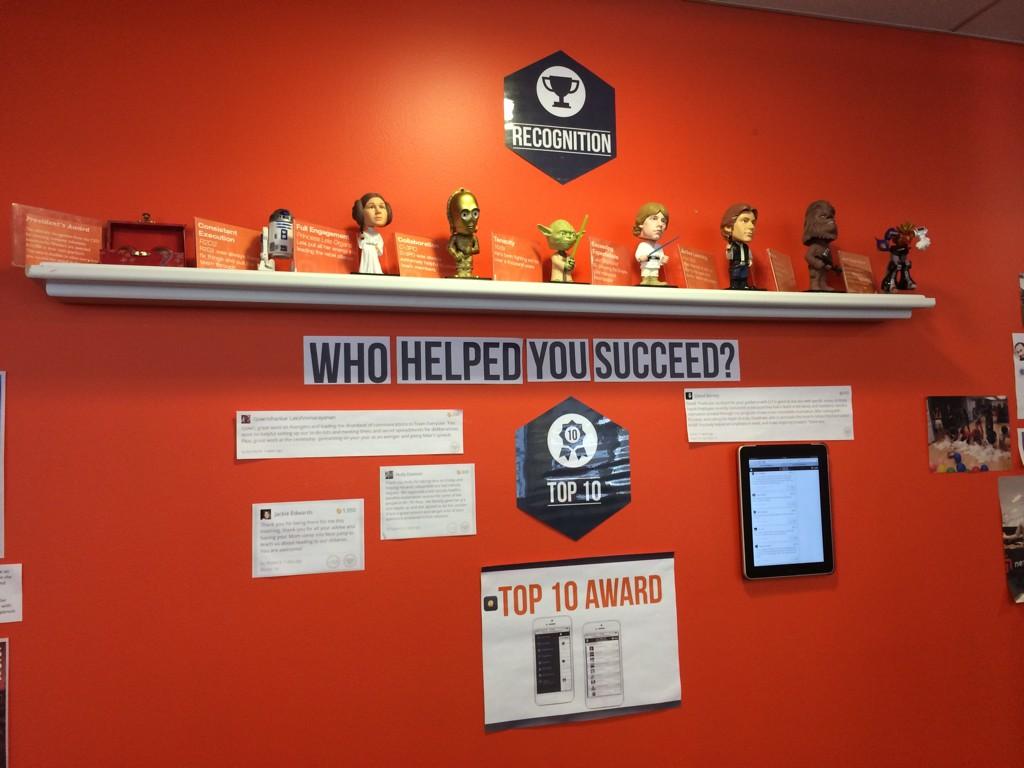
    Another excellent example is New York-based Next Jump who make software for employee engagement programs. They transitioned their internal employee awards, so they no longer go to the best or most skilled employees, but to the ones who help others succeed the most:

    Helping at NextJump

    In short, I believe that a culture of helping is both a tool to create a happier workplace and an indicator of workplace happiness.

  • Plan for slack

    Workplaces must give employees unscheduled play time. If work days are overloaded, there is no learning or creativity. Plan for slack.

  • Are you a happy boss? Take this test and find out.

    Happy boss quizz

    What kind of manager are you? Are you a happy boss or do you spread fear and misery all around you? We’ve created an online test that you can use to find out.

    Being the boss used to be about making tough, ruthless decisions. This is changing. More and more wildly successful leaders today devote themselves to creating happiness – for employees, customers, shareholders and themselves.

    Tony Hsieh, CEO of Zappos, committed his company to “Delivering Happiness” to both clients and employees. Richard Branson  has said that “more than anything else, fun is the secret behind Virgin’s success.”

    Take our test and learn if you are a happy boss.

    Related posts

  • When the boss says, ‘Don’t discuss your salary’

    The Atlantic has an excellent article by Jonathan Timm on how companies try to keep employees from discussing their salaries with coworkers and how this perpetuates unfairness and lets them underpay some people.

    From the article:

    … about half of American employees in all sectors are either explicitly prohibited or strongly discouraged from discussing pay with their coworkers. In the private sector, the number is higher, at 61 percent.

    We don’t know whether gag rules directly cause wage discrimination, but they undoubtedly open the door to it. Employers who keep pay secret are free to set pay scales on arbitrary bases or fail to give well-deserved raises because of social norms. “When you don’t have transparency and accountability,” Hegewisch told me, “employers react to these pressures and biases and women tend to lose out.”

    The article also makes the point that workplaces can not legally keep employees from revealing their salaries or retaliate in any way when they do.

    I examined this topic in an article way back in 2006 and I am convinced that keeping salaries secret harms not only employees but also workplaces.

    Read the article here – it’s called Top 3 Reasons why Secret Salaries are a Bad Idea.

  • There is no perfect workplace

    great workplaces fix problems

    I have had the pleasure of visiting some of the world’s happiest workplaces and while some people think that they’re happy because they don’t have problems, that is just not so.

    And if you need a great way to identify and fix problems in the workplace, check out this article.

  • How one CEO ended up naked in the office

    Danish CEO Mogens Norgaard was once naked in the workplace. Not by accident but for a very specific purpose. Find out why in this video.

    If you want to see the actual event, click here. Warning: It does (for obvious reasons) include nudity.

  • What do you do when there’s just too much work?

    What do you do when there’s just too much work?

    graph

    Last year I did a workshop for a client in Copenhagen whose main problem was that they were just way too busy. They’re a trade union and new legislation meant that they got an influx of new government-mandated tasks but budget constraints meant they couldn’t hire more people.

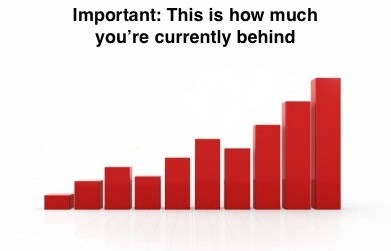
    Consequently they were increasingly falling behind on their work, through no fault of their own. They have an internal IT system that tracks every open case and they were currently 3,000 cases behind.

    Even though this was due to circumstances outside of  their control, knowing that they were behind made everybody stressed and irritable. They also felt a responsibility towards their members – every delayed case meant that one of their union members was waiting for an important answer or potentially weren’t being paid money they were owed.

    This situation is becoming familiar in many workplaces where there is simply more work than resources. Typically management will bombard employees with information showing the current lag, which only serves to make people frustrated and unhappy at work.

    So what can you do instead? Here’s what we did in our workshop with this client.

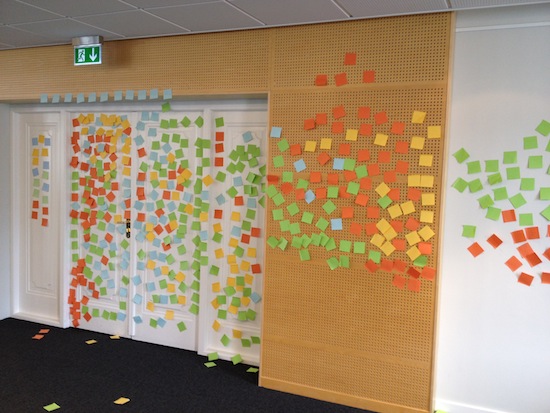
    I pointed out the fact that they were currently behind by 3,000 cases. Everybody had heard that number – it had been sent out en emails and mentioned in countless meetings. I then gave the group 30 post-its notes and told them that each post-it represented 100 open cases.

    I asked them to stick those post-its on the wall. It looked like this:

    Resultater_med_postit_II

    I asked how looking at that made them feel and they said things like “I feel hopeless,” “I feel like we’re failing our members,” and “I don’t see how we can ever catch up.”

    Then I gave them 900 more post-it notes and asked the group to stick them on the wall next to that. It looked like this:

    Resultater_med_postit

    I told them that I’d checked their IT system, and in the last 12 months they had completed 90,000 cases. Each post-it represents 100 cases – hence 900 post-its.

    I asked how they felt looking at this and they said things like “I feel proud,” “I feel like we’re making a difference,” and “I feel hopeful.”

    Interestingly, the year before that they’d processed 73,000 cases so they had actually become much more productive, but had never focused on that. Instead their focus was only ever on how much they were falling behind.

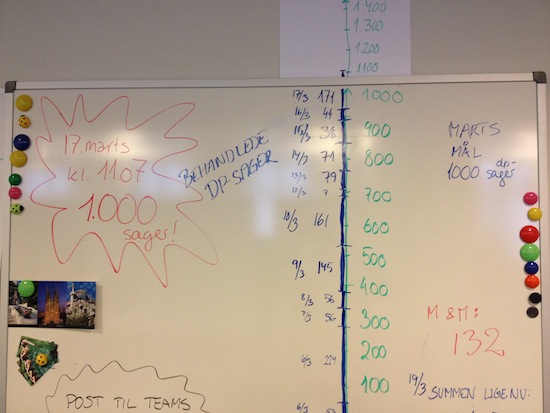
    This gave them renewed energy to tackle their increased case load. They also came up with their own way to track progress, using a whiteboard in their cafeteria:

    Resultater

    They use it to track monthly completed cases. They’d set a goal for March of 1,000 cases – and reached  it on March 17th. Note how they had to extend the scale upward with a piece of paper because they completed much more work than planned.

    In short, focusing on the work they completed (instead of how much they were falling behind) allowed them to catch up over a period of a few months.

    Sadly, many workplaces do the exact opposite. When teams fall behind, they are constantly told exactly how much. I’ve seen workplaces send out weekly emails with red graphs showing the current lag. I’ve seen the same graphs hanging in offices, cafeterias and being presented in every department meeting.

    The problem is of course that this makes employees frustrated, hopeless and unhappy. The work of Harvard professor Teresa Amabile has shown that the most important factor that makes us happy at work is perceived meaningful progress in our work and that the absence of progress makes us unhappy.

    And of course we know from the research that happy employees are more productive, creative and resilient.

    In short, this means that most workplaces set up a vicious cycle:

    1. There’s too much work compared to the available resources
    2. Employees are constantly told that they’re falling behind
    3. Employees become unhappy at work
    4. Employees become less productive
    5. Less work gets done
    6. Back to 1

    So that’s my challenge to your workplace: How can you highlight and celebrate the work that gets done, instead of only feeling bad over the work that’s not yet completed?

    Related posts

  • Top 5 Policies That Make Danish Workers Way More Happy Than Americans

    DenmarkYou will often see Denmark listed in surveys as the “happiest country on the planet.” Interestingly Danes are not only happy at home, they’re also happy at work. According to most studies of worker satisfaction among nations, the happiest employees in the world are in Denmark. The U.S.? Not so much.

    I wrote an article for Fast Company on the 5 most important factors that explains this difference and it’s been incredibly popular. It seems the Danish way of working is attractive to many Americans.

    You can read the whole article and add your two cents here.

  • Happy nurses = happy patients

    I’m on a train on my way to speak to 300 nurses and a bit of google research turned up this:

    “Places that are good environments for nurses to work also then translate into nurses being able to do their jobs well and being able to provide good quality care to their patients.”

    Source

    Simply put, the study found that happy nurses = better care = happy patients.

    This just confirms that happiness at work improves business results on almost any meaningful metric.