Category: Leadership

Leadership is an insanely important discipline. Here you’ll find the thought, tools and tricks of the trade of great leaders.

  • Creating a happy workplace

    Here’s a 1-hour video of a speech I did last year for a group of South African business leaders:

    This is one out of 6 speeches I did for ICAS in South Africa last year and after the speech they wrote that:

    The guest speaker, Alexander Kjerulf, wowed the crowd with his charismatic charm and his pure passion for making people happier in the workplace.

    If you’re thinking of booking me for a speech, this video will give you a great sense of how my speeches go. You can book me to speak in your company right here.

  • “The Customer Is Not Always Right” – follow-up

    “The Customer Is Not Always Right” – follow-up

    My article on why “The Customer is Always Right” is wrong has generated an amazing amount of attention. It’s been read by 100,000s of people and been mentioned all over the internet.

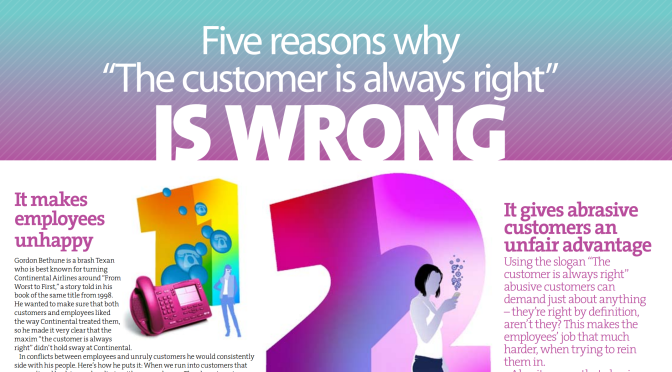
    WallchartCall Center Magazine in the UK liked it so much that they turned it into a wall chart that is waaaaay more attractive than my original post. Download it here.

    But most of all the article gets a LOT of great comments. Here are some of my favorites.

    Chris wrote:

    I run a small company with about 20 employees. One day I heard commotion coming from the reception area. I hear a man yelling “I am the customer, you work for me and the customer is always right!”. I immediately went up and said, “No sir, you can’t get away with what you get away with at Walmart here. This young lady works for me and no matter what you think you were right about, you raised your voice and are no longer welcome.”

    He needed our services and wrote a letter of apology for his ‘cranky mood’.

    You raise your voice and you are out. No exceptions.

    That’s it in a nutshell.

    Grant wrote:

    I read this post the other day and it was hiding in the back of my mind then this past Thursday I had a job interview. The interviewer asked me, “What do you feel about the statement, ‘The customer is always right’?” I remembered this post and mentioned these points as well as embellished to make it more appropriate to the job description.

    After I answered that, the interviewer told me that I was the first person all day to answer that question correctly (she had already interviewed 6 people). Today I got a call offering me the position. I’d like to think that it had something to do with this blog post.

    Thanks :)

    SEE MOM! BROWSING THE INTERNETS IS A GOOD THING!!!

    I’ve told Grant that I take full credit for him getting the job and given him an account number where he can deposit 10% of his first year’s salary :o)

    Marie wrote:

    We recently had a customer who bounced a check, and had the audacity to call my customer service manager with a tirade of yelling & profanity (before she could explain what had happened). She was calm and waited for him to settle down and tried to explain… He continued to use profanity, only to stop when my CS Manager politely told him that if he didn’t quit, she would hang up… Later, he emailed a complaint to the corporate office stating how rude and unprofessional she had been…

    The customer DOES NOT have the right to harass my employees. I just happened to be in the office that day and could hear him screaming at her over the phone. I think she handled it WONDERFULLY; I took her out to lunch!

    I don’t believe that a customer has the right to verbally assault my employees and I have trained them not to take that type of abuse from anyone.

    SueBob writes:

    I worked at a print shop where my manager would occasionally fire customers. In four years, I think it was 3 people. He told one person, “I won’t have you abuse my employee.”

    I would have crawled through broken glass for him. It was one of the best employment experiences of my life.

    These comments show that there are many companies out there that realize that putting the employees first actually results in better customer service. The formula is simple: Happy employees = happy customers.

    But of course not everyone gets it. Yet.

    Anonymous writes:

    I work in a call center and showed this article to my boss. I’m told that senior managers view the ideas presented here as “silly.” Is it any wonder employees think our company is out to get them?

    Customers are allowed to verbally abuse our employees and this is supposed to be a sign of great customer service. All the while, lower level managers are directed to keep turnover down. The company doesn’t understand that people are not satisfied in a job where the company supports abuse towards them.

    Get a clue.

    Sheeesh!

    Related posts

  • Check out my article for Fast Company’s Co.Exist website

    My article for Fast Co.Exist has just been published. In it I list the 5 major differences between Danish and US workplaces that explain why Danish workers are the happiest in the world and US workers tend to be miserable.

    Check it out and let me know what you think.

  • Change

    The keys to successful change in an organization are well known:

    1.  Involve those affected
    2. Have a clear purpose
    3. Listen to concerns

    So why do so few follow this?

  • Every workplace should train employees to disagree with the boss – here’s why

    Every workplace should train employees to disagree with the boss – here’s why

    The worst accident in the history of aviation happened on the Spanish Island of Tenerife on March 27 1977 when a KLM 747 taking off crashed into a Pan Am 747 that was still on the runway.

    A long chain of events led up to the crash, but one of the major causes was that the captain of the KLM flight chose to ignore a crucial warning from his co-workers in the cockpit.

    The KLM captain was no novice – in fact he was one of KLM’s most experienced pilots, the head of pilot safety training at KLM and featured in some of the company’s ads.

    On the day of the crash the flight was already significantly delayed and any more delays would have forced the plane to stay on Tenerife overnight to comply with pilot rest requirements.

    The captain, being eager to get off the ground, misheard an instruction from the control tower. He thought he was cleared for take off even though another plane was still on the runway, though he couldn’t see it in the heavy fog.

    Then, and this is crucial, he ignored concerns from both his co-pilot and his flight engineer and proceeded to take off down the runway, eventually hitting the other plane. 583 people died.

    As a result, “less experienced flight crew members were encouraged to challenge their captains when they believed something was not correct, and captains were instructed to listen to their crew and evaluate all decisions in light of crew concerns” (source).

    This is obviously a horrific example but the learning that applies to all workplaces is that much is gained if:

    1. Employees can voice their disagreements with managers
    2. Managers can listen to their employees

    However, the implicit power imbalance between employees and managers means that this is not something people do automatically. You have to explicitly train both of these aspects in order to make sure that it becomes part of the corporate culture.

    There are three reasons why a company should do this.

    1: You avoid mistakes

    If the KLM captain had listened to his subordinates that accident would have been avoided.

    How many accidents, mistakes and errors are allowed to happen daily in workplaces around the world because employees are too intimidated to disagree with the boss or are ignored when they do so?

    2: You make employees feel valued

    I recounted that story with great sadness, as it had been agonizing to watch my patient suffer through treatments that I believed he would not have chosen had he known the harm they could cause and the unlikeliness of being cured.

    He eventually was admitted to hospice and died, but only after the chemo had left him with unstoppable and painful bleeding in his bladder, robbing him of a more peaceful and more comfortable end to his life.

    This is from a NYT story written by a nurse who believed that one of her patients was receiving an unnecessary and incredibly painful round of chemo. She raised her concerns to a doctor and was promptly ignored. Reading the story makes it clear that this made her unhappy. Not only was her patient suffering needlessly but her expertise and judgment was being ignored.

    The nurse goes on to write this:

    Many of the nurses I know could share their own, dramatic stories of rescuing patients or catching frightening errors by other health care workers, including doctors.

    3: You can weed out managers who are unable to take advice

    And finally, giving employees permission to disagree and managers the obligation to listen and act on disagreement could help weed out those managers who are pathologically incapable of ever admitting error or admitting that they might not know everything already.

    That kind of boss is endemic (and is even celebrated in many workplaces) but is ultimately incredibly damaging to business results.

    Furthermore, when managers keep screwing up, it’s usually up to employees to keep fixing their mistakes and dealing with the fallout which clearly makes people frustrated and unhappy at work.

    The upshot

    There are plenty of articles out there with tips on how to disagree with your boss but most of them suffer from one fundamental problem: They take it as a given that the boss has the power, and therefore it is the responsibility of the employee to raise their disagreement in a respectful way that doesn’t bruise the bosses ego.

    Also, many bosses see disagreement from subordinates as a sign of disloyalty and disrespect. Of course, nothing could be further from the truth. Disagreeing with what you see as a bad decision is in fact a sign of engagement and bosses should learn to appreciate that.

    So I say we should turn that around and create workplaces where anyone is free to disagree with anyone else.

    And this should apply not only to imminent mistakes but also to workplace practices, workloads, task assignments – everything. Every time you as an employee see something you disagree with or think is wrong you should be able to speak up and know that your concerns will be taken seriously.

    Your take

    Are you free to disagree with your boss at work? Will your boss listen? What if you can see your workplace doing something silly or wrong – do you know how and when to raise that?

    Related posts

  • Why do we accept bad bosses?

    A journalist once asked me why employees put up with bad bosses.

    Without thinking about it I blurted out “Stockholm syndrome.”

    I later realized I may have been right.

  • What makes Zappos a happy workplace?

    I’ve previously written about US online retailer Zappos and what makes them such a happy workplace.

    In this video I talk to their Director of HR Hollie Delaney and Jamie Naughton who is Speaker of the House and we especially focus on the Zappos culture which permeates every aspect of running the company.

    I also ask them how weird they are – but there’s a point to that :-)

  • I screwed up yesterday. Woohoo!

    OopsYesterday I made a massive mistake that was both awkward, stupid and painful.

    I had a really important meeting with a large group of people from a client – and somehow that meeting wasn’t in my calendar. The meeting was at 1 o’clock, which I found out when one of them called me at 1:05 to ask where I was.

    And this is not only a big client, this was the kick-off meeting for that project, and I forgot to go. I felt awful.

    But then I remembered my own advice about celebrating mistakes.

    Everyone makes mistakes at work. But rather than hide them and be embarassed, it is much better to celebrate your mistakes with others.

    So let me reframe that: WOOHOO – I forgot a meeting.

    This is not to say that I take forgetting my commitments lightly or that I plan to miss more meetings.

    This is simply to say that mistakes are inevitable – the key thing is to learn from your mistakes, so you don’t have to make the same ones over and over. Instead, you can move on to make bigger and better mistakes.

    As Samuel Beckett put it:

    Ever tried.
    Ever failed.
    No matter.
    Try again.
    Fail again.
    Fail better.

    I have rescheduled the meetings with the client who took it very nicely and I do plan to be there this time. I may even bring cake to celebrate my mistake :-)

    Got a mistake you’d like to celebrate? Share it in the comments.

  • Kill the suggestion box – there’s a much better way

    Kill the suggestion box – there’s a much better way

    Almost every company talks about empowering their employees, but few actually do it an any meaningful way. In many cases it becomes a sham process, where employees are encouraged to voice their opinions and those opinions are then promptly ignored.

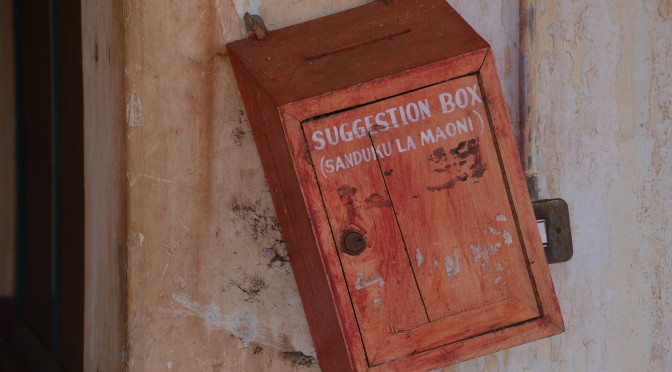
    And the best (or is that worst) symbol of fake empowerment is the suggestion box. Many workplaces have one hanging on a wall somewhere. You can stick in your idea, but then what? Who (if anyone) will read it? Will it ever be acted upon? If not, why not? If it is, who will take credit?

    It’s time to kill off the suggestions box and the coolest way I’ve seen to do this comes from marketing agency Quirk based in Cape Town, Johannesburg and the UK.

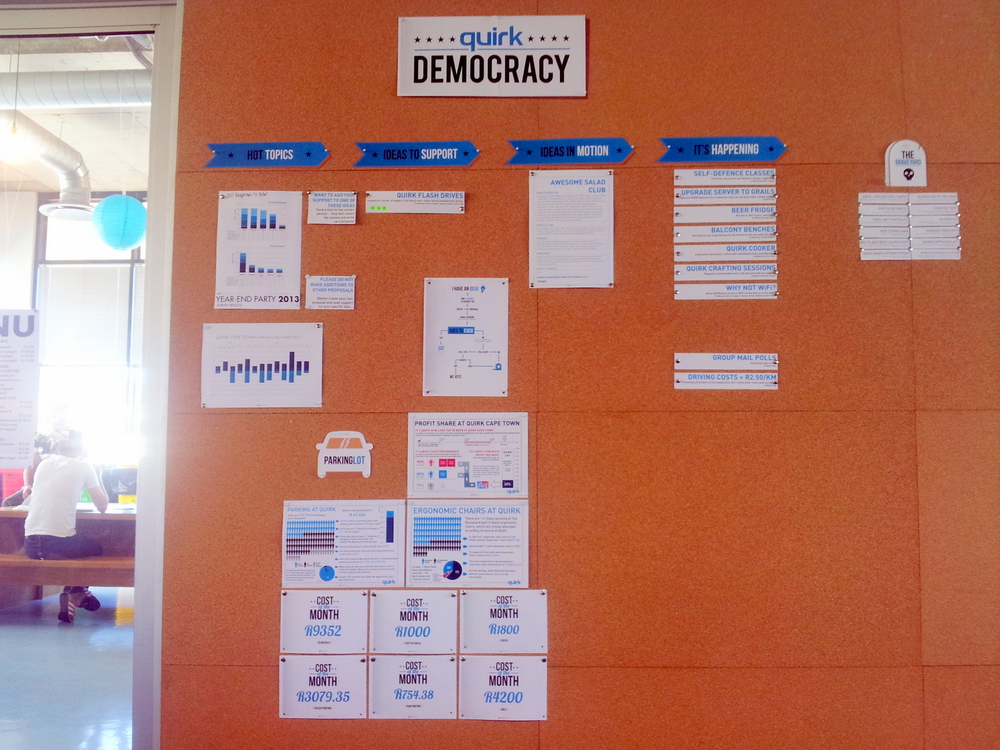
    They have created a process that let’s anyone in the company suggest ideas, gather support for them and then have them implemented (or not). When I visited their Cape Town HQ I had a chance to see it for myself, and I think every workplace who wants to give their employees a voice should do something similar.

    This flowchart shows how it works:
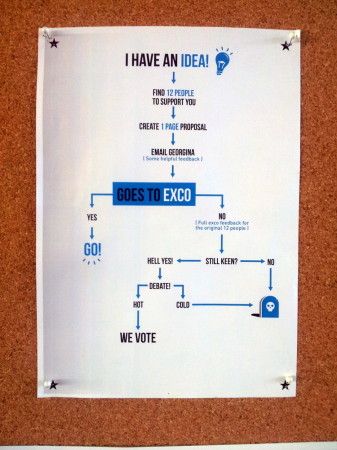
    Flow Chart

    The first step is to post your idea to a board that hangs in a prominent spot in the office and get 12 of your coworkers to also sign on. If you like an idea, you show your support in a very low-tech way: you put a sticker on it.
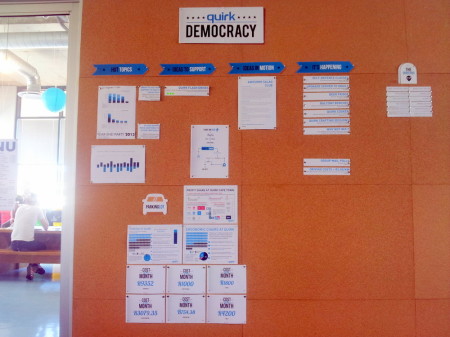
    Overall Board

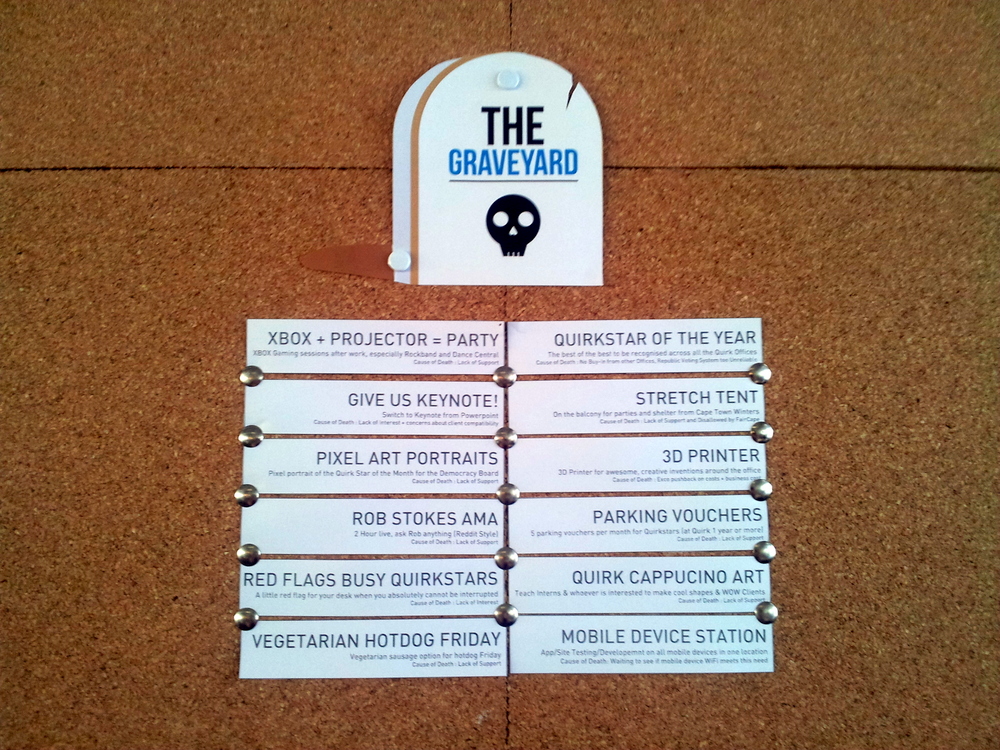
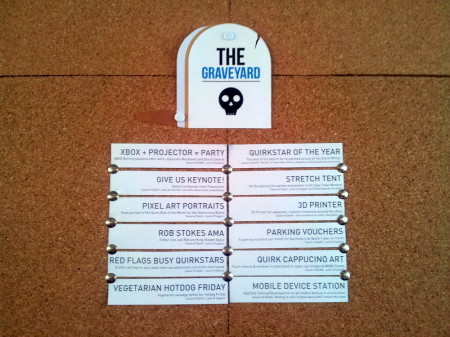
    Some ideas die at this stage – there’s just not enough energy or support behind the proposal. All ideas that don’t make it for one reason or another are displayed in The Graveyard:
    Grave Yard

    Here you can see each idea that failed and why.

    If an idea does get the necessary support, the person behind it writes a one-page proposal which is then submitted to Quirk’s EXCO, which is basically their top leadership team.

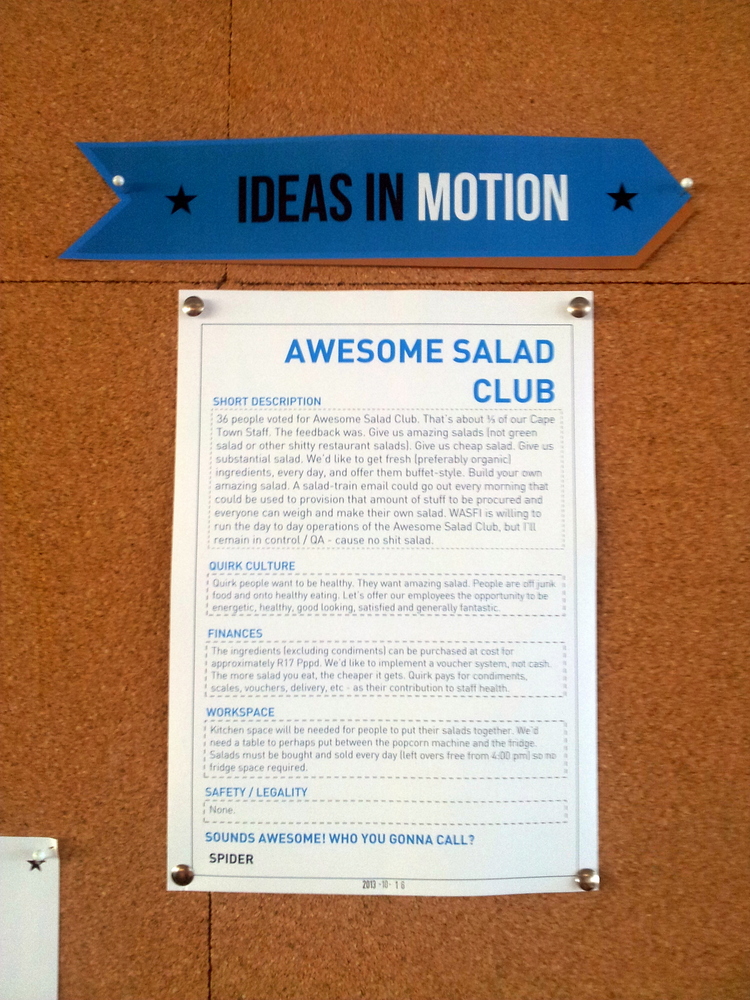
    If they approve it, the idea goes ahead immediately and is placed on the “Ideas in motion” section of the board:
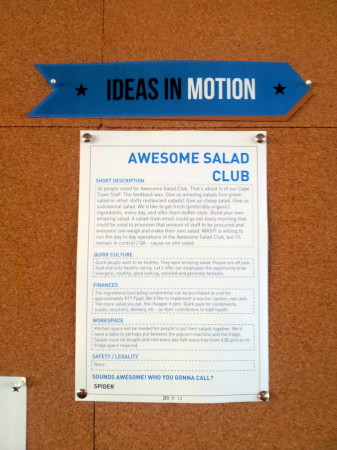
    Ideas In Motion

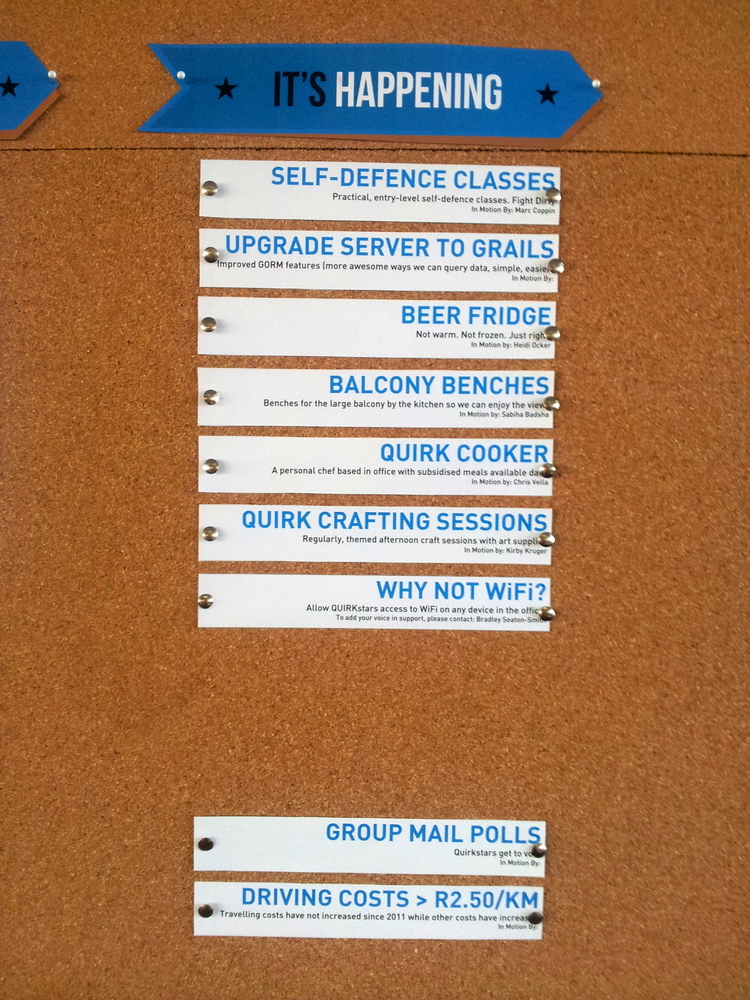
    Ideas that were previously approved are shown on the “It’s happening” section.
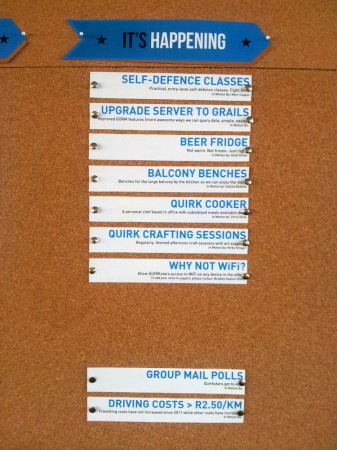
    It's Happening!

    Of course, the leadership group can turn the idea down, and if they do, they must carefully explain why they don’t think it’s a good idea. They can’t just say “No” or “Maybe later.”

    But as you can see from the flow chart above, even if the leadership group turns an idea down, that need not be the end of it. If a person feels that this idea is still to good to ignore, it can be put to a debate and subsequent vote inside the company. If the idea is voted through, this overrides the EXCO’s decision and the idea goes ahead anyway.

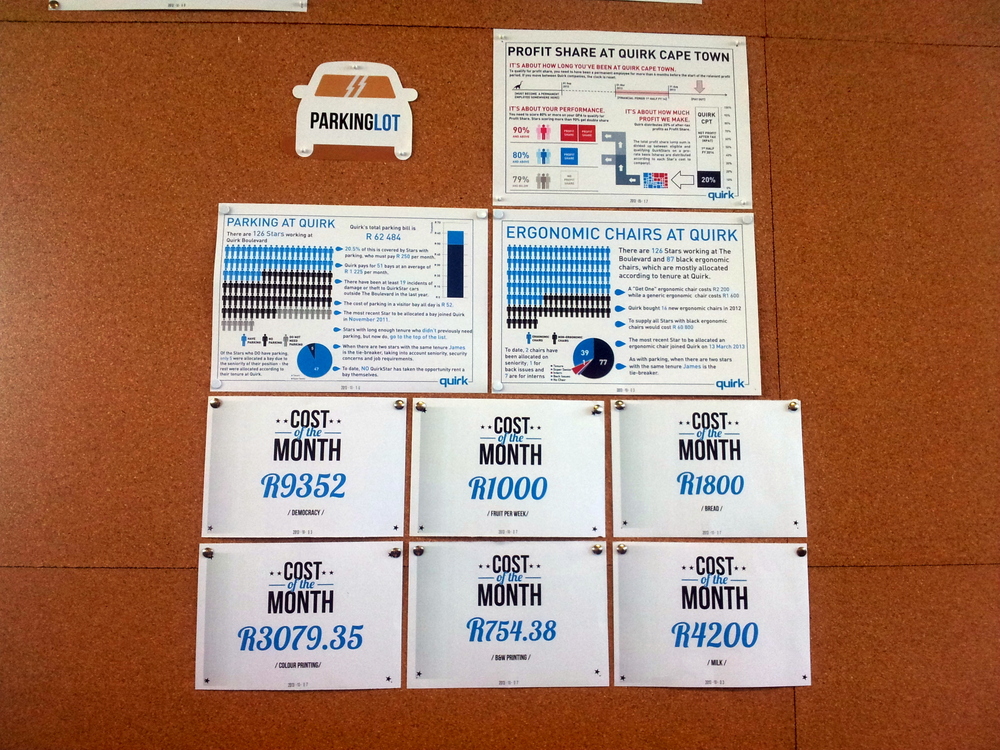
    Another thing they do on the board is highlight the costs of previous ideas, so employees know how much things end up costing.

    Parking Lot

    I think this process is absolutely brilliant for 5 reasons:

    1: It’s visual
    It’s not just a bunch of documents or lines in a spreadsheet – this is highly visual which gives you a great overview. It’s also well-designed and looks pretty, which probably helps a little too.

    2: It’s low-tech
    This could also be done on the intranet or in an app, but I kinda like that it’s on paper and cork board and you vote with stickers. This also makes it very flexible. Also, a page or an app is on demand – that means that people need to be proactive to access their democracy (and apathy is a killer). This board is a sort of dynamic wallpaper – it sits in front of your eyes while you butter your toast in the kitchen – you can be as passive as you like – the democracy comes to you.

    3: It’s fast
    The process is fast. The leadership group have committed to addressing each idea at their next meeting and this means that ideas can get acted on while the energy is still there.

    4: It has memory
    The board is a great record of previous failed ideas (so you don’t have to deal with the same proposals once every 6 months from different people and it also highlights ideas that were implemented, so you can see that this actually works.

    5: It’s transparent
    This takes most of the politics out of these ideas. Getting your idea implemented is not about who you know or how well you can lobby for it, it’s about gaining support for good suggestions.

    There is zero doubt that autonomy and control over our own situation makes us happy. The more we can meaningfully contribute to things we care about at work, the prouder and happier we feel. And that way the company can also better tap into the creativity of its employees and become more efficient.

    So simply put:

    Fake empowerment = frustration and cynicism.

    Real empowerment = trust and happiness.

    Your take

    Does your workplace empower its employees? For real or in a fake way? If you have a really good idea, do you know where to go with it?

    Related posts

    Photo credits: The awesome picture above of the suggestion box is from a train station in Moshi, Tanzania and was originally shown here. All other photos are courtesy of Quirk.

  • Company to employees: Got an idea for more happiness? Just do it!

    Screen Shot 2014-02-04 at 09.01.56

    Last week when I was in London I met Gaye Andrews who is Head of Customer Service, EMEA at PEER 1 Hosting and very much the woman behind creating a great workplace.

    She shared a cool policy they have: Any employee who has an idea to make work more fun or the office a little more cool that costs less than £100 can just do it and expense the amount.

    As an example, that’s how they got space hoppers.

    I think it’s a cool idea, that can remove layers of bureaucracy and get employees involved in making the workplace better and happier.

    Related posts