Category: Leadership

Leadership is an insanely important discipline. Here you’ll find the thought, tools and tricks of the trade of great leaders.

  • Herb Kelleher: I think people should have fun at work

    I stumbled on this interview with Herb Kelleher, former CEO of Southwest Airlines and it is all kinds of awesome.

    From the interview:

    Well, I think people should have fun at work. It should be an enjoyable part of their life. They should gain psychic satisfaction from it.

    I think most of us enjoy fun, and why not at work as well as at play? And so we’ve always encouraged people to be themselves, not to be robotic, not to be automatons. We don’t expect you to surrender your natural personality when you join Southwest Airlines. We want you to have some fun, we want you to have psychic satisfaction from your job. It’s not just about money, it’s also how you feel about what you’re doing.

    We want people to be recognized, participated, diligent and creative. And you can’t ask people to be someone other than themselves and have that kind of creativity and dedication and participation. So, we liberate people at work.

    Go see the whole thing.

  • Warren Bennis: The most dangerous leadership myth is…

    The most dangerous leadership myth is that leaders are born — that there is a genetic factor to leadership. This myth asserts that people simply either have certain charismatic qualities or not.

    That’s nonsense; in fact, the opposite is true. Leaders are made rather than born.

    – Warren Bennis

  • Why every company should have a CHO (Chief Happiness Officer)

    Why every company should have a CHO (Chief Happiness Officer)

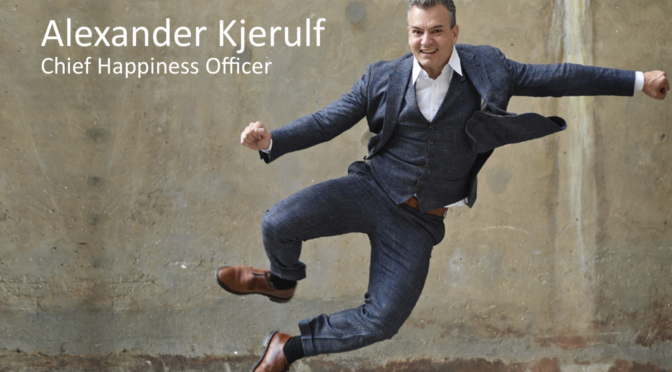
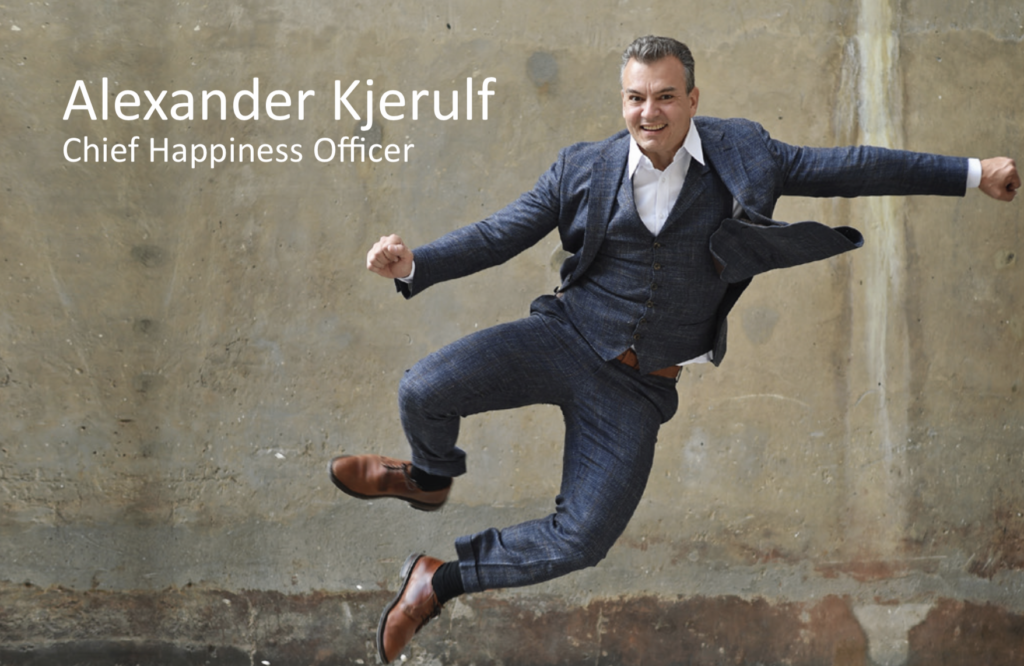
    This is my business card. Does your workplace have a CHO?

    I think every company should have a CHO – a Chief Happiness Officer. Here’s why.

    The CHO title is modelled on all the other CXO titles. The CTO is in charge of technology, the CFO is responsible for the financials, the COO is head of operations, etc. And once you realize that employee happiness may be the most important success factor for a business today, it becomes essential to have a Chief Happiness Officer, someone who is the main driver in making and keeping the workplace happy.

    I see more and more CHOs which is fantastic because this is one of the most important roles in the organization. They may not always be called Chief Happiness Officers – it can be the HR manager, it can be the CEO, it can even be a regular employee. The important things is that it’s a person who sees themselves as responsible for making and keeping the organization happy.

    Why do companies appoint CHOs? For one simple reason: Because they are realizing that happy workplaces make more money.

    Studies show that happy employees are more productive, more innovative, more motivated, more energetic and more optimistic. They are also less sick, stay with the company longer and make the customers more loyal. For those reasons (and many others) happy companies make more money.

    Also, companies are starting to see that there is an ethical dimension to running a workplace, and that a corporate culture that is toxic and stressful will slowly wear employees down and can ruin their careers, their health and their private lives. This is wrong and more and more leaders understand that a workplace should have a net-positive influence on employees’ lives.

    So what does a CHO do? The job is both inspirational and practical. First, this person should (of course) be happy him- or herself. It should be someone who can inspire happiness in others by their nature, and someone who is fun, likable and has a lot of energy. It should also be a person who genuinely cares about the well-being of people in the workplace.

    Secondly, the CHO’s job is to spearhead different initiatives to make people happier in the workplace, like celebrations, trainings, events and similar activities in the workplace that help people do great work and see the purpose of what they do.

    The important thing is that the CHO has the support of top-level management. They may not require a huge budget but if the CEO does not give a crap abut the employees, all the efforts of the CHO will be wasted. Or worse, they may come off as a a cynical attempt to keep people content in a toxic culture.

    Some people hate the very idea of a CHO – they find it creepy and weird. And there are absolutely some pitfalls. The role is not to be a corporate clown or a happiness enforcer, constantly checking if everyone’s happy. That would be horrible.

    But having a great CHO, a person somewhere in the organization who has the skills, the knowledge and the passion to help create a happy workplace and who has the unconditional support of top management makes perfect sense. It will not only make employees happier, it will also most likely make the company money.

    Related

  • 3 Things Your Workplace Can Learn from Parks and Recreation

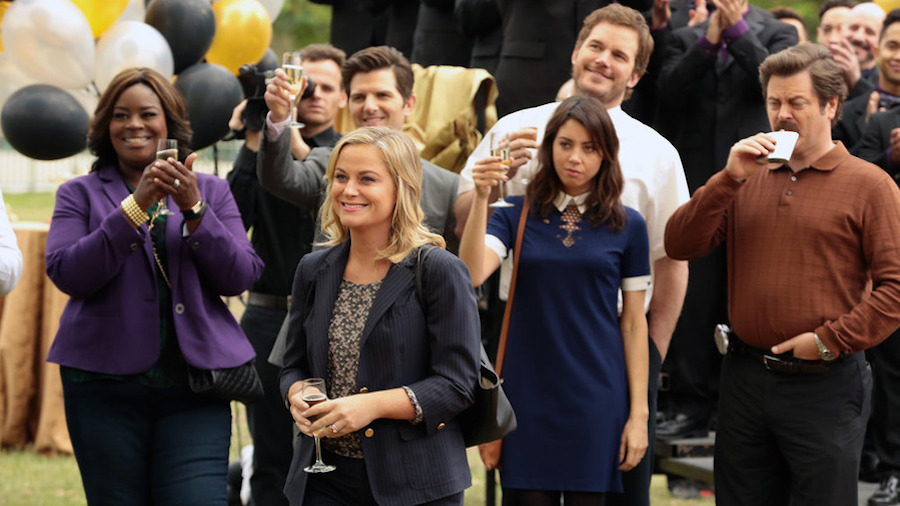
    Parks and Recreation - Season 7

    The TV show Parks and Recreation recently ended and while I was sad to see it go, the final episodes were awesome and very satisfying.

    I have admired the show for a while not just for being very funny and moving but also for how much the cast and crew obviously loved their work.

    Here are 3 lessons any workplace could stand to learn from the cast of Parks and Rec.

    3: Have someone nice at the top

    In this clip Chris Pratt talks about the positive atmosphere they had on the set and how that started with their biggest star (#1 on the call sheet) Amy Poehler.

    2: Give people freedom to screw up

    Here the cast talk about the freedom they have to improvise lines because the set is “a super-safe environment” as Jim O’Heir who plays Garry/Jerry/Larry/Terry on the show puts it.

    I love that – it reminds me of an article I wrote previously about Why You Should Celebrate Mistakes at Work.

    1: Praise each other

    Here are two clips from a late night show where the cast plays a game in which they have to toast each other in 20 seconds.

    Could your team do something like this?

    I think we all know that the world of movies and TV is not necessarily very happy. Just for contrast, here’s a list of movie co-stars who hated each other’s guts.

    So to see a group of people who clearly love each other  working together to create something amazing is all the more encouraging and I think there are some lessons here for workplaces all around the world.

  • The CEO who made pancakes

    From the workshop

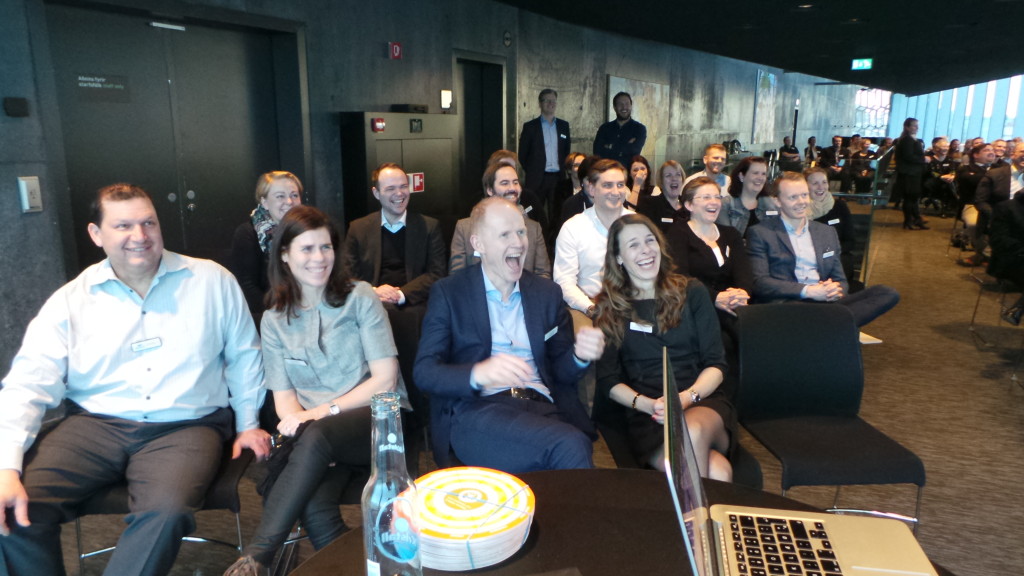
    A few weeks ago I did a workshop for a pharmaceutical company in Iceland called Medis as part of their 30 year anniversary and strategy kick-off. As you can see, they kinda liked it :) The guy in the front row in the blue suit is their CEO Valur Ragnarsson.

    Now, as we all know a workshop itself changes nothing so we always work with our clients to come up with a plan that will actually make a difference in the workplace. As part of that plan, I challenged Valur to come up with something he could do that would be fun, easy and visible – just to show people that he is committed to creating a happy workplace.

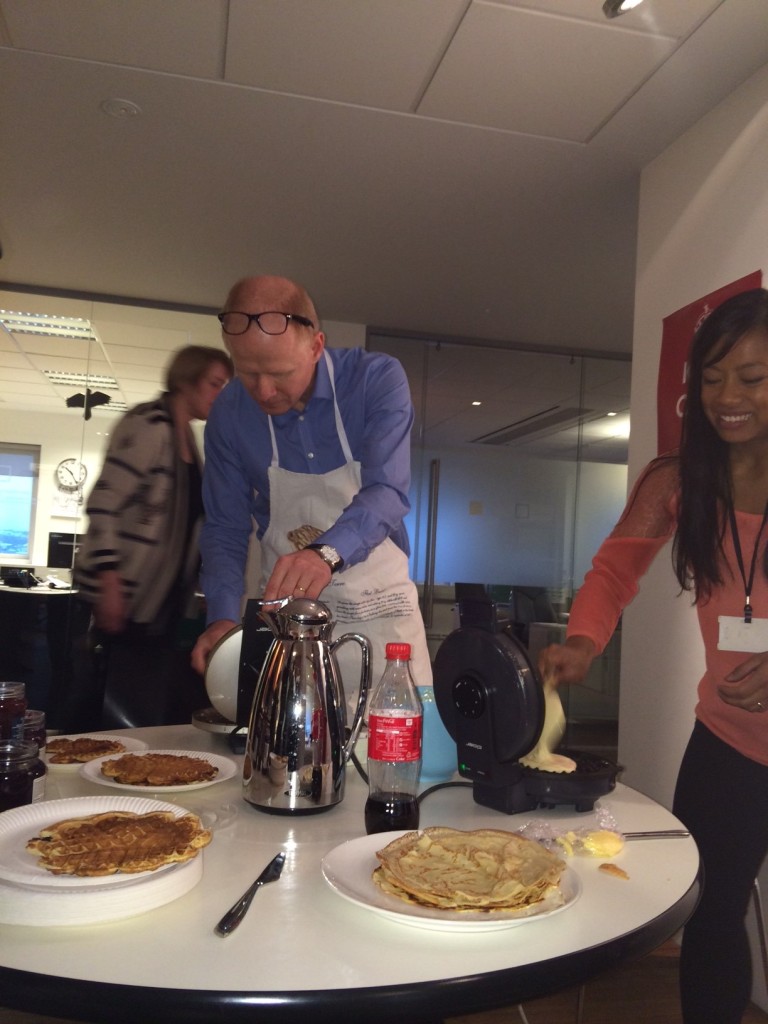
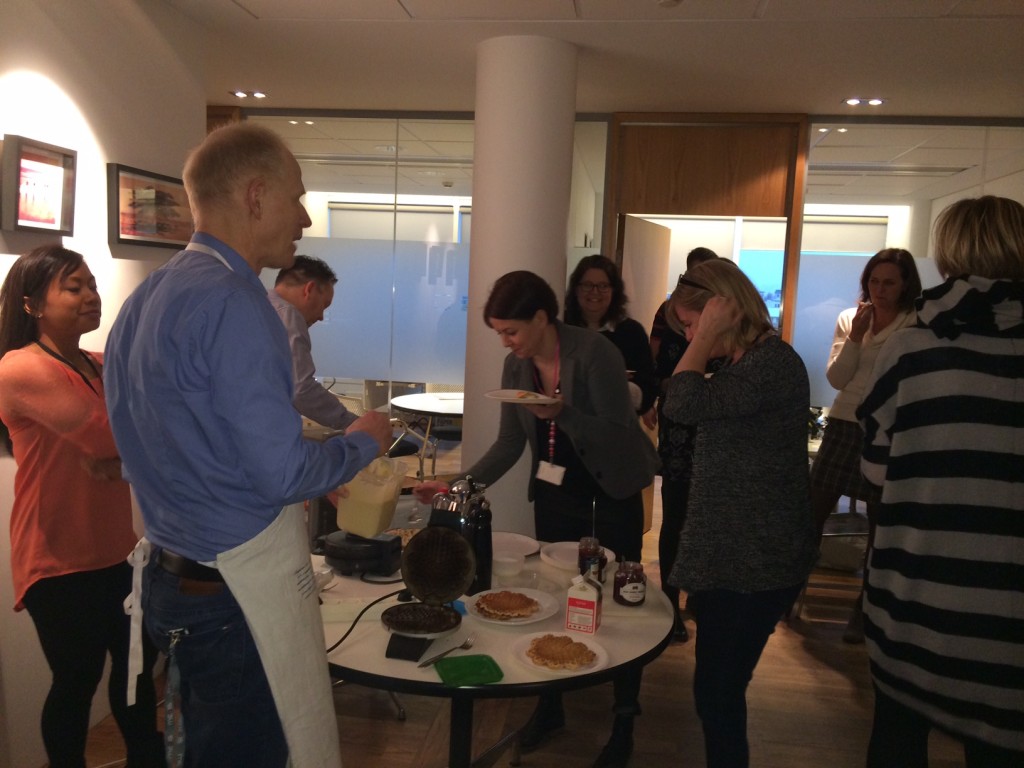
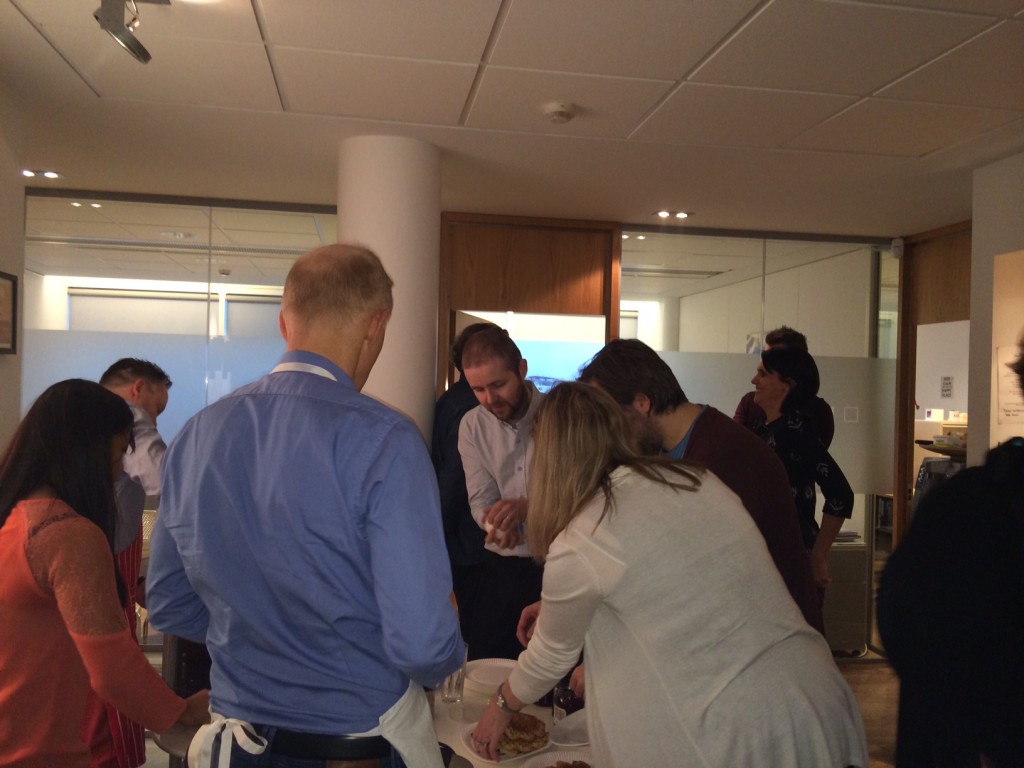
    And a few days later he sent me these pics where he’s making fresh waffles and pancakes for his employees:

    medis 1

    medis 3medis 2What an awesome idea :)

    I asked Valur how he liked the experience and here’s what he said:

    I thoroughly enjoyed it – the biggest joy I actually got out of observing the reaction of the colleagues !

    FYI we did not announce anything but simply showed up in the corridor without notice and took people pleasantly bysurprise….. now it will boil down to a plan and team supporting this (which we have in place already btw).

    The only problem was that the smoke alarm kept going off, so they had to temporarily disable it :)

    medis 4

    Well done, Valur!

    Just to be clear: We’re not saying that you can turn an unhappy workplace into a happy one, by having the CEO make pancakes :)

    What we’re saying is that upper management can support the process of creating a happy workplace by doing something fun and unexpected that shows employees that they are committed to the goal and willing to go a little bit outside of their comfort zone.

  • Free webinar: How to stay happy when things get busy

    Free webinar: How to stay happy when things get busy

    Get the slides right here.

    Are people in your workplace busy? Dumb question, right – everyone is these days.

    Here are the results of one US study from 2005:

    • 26% of employees were overworked often or very often in the last month
    • 27% were overwhelmed by how much work they had to do often or very often in the last month
    • 29% often or very often didn’t have time to step back and process or reflect on the work they were doing during the last month

    And this was 10 years ago – indications are that it’s only gotten worse since.

    This constant busyness is not only making us unhappy and stressed at work, it’s also hurting performance and keeping us form doing our best possible work.

    Join our next free webinar to learn what we can do about it. Topics include:

    • The negative effects of constant busyness on our happiness at work.
    • Why overwork is not the answer and in fact usually makes things worse.
    • Why we need time for reflection and learning at work.
    • How some people end up convincing themselves they’re busy when really they’re not.
    • How to create a workplace where people are happy even when they’re busy.

    Date and time: Wednesday March 4th at noon US East coast time / 9am pacific time / 5pm GMT / 6pm Central European time.


  • Celebrate those who help others

    I’ve previously mentioned New York-based company Next Jump and the great culture they’ve created. One of their practices that really inspires me is that their most important and prestigious employee award is not given based on performance but based on who helps others the most.

    In the video above you can see their 2014 ceremony – it is both brilliant and moving.

  • High CEO pay

    High CEO pay does not attract good leaders, it attracts expensive leaders. Not the same thing at all.

  • Webinar + slides: Leading With Happiness

    I just completed our latest webinar – this one is called Leading With Happiness – and  the video is live and available right here:

    It’s 30 minutes long. If you want my slides, get’em right here.

    We believe that there is a new style of leadership emerging – one that focuses more on doing what’s good for employees and customers than on short-term profits. A form of leadership, in short, that has happiness at its core.

    Topics:

    • What does happy leadership look like? How do you do it in practice?
    • How can managers themselves stay happy in their careers?
    • What are great examples of happy leaders?
    • Could it be that happy leaders ultimately create better results than traditional leaders?

    I mentioned Southwest Airlines as a great example of a workplace that practices this. Here’s a video where their former President Colleen Barrett explains their thinking:

    Our previous webinar was called “What REALLY makes us happy at work.” You can see it right here.

  • Some thoughts on why “empty labor” makes us miserable

    The Atlantic has an absolutely fascinating article that reveals how little work actually goes on at work.

    From the article:

    …the proportion of people who say they never work hard has long been far greater than those who say they always do. The articles and books about the stressed-out fraction of humanity can be counted in the thousands, but why has so little been written about this opposite extreme?

    And this:

    I talked with over 40 people who spent half of their working hours on private activities—a phenomenon I call “empty labor.” I wanted to know how they did it, and I wanted to know why. “Why” turned out to be the easy part: For most people, work simply sucks. We hate Mondays and we long for Fridays—it’s not a coincidence that evidence points towards a peak in cardiac mortality on Monday mornings.

    Read the whole thing – it’s great!

    Similarly, two Swiss consultants have defined the term boreout. They posit that you get burnout from having too much to do and boreout from a lack of meaningful tasks at work.

    If you’ve ever seen the movie Office Space, this is one of the things they get exactly right in this dialog between lay-off consultant Bob and IT employee Peter:

    Bob Slydell: You see, what we’re actually trying to do here is, we’re trying to get a feel for how people spend their day at work… so, if you would, would you walk us through a typical day, for you?
    Peter Gibbons: Well, I generally come in at least fifteen minutes late, ah, I use the side door – that way Lumbergh can’t see me, heh heh – and, uh, after that I just sorta space out for about an hour.
    Bob Porter: Da-uh? Space out?
    Peter Gibbons: Yeah, I just stare at my desk; but it looks like I’m working. I do that for probably another hour after lunch, too. I’d say in a given week I probably only do about fifteen minutes of real, actual, work.

    My sense is that this goes on in a lot of big workplaces, where there can be any number of tasks that don’t serve any meaningful purpose. Much effort instead goes into things like:

    • endless meetings
    • enforcing bureaucracy and red tape
    • writing and reading memos
    • internal politicking and backstabbing
    • activities intended only to CYA (Cover Your Ass).

    For me, this is a tragedy because above all else, what we crave at work is meaningful results, i.e. knowing that we make a difference at something that matters. Having to pretend that you’re contributing while knowing that your job is essentially meaningless is a recipe for stress.

    What we need to do instead is eliminate all work that is not meaningful and then work hard to make sure that each and every person in the organization:

    1. Are good at their jobs (i.e. what they do)
    2. Know that what they do is important (i.e. why they do it)

    This is a recipe for not only greater happiness at work but also for more energy, motivation and engagement.