In 1988 she became the leader of a troubled nursing home in Copenhagen called Lotte.
She had no budget to change things but with lots of heart, a deep commitment to helping others and a healthy dose of common sense, she turned it into one of the happiest workplaces in Denmark.
In this funny and moving speech, she shares how she created a nursing home where the staff loved to work and where the residents were healthier, happier and lived twice as long as in other nursing homes in Denmark.
Positive feedback not only feels great – it also makes us more effective.
Yet another study (this one from Harvard Business School) confirms what we all know: Receiving positive feedback makes us happier at work, less stressed and more productive. From the study:
In the study, participants… were asked to solve problems. Just before that, approximately half of the participants received an email from a coworker or friend that described a time when the participant was at his or her best.
Overwhelmingly, those who read positive statements about their past actions were more creative in their approach, more successful at problem-solving and less stressed out than their counterparts.
For instance, participants had three minutes to complete Duncker’s candle problem. Fifty-one percent who had read emails prior to the task were able to successfully complete it; only 19% of those who did not receive “best-self activation” emails were able to solve it.
Those who received praise were also significantly less stressed than the control group.
The broaden-and-build theory of positive emotions suggests that positive emotions broaden one’s awareness and encourage novel, varied, and exploratory thoughts and actions. Over time, this broadened behavioral repertoire builds skills and resources.
Essentially we now know that when you experience positive emotions, your mind functions in a broader and more open way. This is also confirmed by the research performed by Teresa Amabile who found that:
If people are in a good mood on a given day, they’re more likely to have creative ideas that day, as well as the next day, even if we take into account their mood that next day.
There seems to be a cognitive process that gets set up when people are feeling good that leads to more flexible, fluent, and original thinking, and there’s actually a carryover, an incubation effect, to the next day.
This is crucial. It shows that being happy is not just about feeling good – it has a large measurable effect on our work performance in many different way. Creative thinking is just one – happy people are also more productive, more resilient, more empathetic and make better decisions – just to mention a few effects.
Praise is rare in the workplace
Giving positive feedback is an interesting way to create more happiness at work for two reasons: It’s incredibly effective (as the Harvard study showed) but it’s also sorely lacking from most workplaces.
Lack of praise or recognition for the work I do (37%)
Not only is a lack of praise and recognition a major cause of unhappiness at work, the top two might even be lessened if people felt more appreciated
Why praise matters: Results AND Relationships
Our model of what makes us happy at work says that it comes from two main factors: Results and Relationships. Or to put it another way doing great work together with great people. Here’s a video on that.
We’ve always said that praise at work is important because it shows people that they do good work, make a difference and get results. This gives us a feeling of pride that makes us very happy at work. Praise also motivates us for future tasks.
But lately we’ve realized that there is more to positive feedback: It’s also about strengthening relationships in the workplace. When you praise someone else, it shows that you actually pay attention to them and are able to see their good work and positive qualities.
One of our most fundamental psychological needs is the need for others to see and recognize the good in us. Some sociologists argue that how others see us is in fact one of the major factors that shape our identity. And we know that people who are never seen, or only seen for the bad they do, have a much higher risk of developing mental problems over time.
Resistance to praise
We’re not saying it’s easy – far from it. In many workplaces there is no tradition of positive feedback. Many managers in particular have developed a notion that praise is trivial or ineffective – they’re completely wrong, of course. I’ve even heard managers argue that “we shouldn’t praise employees – they’re just doing their jobs.” How incredibly narrow-minded.
Some workplaces even have a strong culture of negative feedback, so that good performance is met with silence but even the slightest mistakes are punished harshly.
Not only does the current absence of praise in the workplace make it harder, it might even mean that praise is initially met with scorn or suspicion. Over time, people will come to realize that the praise is genuine and not just an attempt to butter them up for something else :)
I have always believed that the way you treat your employees is the way they will treat your customers, and that people flourish if they’re praised.
What is good praise
Good praise is:
Genuine – only praise people if you mean it
Meaningful – praise people for something worth praising
Specific – tell them what was good
It’s also worth remembering that we can praise others for what they do (their work or their results) but we can also praise others for who they are, i.e. the personal qualities we see in them.
So get praisin’. Positive feedback takes no time and costs no money and is one of the most effective ways to make a workplace happier and, apparently, more productive.
And anyone can praise anyone else. Of course bosses should praise employees, but employees can also praise each other, praise the boss or even praise customers. Why not?
We can all start with ourselves. Could you become the kind of person who is really good at seeing the good in others and telling them about it? This is a great thing to do, not just at work but also in your family, with your friends or even with random strangers on the street.
When you praise others, you don’t have to make a big production out of it. You can simply go up to someone and quietly and give them positive feedback. You can send the praise in an email, you can write it on a post-it note and stick it on their desk, you can praise people in meetings in front of their coworkers or in a million other ways.
Here are 5 specific suggestions for how to praise others at work:
We would suggest making it a daily challenge to give at least one other person at work positive feedback of some kind. This can help develop a habit around it and get to the point where it’s something you do naturally.
And if all else fails, there’s always the self-praise machine :)
Your take
Does your workplace have a culture of positive feedback? Are you good at praising others? What’s a time that you praised someone else at work, where you could see it meant something to them? What does it do to you, when others appreciate you at work? Write a comment, we’d love to hear your take.
The Academy is our in-depth 3-day training where we share the latest research and practice for creating happier workplaces.
The Academy is both for external consultants who want to build a business making their clients’ workplaces happier and for internal change agents (HR staff, managers, facilitators) who want tools to make their own organization happy.
Participants LOVED the previous trainings. Here’s a sample comment:
The Woohoo Academy was, without a doubt, the best training I have ever experienced (and I’ve participated in many trainings).
It was very well organized, and provided the latest research, practical strategies and opportunities to engage in many meaningful experiential activities.
So why are bad bosses bad? Partly, there’s a sense that the boss is not there for employees work-wise, is always too busy with his own tasks to help them or simply has no insight or no interest in the work they do.
40% of respondents in our survey mentioned “A lack of help and support from my boss” as one cause of their most recent bad work day. 37% mention “Uncertainty about the workplace’s vision and strategy.”
One person wrote:
I love my actual job. It is rarely job specific tasks that make my days go bad. It is almost always frustration about having to work through hierarchy despite that fact that my boss is recognized as ineffective throughout the organization. (just writing that made my day better!)
Another wrote:
“My boss suddenly started to instruct me on things that I’ve done for 15 years. Very annoying.”
When you lack support from the boss, it becomes unreasonably hard to do your job well and get good results. And getting great results that you can be proud of is a major source of happiness at work.
… But it’s also about relationships
35% of respondents name bad behavior from bosses as one cause of unhappiness at work. One person wrote:
“My boss contributes to the bulk of the cause of everything else that is bad at work. We have a new director, and my job has not changed. Just bosses changed. I used to love my job. Now I hate it.”
Good workplace relationships and social support are crucial for our happiness at work and studies show that the most important workplace relationship is with the immediate manager.
When employees have a good relationship with the boss, they are much more likely to be happy at work. When they know that the boss sees them, respects them, trusts them and appreciates them personally and professionally.
On the other hand, when bosses show that they don’t care about their people, e.g. by being rude, disrespectful or simply by ignoring them, it is a clear sign of bad relationships and this makes employees miserable.
Crucially, this bad behavior can come from both the immediate manager or from executives higher up on the org chart. One respondent wrote:
“I love my new boss, but the c-suite is clueless and mean.”
Another wrote:
“My VP is an HR nightmare. He constantly makes derogatory remarks about employees behind closed doors during meetings that I’m forced to attend.”
So it’s not enough to have a good team managers, the whole company must have a good leadership culture and top executives who are highly visible inside the organization must be good leaders.
Dire consequences
The negative effects of bad bosses are profound.
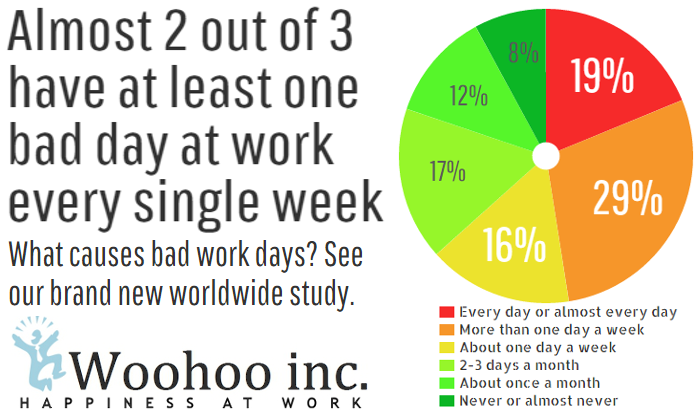
Our study showed that 2 out of 3 employees had at least 1 bad work day every week. 19% say they have a bad day at work “every day or almost every day.” When the bad work days become too many, they can really harm people at work and at home. And as mentioned, the #1 factor that makes bad work days bad is the boss.
Respondents wrote:
“This is the first position I have ever held where I actually hate my job. I never understood people who say ‘I hate my job!’ or who constantly complain about their work lives until this last year. Now I know what those people are talking about.”
“I don’t sleep well at night, when I have a bad day at work because the anticipation and anxiety of the next day is always on my mind.”
Bad bosses are bad. Thank you, Captain Obvious. So what do we do about them?
Given that bad bosses are the most common cause of unhappiness at work and given the negative effects they have on employees and on the company’s results, we clearly need to do something about this problem.
Here are our top 5 suggestions.
1: Realize that good leadership is about happiness
On an organizational level, we can recognize that good management skills are not an inherent trait in most people. It’s something we can look for when we select people for management positions, and something we must systematically train bosses to do well.
The best way to do that, is to realize that the best leaders have excellent relationship-building skills. They are excellent at understanding and relating to many different kinds of people – bad bosses relate only to people who are like themselves.
And crucially, we need to stop bad managers. Every workplace has them; bosses who should not be bosses because they lack the professional or personal skills to manage well. If bad bosses can not learn to be good bosses, they need to stop being bosses altogether.
On an individual level, each of us can learn to recognize bad management when we see it and realize exactly just how badly it affects us professionally and personally. And if you find yourself working for a bad manager with no desire or skill to improve their ways, the best (or even the only) solution may be to quit and go work somewhere else.
On November 26+27 I will hold an in-depth two-day workshop about happiness at work in Prague. We don’t do a lot of these longer trainings, so this is a rare chance to get the complete scoop on how to create happy workplaces.
Yet another study confirms what we all know: Giving employees positive feedback leads to more happiness at work, less stress and better performance:
In the study, participants… were asked to solve problems. Approximately half of the participants were told to ask friends and family members to send them an email just prior to their participation that described a time when the participant was at his or her best.
Overwhelmingly, those who read positive statements about their past actions were more creative in their approach, more successful at problem-solving and less stressed out than their counterparts.
For instance, participants had three minutes to complete Duncker’s candle problem. Fifty-one percent who had read emails prior to the task were able to successfully complete it; only 19% of those who did not receive “best-self activation” emails were able to solve it.
Those who received praise were also significantly less stressed than the control group.
So get praisin’. Positive feedback takes no time and costs no money. It does require you to actually pay attention to other people and be able to see their good work and positive qualities. But if we can’t even do that, there is something more fundamentally wrong.
Earlier this year I spoke at the WorldBlu Freedom at Work Summit in Miami. I’ve been to every single one of their events and they are the best and most inspiring business conferences I’ve ever been to.
I talked about being a rebel and saying no at work – because there is no freedom without the freedom to say no.
Now they’ve just released videos of several of the talks from this year’s event. They are all AWESOME – seriously, just go watch them all – but here are my 5 favorites.
Rich Sheridan on how to hire democratically:
Carrie Brandes on how to set bonuses democratically:
Garry Ridge, the CEO WD-40 gave this excellent talk:
Our good friend Steve Shapiro did actual magic on stage:
And of course the founder of WorldBlu, Traci Fenton, talked about freedom at work:
The Chief Happiness Officer Academy is our most in-depth 3-day training where we share everything we know about creating happier workplaces. You get a comprehensive understanding of the latest research, tons of effective practical tools and learn how to use them in your own business.




 I’m on BBC Radio 4 today advocating for open salaries –
  Our brand new