The top 5 new rules of productivity

We all want to increase productivity and get more done with our working hours.
There’s just one problem: Most people’s view of productivity comes from an industrial age view of work. This leads to some fundamental misconceptions about work, including some of these:
- If you work more hours, you get more work done.
- Adding more people to a team means you can finish sooner.
- Productivity is more or less constant and can be easily scheduled.
For knowledge workers, i.e. anyone who works with information rather than physically producing stuff, these notions are not only wrong, they’re actively harmful.
So here is my suggestion for 5 new rules of productivity for knowledge workers.
1: Your productivity will vary wildly from day to day. This is normal.
In an industrial setting, production and output can be planned in advance barring accidents or equipment failure. Basically you know that if the plant operates for X hours tomorrow you’ll produce Y widgets.
For knowledge workers, you can’t possibly know in advance whether tomorrow will be a day where you:
- Reach a brilliant insight that saves you and your team weeks of work.
- Work tirelessly and productively for 12 hours.
Or the day where you:
- Spend 8 hours gazing dejectedly into your screen.
- Introduce a mistake that will take days to find and fix.
This variation is normal – if a little frustrating. It also means that you shouldn’t judge your productivity by the output on any given day but rather by your average productivity over many days.
I have never seen this more clearly than when I was writing my first book. Some days I’d sit myself down in front of my laptop and find myself unable to string two words together. Some mornings I banged out most of a chapter in a few hours. Writing is a creative process. I can do it when I’m in the mood. Trying to write when I’m not, is a frustrating exercise in futility. On the days where I couldn’t write, I’d go do something else. Probably wakeboarding :o)
The result: I wrote the book in record time (a couple of months all told), the book turned out really well AND I enjoyed the writing process immensely.
Three things you can do about this:
- Don’t make project plans based only on your maximum productivity days. Not every day will be like that. Base your schedules on your average productivity.
- Don’t beat yourself up on the low-productivity days. It’s normal, it’s part of the flow and these days have value too. I like to think that on these days, my subconscious mind is working on some really hairy complicated problem for which the solution will suddenly appear fully formed in my mind.
- If you do have a day where you get very little done, why not go home early and relax or get some private chores done?
2: Working more hours means getting less done
Whenever we fall behind, it’s tempting to start working overtime to catch up. Don’t! Instead, commit this graph to memory:
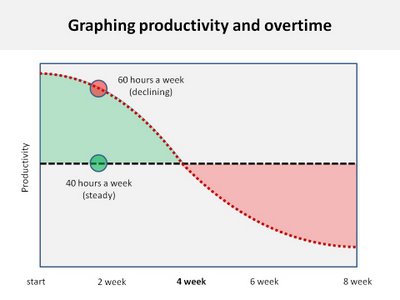
It comes from this excellent presentation on productivity. Read it!
Here’s another data point:
In 1991, a client asked me to conduct a study on the effects of work hours on productivity and errors…
My findings were quite simply that mistakes and errors rose by about 10% after an eight-hour day and 28% after a 10-hour day…
I also found that productivity decreased by half after the eighth hour of work. In other words, half of all overtime costs were wasted since it was taking twice as long to complete projects. After the study was done, a concerted effort was made to increase staffing.
(Source)
This may be counter-intuitive but it’s important to grasp: For knowledge workers there is no simple relationship between hours worked and output!
Three things you can do about this:
- Don’t work overtime. In fact, some studies indicate that knowledge workers are the most productive when they work 35 hours a week.
- Take breaks during the work day and make sure to take vacations.
- Experiment to find out what schedule works best for you. Five eight-hour days? Four longer days and a long weekend?
3: Working harder means getting less done
In an industrial environment, you can most often work harder and get more done. An increase in effort means an increase in productivity.
For knowledge workers, the opposite is true. You can’t force creativity, eloquence, good writing, clear thinking or fast learning – in fact, working harder tends to create the opposite effect and you achieve much less.
Three things you can do about this:
- Take the pressure off yourself and your team. Even if you make a mistake or don’t make a deadline the world probably isn’t going to end. Less pressure means higher productivity.
- Schedule a work load equivalent to only 80% of your work week. Trust me, you won’t be wasting your remaining 20% – but you will be more relaxed and more creative.
- In the words of Fred Gratzon: “If it feels like work, you’re doing it wrong”. If you find that most of what you do is a struggle, this is a sure sign that you are not at your most creative and productive.
4: Procrastination can be good for you
In an industrial setting, any time away from the production line is unproductive time – therefore all procrastination is bad. Search for procrastination on google and you’ll find a massive number of articles on how to stop procrastinating and get stuff done.
They will tell you that there is only one reliable way to get stuff done:
- Check todo-list for next item
- Complete item no matter what it is
- Go to step 1
They’ll tell you that if only you had enough willpower, backbone, self-control and discipline, this is how you would work too.
Well guess what: Knowledge workers don’t work that way. Sometimes you’re in the mood for task X and doing X is ridiculously easy and a lot of fun. Sometimes doing X feels worse than walking barefoot over burning-hot, acid-covered, broken glass and forcing yourself to do it anyway is a frustrating exercise in futility.
Sometimes procrastinating is exactly the right thing to do at a particular moment. This is largely ignored by the procrastination-is-a-sign-of-weakness, the-devil-finds-work-for-idle-hands crowd.
Three things you can do about this:
- Procrastinate without guilt. Do not beat yourself up for procrastinating. Everybody does it once in a while. It doesn’t make you a lazy bastard or a bad person. If you leave a task for later, but spend all your time obsessing about the task you’re not doing, it does nothing good for you.
- Take responsibility, so that when you choose to procrastinate, you make sure to update your deadlines and commitments. Let people know, that your project will not be finished on time and give them a new deadline.
- Remember that “Time you enjoy wasting is not wasted” (according to John Lennon).
5: Happiness is the ultimate productivity enhancer
The single most efficient way to increase your productivity is to be happy at work. No system, tool or methodology in the world can beat the productivity boost you get from really, really enjoying your work.
I’m not knocking all the traditional productivity advice out there – it’s not that it’s bad or deficient. It’s just that when you apply it in a job that basically doesn’t make you happy, you’re trying to fix something at a surface level when the problem goes much deeper.
Three things you can do about this:
- Get happy in the job you have. There are many things you can do to improve your work situation – provided you choose to do something, rather than wait for someone else to come along and do it for you.
- Remember to appreciate what is already good about your job. Often we forget, and overfocus on all the annoyances, problems and jerks. This is a natural tendency called negativity bias, but it also tends to keep us unhappy because we forget what works.
- If all else fails, find a new job where you can be happy. If your current job is not fixable, don’t wait – move on now!
The upshot
The industrial age view of productivity has serious limitations when applied to knowledge workers – but it remains the dominant view and still informs much of our thinking and many of our choices at work. Let’s change this!
This is not without it’s challenges. The old view of productivity may no longer apply, but it does give managers an illusion of control and predictability. The new rules are… messy. Less predictable. They rely less on charts and graphs – and more on how people feel on any given day.
It ultimately comes down to this: Do we want to stick with a model that is comforting and predictable but wrong or are we ready to face what REALLY works?
Your take
What about you? When are you the most productive? What is your optimal number of working hours per week? What stimulates or destroys your productivity? Please write a comment, I’d love to know your take.
Related posts


Jon Kjær Nielsen Said,
February 17, 2010 @ 1:00 pm
Another great post with key insights.
I’ve found that when I do great work, I often don’t do much for most of the time, in the traditional sense. But the ideas churn away at the back of my head, I talk with other people about them, and I gather input. Then, just before the deadline, I finish the work in no time.
For a long time, I used to feel guilty, or beat myself up over not getting things done “in good time” or for not “working effectively like everyone else”. Now, I feel pretty good about letting things hang, knowing that I will eventually finish the work, and (just) in time.
Also, I’ve notised, that ideas improve over time, with the big insights only coming at the end. If I finished work early, the quality could therefore not be the same.
I have, however, found one critical requirement for me: There has to be some kind of urgency. A deadline of sorts, and not just a decided lets-do-it-by-friday one, but a real one. Like doing workshop, speaking at a conference, or presenting something to a client. Things that influence other people, and would get me in trouble if I didn’t do them. I’ve now startet actively introducing deadlines like these on the tasks I like to get done, and it can do magic!
Karl Staib - Work Happy Now Said,
February 17, 2010 @ 1:57 pm
Very well put together. We have to stop being a big bully to ourselves and appreciate our natural rhythms. If we don’t feel like doing the work then we need to stop doing it and come back when motivation is higher.
It’s funny how one day I can be very productive – writing a few blog posts, talking to clients, and networking on social media then the next I’m flopping around like a fish our of water. I’ve been working on being ok with this. I have to admit it’s tough. I want every day to be amazing. To be ok with this state of productivity I slow down and just breathe. I let me feelings come and go without too much judgement.
Excellent article Alex!
Dan (Leadership Freak) Said,
February 17, 2010 @ 2:36 pm
Alex,
I agree with Jon on the importance of urgency. I’ve enjoyed Kotter’s book “Urgency.” It explains both good and bad urgency. Deadlines help me. Did your research include deadlines?
Here’s another thought. Positions that require innovation or creativity include hopelessness. I think we’ll be more productive if we embrace rather than resist feelings that we can’t/won’t find the answer. http://leadershipfreak.wordpress.com/2010/02/04/just-before-innovation/
Your research opens my eyes.
Regards,
Leadership Freak
Dan Rockwell
Henry Stewart Said,
February 17, 2010 @ 2:51 pm
Great article, Alex. I’ve long belived that working long hours is futile and counter-productive but its great to have some stats to back it up.
Jake Said,
February 17, 2010 @ 3:17 pm
Must be nice to have the luxury of free time to make this happen.
And now, back to work. See ya.
Greg Said,
February 17, 2010 @ 7:24 pm
Sorry, I don’t buy most of this. It sounds like motivational speaking rather than behavioral science. Maybe it’ll make people happier, but I doubt it’ll help them get more work done.
Sure, it’s important to keep in mind that productivity goes down if you’re working a lot. But productivity does not equal the total amount of work done; rather, it’s the rate of getting things done. So I’ll still get more done, on average, in a 12 hour day than an 8 hour day.
Also, the plural of anecdote is not data. While your experience writing your book is interesting (taking time off when it wasn’t coming to you), it seems to contradict the habits of most writers, who focus on maintaining a spending a certain amount of time writing every day. Neither of these is data, but I’m not convinced.
Curated Stories Feb. 17, 2010 Said,
February 17, 2010 @ 11:03 pm
[...] The top 5 new rules of productivity Published: February 16, 2010 Source: The Chief Happiness Officer We all want to increase productivity and get more done with our working hours. There’s just one problem: Most people’s view of productivity comes from an industrial age view of work. This leads to some fun… [...]
Pedro Colaco Said,
February 18, 2010 @ 12:03 am
I don’t buy any of this except for having a bad day and the happiness factor. Happiness and motivation is a biggie in any industry. And everyone has bad days. Just make sure you don’t have two in a row. At the end of the day, even in a post-industrial world it’s only 5% inspiration and 95% transpiration. It’s a competitive World out there, and if you’re not working someone else is. So, if you are in a company that has deadlines and deliverables, shareholders and expectations, you better ensure that the job gets done, on time. So, mambo-jambo about staring at blank screens just doesn’t cut it for me. Bite through, work hard, play hard and I will see you on the other side smiling because you got there. Sorry for the bluntness.
links for 2010-02-17 « memor.ia blog Said,
February 18, 2010 @ 5:01 am
[...] The top 5 new rules of productivity (tags: work job productivity) [...]
Anne Louise Bannon Said,
February 18, 2010 @ 5:33 am
As a knowledge worker who also works from home, who just had one seriously nasty monkey wrench tossed into her perfectly wonderful plan for the day, THANK YOU!!!!
Seriously. My work plan for the day just got thoroughly derailed by some nastiness from outside the office. And I’m up against a deadline. So it’s nice to know that taking the time to deal with my feelings about the nastiness is smarter to do than try to meet the deadline and turn in inferior work.
Anne Louise Bannon
YourFamilyViewer.com
Jose da Silva Said,
February 18, 2010 @ 11:11 am
Hi,
First of all i want to tank you for the post, and for bringing the discussion alive. My comments bellow.
Totally agree with 1, 2 and 5.
About 3, i strongly believe that “it depends” on how the reader interprets the text, if the desired interpretation is, “When you overwork, you will get less work done by hour and less quality in the work performed”, i totally agree.
Procrastination is a little bit more tricky, there are several ways of procrastinate, i believe that there are active and passive procrastination, and passive procrastination is not good for a person productivity.
I totally believe that in a post-industrial era, on a knowledge worker, the number of hours worked is not proportional to the work delivered, and neither should be! That only applies in old days or if you are a factory worker.
The paradigm should change, when you are talking about knowledge workers, knowledge workers are not factory workers, their productivity is highly affected by the following factors:
* Working schedule, the level of productivity will vary from individual to individual depending on time of the day.
* Working environment, a good working environment will be a great stimulus to a more productive individual.
That are my 5 cents.
User Experience, Usability and Design links for February 18th | BlobFisk.com Said,
February 18, 2010 @ 12:01 pm
[...] The top 5 new rules of productivityWe all want to increase productivity and get more done with our working hours. There’s just one problem: Most people’s view of productivity comes from an industrial age view of work. [...]
Are you a procrastinator or an incubator? Said,
February 18, 2010 @ 12:40 pm
[...] The top 5 new rules of productivity [...]
Luís Soares Said,
February 18, 2010 @ 3:45 pm
Excelente article! I really felt identified with it.
The reality is that our motivation depends on the amount of dopamine and other neuro-transmiters present at the moment on the brain, so we cannot force us to have motivation; the solution is indeed to find ways to be happy, to raise the average amounts of those dopamines..
The Connected Lawyer » How to Increase Your Productivity Said,
February 18, 2010 @ 4:02 pm
[...] Happiness Officer recently had an interesting post in which he talks about increasing productivity. He begins by explaining: There’s just one problem: Most people’s view of productivity comes [...]
Joy Said,
February 18, 2010 @ 10:36 pm
I agree, mostly. Deadlines are a must for this kind of employee – otherwise the work may never get done. I’m a perfect example of this as I love to put off tasks that I hate. My solution is to get the crappy stuff done first so I can work on the stuff I love to do. I really believe in work smarter, not harder. I am never impressed when someone in my office, (or previous jobs) is working 12 hour days all the time. (Everyone has to once in a while…) They are either doing this to impress their own boss, because they are not efficient, or there is not enough staff to do the work that needs to be done. If it’s because of staff or efficiency then they’re not doing a good job anyway.
Of course, it all depends on your job. If you’re writing a book that is a lot different than if you’re writing for a newspaper with strict deadlines.
Cassandra Said,
February 19, 2010 @ 12:14 am
I am in total agreement with the majority of what you have to say here.
Being in sales as I am, it’s always about the numbers. Where I am employed if you aren’t at quota you have to work harder and longer (50+ hrs/wk) – someone told them that was the key to making us produce more.
The one thing my management can to do to squash any enjoyment I get out of my day is to tell me how to do my job – especially if they’ve never walked in my shoes. I would hope that my record here would speak for itself. Unfortunately it should say on the office door, “You are only as good as your last sale.” Quarterly averages, yearly averages – never looked at. If you can sustain high output endlessly you’ll be ok, but you are damned if you have a dip in production for longer than a week.
The economy is tough as everyone knows which invites employers to squeeze the blood from turnips. And since there are a lot of turnips looking for work, they become disposable.
Until times change I believe many companies will continue to operate with an industrial mindset.
Cheers!
samax Said,
February 19, 2010 @ 6:54 am
I work from home, primarily as a freelance illustrator, and I’ve found these rules to be accurate. The work world has trained us to operate under stress to the point that we consider it normal.
When I first started working at home, I tried subjecting myself to the kinds of pressures I know from work, and my work suffered.
When I learned to accept and indulge myself (take frequent breaks, stop to take personal calls and emails), I found that I hit productive strides more frequently. As a result, I work a lot more, but the quality of my work and my enjoyment of it has increased dramatically.
I try to be determined and flexible. Sometimes that means not overloading myself with clients so I have room to breathe, often it just means continuing to work past a cutoff time when I’m in ‘the zone’…
Anyways, thanks for posting this!
great stuff!
Alexander Said,
February 19, 2010 @ 9:05 am
Thanks for all the great comments, people. This blogpost has gotten a lot of attention – and has also provoked a lot of people. Which is good :o)
Jon: You know I agree – and deadlines help focus the mind.
Karl: You have the same experience as me – that your productivity varies wildly from day to day. It takes some practice, but we need to accept this in ourselves.
Dan: Interesting point. I have never seen that connection between hopelessness and innovation. I’ll have to read up on it.
Henry: Glad you like it!
Greg: You raise an important distinction between productivity and output – what matters in the end is of course output. However, you can bring yourself into situations where more work makes your productivity negative – eg. when you introduce mistakes.
As for data, this article is not original research – but it is based on original research. Please check out the presentation on productivity that I link to – that one is full of data.
Pedro: If I may say so, you’re thinking is stuck in the industrial mode, where work is more about transpiration than inspiration. I can’t sweat more and write better articles or give better presentations to my clients. A computer programmer can’t grind his teeth and find better solutions to tricky problems.
What I’m presenting here is not about ignoring deliverables and deadlines – it’s about finding the best way to increase productivity and thereby reach your deadlines.
And for knowledge workers, this is not about 95% transpiration and acting like it is is harmful to our productivity AND our happiness at work.
Anne Louise: Glad I could help :o)
Jose: Thanks for the input. If you have a moment, check out my other post (linked to above) about effective ways to procrastinate and you’ll see that we essentially agree.
Luis: Exactly – neurology plays into this. One thing I’m looking for right now is what happens at the intersection between positive psychology and brains science.
Joy: Fantastic – I love that you’ve figured out what works for you and do that.
Cassandra: Which just shows the folly of the industrial age thinking. “If someone is not performing well, they can just work more!” – this makes no sense for knowledge workers.
You also touch on another point, namely that some companies are using the crisis as an excuse to treat employees like crap. I wrote about it here:
http://positivesharing.com/2010/01/my-message-for-2010/
samax: I’m glad you’ve found these rules to be true and live by them. It is of course easier for us self-employed people who can structure our day any way we want. Also the point about not overloading yourself is crucial!
Stephanie Said,
February 19, 2010 @ 6:58 pm
I like the article. it gives justification for why hourly pay for knowledge workers is ridiculous. You can complete all your tasks in 3 hrs and still sit there for another 5 hrs because you are getting paid by the hour. Talk about wasting time and de-motivating employees. I say we calculate a weekly wage and as long as you complete the work for the week or make tangible progress you get your pay even if you only spend 20 hrs on it. Flat rate billing in consulting was suppose to resolve this but it doesn’t because the person who owns the consulting firm still wants you to be around the office for 8 hrs even though you can complete everything for the day in 3 hrs.
Dan (Leadership Freak) Said,
February 21, 2010 @ 1:26 pm
Alex,
If you find any good research on the feeling of hopelessness before breakthrough please let me know. My blog on that topic is my own observation… although, as I think about it, the saying “its always darkest before the dawn,” applies.
I wonder if there’s good research that expands the idea
thanks
Leadership Freak
Dan Rockwell
Amy Said,
February 22, 2010 @ 10:29 pm
Alexander,
A number of ex-colleagues desperately need to read and act on this post. I am a knowledge worker who used to work for a company that could best be compared to NBC’s Dunder Mifflin (“The Office”).
Key phrase: USED to work.
This company, a player in the PR industry, has employees who are supposed to be agents of change. These employees are supposed to know the trends before they happen; supposed to encourage and foster creativity. Unfortunately, management often frowned upon change. It was almost as though they were frightened by fresh, creative ideas. One of my colleagues was once told that she “had too many ideas.” Have you ever heard of such a thing??
“A model that is comforting and predictable, but wrong” should be the tagline for the company I used to work for. This is a company that thinks the quality of your work is determined by the number of hours you put in each day.
I spent two years at this firm, and watched my happiness fade and my creative spirit die. I am now w/ a different company; one that embraces the rules outlined above. I now have a career – not just a job – and it doesn’t feel like work at all.
Thank you for your post. I sincerely hope executives of knowledge-based companies read this and implement these vital rules if they are not already.
Lynn Ferguson Said,
February 23, 2010 @ 10:40 pm
Thanks for another great post. I now run my own company and the pressure of productivity is a much broader one as no one else is setting the pressures but I will find this extremely useful when I start to beat myself up. I couldn’t help but sent it to my old boss (I used to be a VP at a large North American bank) as your points are so valid but do run “mostly” polar opposite to his perspective on things, on of the main reasons I left the corporate world and became a partner in a small team building company!
Thanks!
links for 2010-02-23 « innovations in higher education Said,
February 24, 2010 @ 4:11 am
[...] The top 5 new rules of productivity (tags: tips business productivity psychology managing gtd) Twitter Updates [...]
kadekmedien Said,
February 24, 2010 @ 10:07 pm
Great post. Great advices full of clarity and insight. All I ever felt is true about productivity of knowledge-workers found its words in here. Great job, well done.
Thank you very much!
Kind regards from Berlin, Germany.
Chris Young Said,
February 26, 2010 @ 3:16 am
Alexander!
Excellent post as always! Your post made our “Fab Five Blog Picks of the Week”!
I especially liked the procrastination piece…
Morning is my most productive time…
Just another busy Saturday Said,
February 27, 2010 @ 11:51 pm
[...] a little more organized, I did want to share a few links. One I thought was a great reminder on how productivity should not be conflated with being busy all the time. I can’t remember who I should be tipping my hat to on either of these, but I really [...]
Accidentally in Code » The Ultimate Productivity Boost Said,
March 2, 2010 @ 2:19 pm
[...] thought all this through, I came across this article – The top 5 new Rules of Productivity – I’m not alone in this feeling! And next time I’m feeling overwhelmed, maybe [...]
Jobs » Blog Archive » Are you a procrastinator or an incubator? Said,
March 3, 2010 @ 1:06 am
[...] of Positive Psychology, tells this story in an article on cnn.com, that fits in perfectly with my post from yesterday about the rules of productivity of knowledge workers: Mark had only a handful of days to write applications for internships, turn in final papers and [...]
sacredfisher » see, procrastination is OK!! Said,
March 6, 2010 @ 10:51 pm
[...] The top 5 new rules of productivity [...]
Noticias 02-Abril-2010 - La Web de Programación Said,
April 2, 2010 @ 12:03 pm
[...] Excelentes artículos sobre productividad en el trabajo, horas extra, etc.: Parece exagerado pero en España se ve con demasiada frecuencia desgraciadamente. Ah, para los vagos, similar diserción en un blog y en El Pais (¿Está de moda el tema?). [...]
Friday Links « The Fight Sequence Said,
May 14, 2010 @ 9:54 pm
[...] A really great post detailing some ‘new’ rules of productivity, specifically targeting knowledge workers. Interesting and [...]
Time Management doesn’t mean rushing | iThoughts.de Said,
May 26, 2010 @ 5:40 am
[...] The top 5 new rules of productivity (positivesharing.com) [...]
yk Said,
June 22, 2010 @ 7:47 pm
This post took away the guilt factor away from me :) Thanks Alex!
However, from my experience, deadlines get work done. Irrespective of the ups and downs of the creativity, we deliver the work just-in-time for the same reason. Oh yeah, creativity factor influences the quality quotient.
Off topic, When I read this post, I felt that many points are “so true!”. Is there any specific word for that? – you agree with the content you read but you never realise those points before..
Noel Rozny Said,
August 3, 2010 @ 7:24 pm
This has always been one of my favorite posts. I stumbled across a related article today in Digg today, thought back to this post, and knew I had to share: “How Daydreaming Could Lead to Your Next Big Idea.”
http://www.openforum.com/idea-hub/topics/lifestyle/article/how-daydreaming-could-lead-to-your-next-big-idea-ben-popper
Productivity: we’re doing it wrong | On Life, the Universe and Everything Said,
September 3, 2010 @ 8:29 am
[...] recent research has revealed new truths about productivity, and disproved many of our old beliefs. This feature by Alexander Kjerulf sums it up pretty well. Glean through it, and you might understand how modern, knowledge-based [...]
How Service Can Multiply Your Productivity! « Rachman ray's Blog Said,
October 7, 2010 @ 7:02 am
[...] Source: http://positivesharing.com/2010/02/5-new-rules-of-productivity/ [...]
5 new rules of productivity | mrc's Cup of Joe Blog Said,
December 3, 2010 @ 11:39 pm
[...] everything you know about productivity. This article on positivesharing.com really challenges our preconceived notions of what is (and isn’t) [...]
Thorbjørn Andersen Said,
February 2, 2011 @ 4:59 am
This is the greatest defence against the protestant work ethic in a long time =)
Let my people surf Said,
February 14, 2011 @ 9:00 am
[...] The Top 5 New Rules of Productivity [...]
Management Quick Takes for Week of 4/18 | Management 4-1-1 Said,
April 22, 2011 @ 8:34 pm
[...] There are a lot of great writers and bloggers out there. Hope you enjoy this week’s selection!The Top 5 New Rules of Productivity: This post was recently shared with me through a colleague at work. Alexander Kjerulf, The Chief [...]
7 tips for getting more done in fewer hours — Online Collaboration Said,
June 27, 2011 @ 2:01 pm
[...] Happiness as work expert Alexander Kjerulf, for instance, has rounded up research that shows that knowledge workers “are the most productive when they work 35 hours a week” and “productivity decreased by half after the eighth hour of [...]
7 tips for getting more done in fewer hours OpenLD | OpenLD Said,
June 27, 2011 @ 2:26 pm
[...] Happiness as work expert Alexander Kjerulf, for instance, has rounded up research that shows that knowledge workers “are the most productive when they work 35 hours a week” and “productivity decreased by half after the eighth hour of [...]
Cesare Said,
June 27, 2011 @ 7:49 pm
At the beginning the article is pretty “quantitative”, but I like it. I usually keep track of how I spend time, so it’s easy for me to find out why I am or I am not productive.
How To Avoid Workplace Burnout | Glassdoor.com Blog Said,
June 30, 2011 @ 6:02 pm
[...] midnight oil working overtime, you could be your own worst enemy. Consider this: in the article “The Top 5 New Rules of Productivity,” Alexander Kjerulf reveals that mistakes and errors rise 10% after an eight-hour [...]
The Real Secret to Personal Productivity | BNET Said,
July 6, 2011 @ 3:05 pm
[...] you know about productivity is wrong.” She quotes five new rules of productivity from the Chief Happiness Officer blog, including, “Working harder and more hours means getting less done” and, get this, [...]
The Real Secret to Personal Productivity Said,
July 6, 2011 @ 11:10 pm
[...] is wrong.” She quotes five new rules of productivity from the Chief Happiness Officer blog, including, “Working harder and more hours means getting less done” and, get this, [...]
links for 2011-07-08 « pabloidz Said,
July 8, 2011 @ 2:01 pm
[...] The top 5 new rules of productivity (tags: productivity) TagsCategoriasmiudezas Uncategorized [...]
4 Resources for Increasing Productivity — Ficiton Said,
July 11, 2011 @ 6:14 am
[...] Jessica Stillman looks at Alexander Kjerulf’s new rules for productivity for knowledge workers. If your project involves creativity or complex thinking, this piece if definitely worth a read, both for the rules themselves and for Jessica’s take on them. You can also read Kjerulf’s original post here. [...]
Today in productivity news | CORINA's CONCERNS Said,
July 11, 2011 @ 2:09 pm
[...] here’s where this interesting post, challenging some of our long-held assumptions, comes into [...]
Plan Anders: Overwerken Loont Niet | projectpraktijk.nl Said,
August 3, 2011 @ 10:43 am
[...] maakt krijg je minder voor elkaar. Eigenlijk zegt dit grafiekje genoeg. Ik heb het gevonden in een artikel van de Chief Happiness [...]
Sometimes You're The Windshield... | The Paul Gillespie Experience | PaulGillespie.me Said,
September 6, 2011 @ 4:52 am
[...] I need to hear. My inability to fully engage my brain at times is really hurting me; if you read this post on knowledge worker productivity from the Chief Happiness Officer right now I feel like I’m closer to the second set of days [...]
3 tips for getting more done in fewer hours | Marketing Blog By MarksBizGroup. Said,
October 14, 2011 @ 2:12 pm
[...] Happiness-at-work expert Alexander Kjerulf, for instance, has rounded up research that shows that knowledge workers “are the most productive when they work 35 hours a week” and “productivity decreased by half after the eighth hour of [...]
Time versus Results in American Business – Blackpool Creative with Bryce Haymond Said,
February 29, 2012 @ 8:11 pm
[...] Any employers that require “time” out of their employees rather than results aren’t interested in getting ahead. They’re only interested in running a factory. The American business ethic says the longer you work, and the more hours you put in, the better you do. But there’s just one thing – it’s not true. [...]
Does Happiness Determine Our Level Of Productivity? | Curious Gibberish Said,
May 18, 2012 @ 12:06 pm
[...] article written by the Chief Happiness Officer - Alexander Kjerulf, states specifically [...]
Mojoify gives you mojo on Employees Doing Personal Chores at Work? Let Them! Said,
July 27, 2012 @ 4:22 pm
[...] more widgets you’d produce. In the information economy, where inspiration is more valuable, new rules of productivity apply, according to the post. These dictate that longer hours don’t always equal greater results, output varies wildly [...]
Employees Doing Personal Chores at Work? Let Them! – SchemaByte Said,
July 27, 2012 @ 10:38 pm
[...] more widgets you’d produce. In the information economy, where inspiration is more valuable, new rules of productivity apply, according to the post. These dictate that longer hours don’t always equal greater results, output varies wildly [...]
Employees Doing Personal Chores at Work? Let Them! | moneyrabbit.info Said,
July 28, 2012 @ 12:53 am
[...] more widgets you’d produce. In the information economy, where inspiration is more valuable, new rules of productivity apply, according to the post. These dictate that longer hours don’t always equal greater results, output varies wildly [...]
Employees Doing Personal Chores at Work? Let Them! | Bootstrap Ventures Said,
July 28, 2012 @ 6:36 am
[...] more widgets you’d produce. In the information economy, where inspiration is more valuable, new rules of productivity apply, according to the post. These dictate that longer hours don’t always equal greater results, output varies wildly [...]
Jobs Avenue – Personnel Performing Personal Chores at Operate? Let Them! Said,
July 28, 2012 @ 11:01 am
[...] you’d generate. In the details economic climate, where inspiration is a lot more beneficial, new guidelines of productivity apply, according to the post. These dictate that longer hours do not often equal higher benefits, output varies wildly over time [...]
Employees Doing Personal Chores at Work? Let Them! | Invoice Factoring at Light Speed Said,
July 29, 2012 @ 4:32 am
[...] more widgets you’d produce. In the information economy, where inspiration is more valuable, new rules of productivity apply, according to the post. These dictate that longer hours don’t always equal greater results, output varies wildly [...]
Much of what you know about business is wrong. You will continue to believe it even now that you know it’s wrong. Said,
October 31, 2012 @ 2:00 pm
[...] The Top 5 New Rules Of Productivity [...]
Memo from one boss: Don’t work too much! Said,
November 9, 2012 @ 9:27 am
[...] The top 5 new rules of productivity. [...]
Workplace: The top 5 new rules of productivity « Hansa-Cequity's Knowledge Centre Said,
November 10, 2012 @ 11:01 am
[...] More Like this:LikeBe the first to like [...]
Want to more productive? Be happy. | Global Workplace Analytics Said,
May 7, 2013 @ 9:38 pm
[...] See on positivesharing.com [...]
4 Reasons to Get Rid of Set Hours | Elexonic.com | Breaking News Said,
May 7, 2013 @ 10:02 pm
[...] argument, in essence, rests on two pillars: the best motivation is intrinsic and creativity and energy are lumpy, rather than steady. If you buy these principles then eliminating hours should follow on naturally [...]