The keys to successful change in an organization are well known:
- Involve those affected
- Have a clear purpose
- Listen to concerns
So why do so few follow this?
How to create positive and effective change at work and in life.
The keys to successful change in an organization are well known:
So why do so few follow this?
On Friday afternoon I had two presentations for two different groups of managers about 200 miles apart.
There was only one way I could possibly make both gigs. This is it:

Yep: A friggin’ helicopter.
I finished my presentation at a convention center in Odense at 4:45, took a taxi to a nearby field where the helicopter was waiting. I got on, and an hour later I was in Elsinore – just in time for my second gig.
Here I am on the chopper, just before takeoff:

In case you want to see more, here we are coming in to land in front of LO-Skolen in Elsinore:
I gotta tell ya – being dropped off at the second venue and the walking right in to start my presentation made me feel like a VIP. I could get used to this :o)

My store manager implemented an embarrassing (and happily short-lived) safety incentive: Employees caught violating safety procedure were immediately given a two-foot rubber chicken on a string to wear around their necks–in front of customers. To get rid of the chicken, an employee needed to catch another employee behaving “unsafely.”
The practice quickly descended into a game of hot potato, with employees chasing one another around the store in search of the slightest violation to rid themselves of the safety chicken.
Many people don’t feel motivated at work, and there’s a very simple explanation for this: The motivational techniques used by most managers don’t work.
While few companies use rubber chickens (fortunately), most of the standard motivational tools like promotions, bonuses, employee of the month awards, pep-talks and free-pizza-nights are downright harmful to the drive, energy and commitment of employees. It only leaves them feeling manipulated, cynical and demotivated.
The result: According to one Gallup study 60-80% of workers are not engaged at work. They feel little or no loyalty, passion or motivation on the job. They’re putting in the hours, but they’re not doing a great job and they’re certainly not happy at work!
As the illustration above shows, there are four different kinds of motivation. Only one of them works and unfortunately, many managers focus exclusively on the other three. Kinda silly, huh?
These are the four different kinds of motivation:
(more…)
What advice do you have for those who want to improve things and are consistently met with opposition?
I gave my answer here but then I thought: “Hey, let’s get an expert in on the conversation.”
I passed the question on to Ann Michael who blogs at managetochange.typepad.com. She wrote an excellent answer in the comments to the post and expanded on it on her own blog. My favorite part is:
I know it’s an overused expression – but look for “low hanging fruit???. What are the relatively easy things (low or isolated implementation impact – e.g., things you or you and a buddy can do yourselves) that could have a noticeable positive impact on the business? That’s where you start (even if it’s not at the top of list for things YOU want to do first!). You need to gain credibility for your approach. Results speak louder than aspirations.
There are more great suggestions in the comments on Ann’s post.
This Saturday (May 20) I’ll be speaking on motivation at a wellness convention arranged by Scandinavia’s largest fitness chain SATS. You may not know this, but in my spare time I teach aerobics at two SATS gyms in Copenhagen. Yes, it’s true, I get paid to exercise :o)
The topic is “motivation to exercise”, but what I’ll say really applies to all aspects of life and not just to getting and staying physically fit.
Attending the wellness convention is free, so if you’re in Aarhus on saturday swing by Turbinehallen (the venue) – my presentation is from 2-3 PM. All the practical details can be found here.
 And speaking of wellness, the wonderful girlfriend and I just started a blog about wellness. She is also a part-time aerobics instructor, and it dawned on us that between us we know a lot about exercise, good eating, yoga, mental wellness, fun and just plain enjoying life. That’s what we’ll be writing about – check it out.
Hey: Wellness at work! That might be an interesting topic!
The Cluetrain Manifesto reminds us that:
Since the manifesto was published in 1999, we have seen the rise of weblogs, discussion groups, wiki sites, chat rooms, podcasts and social networking sites, just to mention a few technologies currently enabling conversations.
But how are businesses harnessing conversations?
As part of the Reboot conference, there will be an excellent 1-day event in Copenhagen on May 31st called Samtalerne (the conversations). I will most definitely be there, and so will
as well as many other very interesting people. Should make for some great… conversations :o)
Yesterday Stephen Shapiro and I toured Copenhagen by land and by water. Steve fell in love with the city, especially Christiania, the canals and smorrebrod from Ida Davidsen.
In the afternoon it was time for Steve to present Goal-Free Living to the Danes, and the presentation was a smash hit.
There are lots of pictures from the presentation here.


 Stephen Shapiro is the creator of one of the most exciting concepts I’ve heard about in a long time: Goal-Free Living, which I wrote about previously here.
I met steve when we both spoke at the Worldblu Forum in DC in October 2005, and he’s a great speaker with a great message.
Stephen is coming to Copenhagen next week to speak about innovation, his other area of expertise, but we’ve also arranged for him to do a presentation on Goal-Free Living which will happen:
Thursday may 11th at 5pm – 6pm
Café Enter, Guldbergsgade 29, Copenhagen N
You can find more information and sign up here, provided you read Danish. Non-danes can sign up by dropping a comment here. The café only has room for 50 people, so sign up quickly – it’s gonna be great!
Update: 35 people signed up in the first 24 hours. If you don’t want to miss it, better sign up fast :o)
 Blue Ocean Strategy by W. Chan Kim and Renée Mauborgne has much in it to like, but in the end it fails to deliver usable business tools because of one huge flaw: It completely misrepresents the nature of corporate innovation.
The book is subtitled “How to create uncontested market space and make the competition irrelevant” and is based on a blue ocean vs. red ocean metaphor. Businesses can stay in their place in the market and fight all others in that red-ocean space (think red with blood) or they can sail of into the blue ocean where no one else has gone yet.
The book cites ventures by companies such as Cirque Du Soleil, Southwest Airlines, [yellowtail] wine, Apple and Curves gyms as examples of Blue Ocean Strategies.
Blue Ocean makes 4 major points that every business can learn from:
Pay attention
All change begins with an appreciation of your current situation. First get to know your business and your market. Listen to your customers and to those who are not your customers.
Go simple
Look at what you can do, but also examine what you can stop doing. What are you doing that isn’t really of value to the customer? How can a simpler product be of even greater value?
Play a non-zero-sum game
Don’t fight over the pie – grow the pie. Cirque Du Soleil didn’t steal customers from Ringling Bros., they brought a whole new crowd of people to the circus.
Visualize your strategy
The book demonstrates a strategy canvas – a 1-page chart that visualizes what areas to focus more or less on compared to the business today and to competitors. This helps sell the strategy inside the organization.
That’s good advice. However, the approach described will not help companies create major change.
The problem is the role the book gives to innovation. When the Blue Ocean strategic process is outlined, only one point out of 10 mentions new ideas, saying “See which factors you should eliminate, create or change”. In other words, one word (“create”) in one sentence focuses on the actual process of creating new ideas – everything else is strategy. That’s not the way it works.
It is typical, though, of the way many businesses misunderstand creativity. There’s a widespread illusion that innovation happens like this:
In real life, however, innovation usually happens like this:
If you don’t believe me, read this story of how post-its were invented at 3M. If ever there was a Blue Ocean product this is it, but the process was most definitely NOT as described in the Blue Ocean book.
It is my firm belief that few companies will be able to apply the tools in the Blue Ocean book to actually create ground-breaking innovation. Even the case stories cited in the book support this – only two stories are told in which companies apply the book’s metods and they result only in incremental innovation.
Which is not surprising. A measured strategic approach like the one described here is fine for creating measured, incremental change, but if you really want to take your business into uncharted water, you will need a completely different approach to innovation.
What is your dangerous idea?
The brilliant minds of The Edge community have been pondering that question and have come up with no less than 117 essays.
Here are a few of my favourites:
Carolyn Porco: The greatest story ever told.
At the heart of every scientific inquiry is a deep spiritual quest – to grasp, to know, to feel connected through an understanding of the secrets of the natural world, to have a sense of one’s part in the greater whole.
…
And we don’t have one god, we have many of them. We find gods in the nucleus of every atom, in the structure of space/time, in the counter-intuitive mechanisms of electromagneticsm. What richness! What consummate beauty!
…
These are reasons enough for jubilation … for riotous, unrestrained, exuberant merry-making.So what are we missing?
Ceremony.
…
We have no loving ministers, guiding and teaching the flocks in the ways of the ‘gods’. We have no fervent missionaries, no loyal apostles. And we lack the all-inclusive ecumenical embrace, the extended invitation to the unwashed masses. Alienation does not warm the heart; communion does.But what if? What if we appropriated the craft, the artistry, the methods of formal religion to get the message across? Imagine ‘Einstein’s Witnesses’ going door to door or TV evangelists passionately espousing the beauty of evolution.
Could it work? Could we create institutions that filled the roles of religion but which were based on science rather than faith? That is one hell of a dangerous idea. Not to mention weird and wonderful.
Philip Zimbardo: The banality of evil is matched by the banality of heroism
This view implies that any of us could as easily become heroes as perpetrators of evil depending on how we are impacted by situational forces. We then want to discover how to limit, constrain, and prevent those situational and systemic forces that propel some of us toward social pathology.
It is equally important for our society to foster the heroic imagination in our citizens by conveying the message that anyone is a hero-in-waiting who will be counted upon to do the right thing when the time comes to make the heroic decision to act to help or to act to prevent harm.
This is a wonderful shift in thinking: Rather than thinking of people as potential nazis or executioners (common thinking has it, that under the right circumstances all of us could become either), think of people as potential heroes and foster that potential.
Simon Baron-Cohen: A political system based on empathy
What would it be like if our political chambers were based on the principles of empathizing? It is dangerous because it would mean a revolution in how we choose our politicians, how our political chambers govern, and how our politicians think and behave. We have never given such an alternative political process a chance. Might it be better and safer than what we currently have? Since empathy is about keeping in mind the thoughts and feelings of other people (not just your own), and being sensitive to another person’s thoughts and feelings (not just riding rough-shod over them), it is clearly incompatible with notions of “doing battle with the opposition” and “defeating the opposition” in order to win and hold on to power.
Yes! I think more and more these days on how to create a better way of politics. This is an important insight.
Also check out last year’s question: “What do you believe is true even though you cannot prove it?”
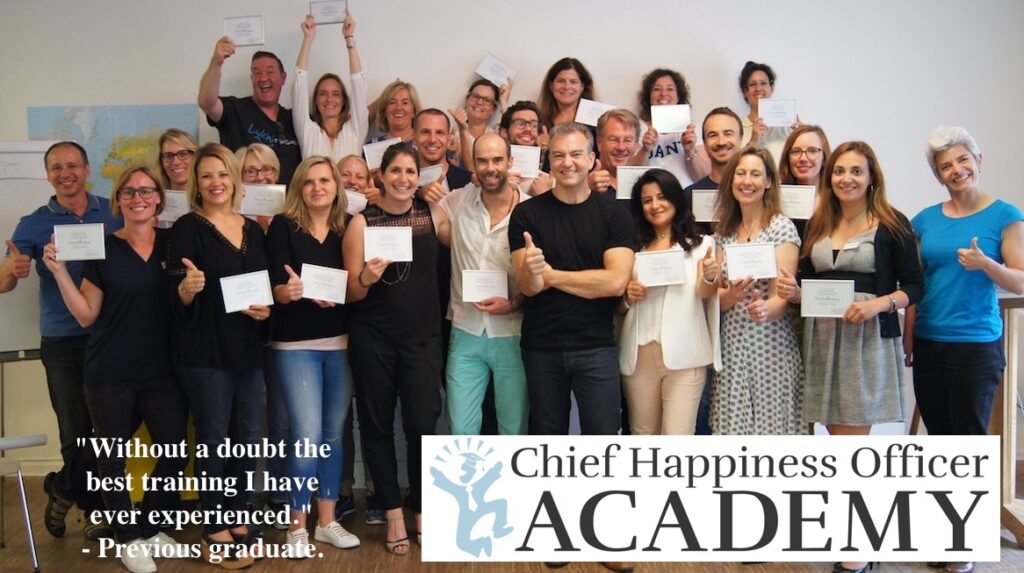
The Chief Happiness Officer Academy is our most in-depth 3-day training where we share everything we know about creating happier workplaces. Get an in-depth background in happiness at work, hear about the latest research in the field and learn how to use this in your own business.