Category: Best of site

The very best from the site

  • 3 simple ways to hack your to do list for happiness

    Do you keep a to-do list at work? And if you do is it a source of happiness at work or an endless source of frustration, overflowing with unsolved tasks – as it is for many people?

    One blog post sums it up like this:

    I hate my to-do list because

    1. I feel so overwhelmed when I see this long list of to-dos.
    2. Items not crossed off on the to-do list are a reminder that I didn’t finish what I set out to do and that I could have done more with my day.

    If you feel the same way, here are 3 simple tips to help you use your to-do list in a way that creates happiness at work rather than frustration.

    1: Change your to-do list to a could-do list

    We got a tip from a reader who had been feeling the pressure of an endless to-do list and had come up with a simple but brilliant hack. She wrote:

    This is something I’ve been doing for several months now when I noticed my ‘To Do’ list was generating a sense of frustration.

    Now, I write a ‘Could Do’ list, instead of a ‘To Do’ list. When I draw up my daily lists of tasks I refuse to see it as stuff I have to get done. When I did that in the past, I’d feel a sense of dissatisfaction at the end of the day when I didn’t have everything ticked off, despite the fact that I knew when I wrote it, it was highly unlikely I’d get to everything.

    It’s a tiny shift, but by viewing it as a list of things I could do today, I’m relieving the pressure to get them all done. It feels like there’s more of an element of choice around how I spend my time – I don’t have to do x today, I could leave it till tomorrow and focus more attention on y today instead.

    Now, at the end of the day, I don’t mind how many ticks I do or don’t have against the items on my list, and I feel better about my day’s work because there is no shadow from what I should have done and didn’t.

    I think that’s a fantastic idea. It’s a subtle shift inside your own mind that is likely to help you get started. In my experience, taking the pressure off yourself makes you more likely to get stuff done. Which is of course a sharp contrast to traditional business thinking which holds that greater pressure = greater performance.

    2: Add everything you do to the list

    Let’s face it, most of what you do during the day probably isn’t on your to-do list. Many tasks just arise during the day in an ad hoc manner. So add those to the to-do list as well.

    For instance, after writing this blog post (which was NOT on my to-do list, inspiration just suddenly grabbed me) I will add an item to my list that says Blog about to-do lists, set the deadline for today and immediately cross it off my list.

    It may seem redundant, but there is actually a sense of accomplishment (and a release of dopamine, the brain’s own motivation drug) from crossing it off the list) even if I’ve just now added it.

    This also makes sense in light of the third tip:

    3: Once a week, look at all the tasks you’ve completed

    In my opinion, the major problem with most to-do lists software is, that they only show you what you haven’t yet completed. As soon as you finish a task it disappears from the list forever.

    One of the major sources of happiness at work is getting stuff done and seeing the results of your work. A to-do list that only shows you everything you haven’t yet done, is likely to make you less happy at work.

    But there’s an easy hack for that: Once a week go into your to-do list and look at everything you got done in the last week. This may be a good thing to do on a Friday afternoon. If you have trouble remembering to do it, you could even put this on your (yes) to-do list and then cross it off once you’ve done it :o)

    The upshot

    To-do lists are an effective tool to make sure you remember to do everything you need to do at work. However, they tend to make people unhappy at work because they only focus on what we have not done. Fortunately, we can hack that.

    Update… Here’s a bonus tip:
    When you’re deciding which task to do next, don’t necessarily pick the first one on the list or the most important one. Instead, pick one you feel like doing right now.

    This is not always possible and sometimes there are critical tasks that you simply need to do right now. But often you have the choice of what to do first and in that case, go with the one you want to do.

    That will make you much more likely to get it done and give you more energy to apply to the less fun tasks. If you start with the hardest, the most important or the most boring task, that may steal your energy and motivation completely.

    Your take

    What do you think – could any of these tips work for you? Do you have any other good ways to effectively and happily use to-do lists? Please write a comment, I’d love to hear your take.

    Related posts

    If you’re still not getting your could-do items done, you can also read my previous post on How to procrastinate effectively.


  • My top 10 most popular articles ever

    I started this blog on October 14 2002, almost exactly 10 years ago, and it may have been one of my smartest decisions ever. Not only has blogging taught me to enjoy writing (and led to me writing 3 books) but it’s also been a great way to spread the message of happiness at work to the world.

    Since 2002 the blog has had more than 10,000,000 page views from about 7,000,000 unique visitors. My most popular blog post alone, has over 1,000,000 page views. Not bad :o)

    It’s been quite a ride and it’s still going strong, but here’s a short stroll down memory lane with my top 10 most popular articles from the last 10 years.

    10: Top 5 reasons why “The Customer is Always Right” is wrong
    The phrase “The customer is always right” was originally coined by Harry Gordon Selfridge, the founder of Selfridge’s department store in London in 1909. Ironically it often leads to unhappy employees and bad customer service. Here are the top five reasons why “The customer is always right” is wrong.

    9: Ten seeeeeeriously cool workplaces
    Physical space matters. It’s easier to be productive, creative and happy at work in a colourful, organic, playful environment than in a grey, linear, boring one. Take a tour of 10 really cool, beautiful workplaces.

    8: How NOT to lead geeks
    The main reason IT people are unhappy at work is bad relations with management, often because geeks and managers have fundamentally different personalities, professional backgrounds and ambitions. See the top 10 mistakes IT managers make.

    7: Secret salaries are a baaaaaad idea
    It’s a golden rule in most businesses that salaries must be kept secret. Except for a few heretics, it is almost universally accepted that mayhem would ensue in the workplace if people knew what their co-workers, their managers or – gasp – the CEO was making. Making salaries open inside a company instead seems like a wild idea sure, but it makes a lot of sense and brings advantages for both the workplace and for its people.

    6: Top five business maxims that need to go
    Much well-known business advice is sadly obsolete but can still be found in articles, business books and, not least, in daily use in the workplace. The worst of these old maxims are not only wrong, they’re bad for people and bad for business. Here’s my pick of the top 5 business maxims in serious need of an update – with a replacement for each.

    5: Rewards don’t motivate. No, really, they don’t.
    Many people don’t feel motivated at work, and there’s a very simple explanation for this: The motivational techniques used by most managers don’t work.

    4: Top ten bad excuses for staying in a job you hate
    If you’re unhappy at work, I’m sure that the thought “Man, I really should quit!” crosses your mind occasionally. So why don’t you? Here are 10 of the most common bad excuses for staying in a crappy job.

    3: 12 ways to pimp your office
    I’m not going to claim that a fancy desk or a weird chair is going to magically improve your creativity and productivity – but I am damn sure, that all that sameness and eternal corporate grayness, does nothing good for your ability to come up with great new ideas. Here are some ways to spruce up a workplace that may actually inject some color and fun into your work environment.

    2: Top ten signs you’re unhappy at work
    How do you know that you’re unhappy at work? In my work, I talk to a lot of people who are not happy with their jobs. Here are the top ten symptoms of unhappiness at work that I’ve observed. How many apply to you?

    1: Don’t let The Cult of Overwork ruin your life
    I know it’s normal to view people working constant overtime as heroes of the organization. But still I think they would be more efficient and enjoy life more if they cut down their time at work. They may find that they become more open, less stressed, have more fun AND are better role models for their employees. This cult of overwork has got to stop.

    You can find more popular posts from the blog here.

  • Why are managers so afraid to show some happiness?


    Billionaire Ingvar Kamprad hard at work

    That day, the IKEA store in Gentofte, Denmark is a hive of activity. Not only is there a European executive meeting taking place, but the company founder, Ingvar Kamprad himself, is in the house. That’ll make most employees straighten up and put in a little extra effort.

    The execs wrap up at 6 in the evening, and Ingvar takes a stroll through the store as if this was the most natural thing in the world, kindly greeting each and every employee. He encounters two female employees talking to each other and approaches them with a smile and the words: “And what are too such lovely ladies talking about?” – following up with huge hugs for both of them.

    Ingvar Kamprad is not merely a multi-billionaire and the top guy of company employing well above 100,000 people worldwide – he’s is also a happy person, and he’s not afraid to show it.

    The same goes for many other top executives like Tony Hsieh of Zappos, Herb Kelleher of Southwest Airlines, Jørgen Vig Knudstorp of LEGO and Brin&Page of Google. Richard Branson of Virgin is perhaps the most famous example of a top exec who isn’t afraid of being happy, enthusiastic and funloving.

    Would you dare to? Can people tell that you’re happy from looking at you? Are you walking the halls of your company with a smile on your face, a cheerful outlook and an unflagging faith in the future? Or have you, like so many other managers, bound yourself to an identity that requires a professional, cold, serious, disparaging and businesslike appearance?

    Happiness pays off. Happiness at work is catching – and when the boss is happy, it’s downright infectious. If you, the person in charge, seem unhappy, you dampen the mood of everyone else in the company. This leads to more sick days, more stress, higher staff turnover and lower efficiency. On the other hand: When you radiate energy, curiosity and enthusiasm, you inevitably pass on your attitude to your employees. They grow happier and more creative, and they’ll ultimately end up providing better service to your customers.

    Happy managers also gain a natural rapport with their employees, and people are much more eager to go the extra mile for a happy manager than for an unhappy one.

    However, there’s one downside to being happy that you should be aware of: You may be regarded as less competent. In an exciting psychological study, participants were asked to read an article and subsequently assess the smartness of its author. Half the participants got an article with a negative, critical attitude towards a certain topic – the other half got an article on the exact same topic, but worded in a much more positive way. The study showed that the author of the negative article was perceived as the more intelligent of the two.

    That’s frankly strange, because loads of studies prove that happy people do a much better job. But apparently, many people also think that happy people aren’t all that serious. They’re seen as kind of happy-go-lucky and maybe a bit gullible too.

    On the whole, however, there’s no doubt that the advantages to being a happy manager far outstrip the disadvantages. So what can you do to bring some more happiness into your management style? Here are three concrete and dead simple suggestions.

    1: Smile.
    Look happy when you’re at work. Smiles are infectious and build good relationships. Don’t be fake, though. It has to be a genuine smile.

    2: Look at the bright spots.
    Many managers spend all their time on problems and all the stuff that doesn’t work. Change tack and spend much more of your time praising good work and finding and cherishing the heroes of your organization.

    3: Cultivate optimism.
    Some managers believe that a permanent atmosphere of impending crisis leads to good results, and they work hard to point out threats in order to create a burning platform. That’s a mistake. If you convey calm, optimism and faith in the future, you create a much more efficient and adaptable organization. Optimism is not an excuse to sit around doing nothing – it’s the most important driver of change there is.

    The upshot

    Studies show that managers on average are happier at work than employees but you wouldn’t usually think so to look at them, since many believe that leaders should be serious rather than happy. They forget that it’s possible to be both.

    Smiling and being happy is no substitute for being good at your job of course. You still need to be professionally competent, efficient and a good manager. But the collective experience of some of the most capable and successful managers in the world shows that being happy makes you a better boss.

    That is, if you’re not afraid to show it!

    Your take

    Are you a leader? If so, are you happy and not afraid to show it? Or do you adopt a more professional facade?

    As an employee, have you tried working for happy boss? Or a very unhappy one? What was that like?

    Related posts

  • The top 5 ways NOT to praise people at work

    In 2011 we conducted a study of 1,000 Danish employees from a wide variety of workplaces to try to find the biggest factors that make people unhappy at work. Our study found that the second biggest driver of dissatisfaction at work was a lack of praise and recognition. Too many Danish employees are unhappy and demotivated at work because, even though they do great work, they hardly ever receive any positive feedback and I’m willing to bet good money that this applies in most other countries too.

    That’s a damn shame because studies confirm that workplaces that have a culture of recognition are happier, have lower absenteeism and are more successful.

    So we need more praise at work, sure, but that’s not enough. It’s also about better praise. We won’t create a viable culture of recognition in a workplace simply by increasing the amount of praise given, we must also improve the quality of the praise.

    It is actually possible to praise employees and co-workers in ways that make them less happy at work.

    Here are the top 5 ways NOT to praise people at work. Do you recognize any of these from your workplace?

    1: Obligatory praise
    Never praise people just because you feel you should. Praise has to be meaningful and earned. This means you can only praise others when there is a good reason to do so – which fortunately is quite often.

    Praise given because you have to and not because you feel the person has earned it makes no one happy at work. It will also undermine all future praise, because people can’t trust it to be honest.

    Also, some people will only give praise and tend to avoid giving negative feedback, possibly in an attempt to avoid unpleasant conversations and conflict. That won’t do. Our study showed that people long for feedback at work. They want to know what they do well but they also want to know what they can do better.

    2: Sarcastic praise
    Imagine this said in a wildly sarcastic tone: “Wow, you just did an awesome job on that, didn’t you?”

    That’s not very likely to make anyone happy at work.

    3: Praise mixed with criticism
    Have you ever heard that you should preface any criticism with praise? Some people argue that the best way to give negative feedback is to wrap it in praise, i.e. you should praise, criticize and then praise again at the end.

    I disagree completely with that approach. I say if you have negative feedback, say so. If you have praise to give, do it. But don’t feel like you have to mix the two.

    The problem is this:

    • The praise you do give seems fake – it’s just a preamble to the real message.
    • It seems like you think people can’t take criticism since you wrap it in praise to soften the blow.
    • In the future when you praise people, they’ll just be waiting for the hammer to drop.

    4: Praising some – ignoring others
    If some people get tons of praise while others are consistently ignored, this is highly demotivating since it give the praise-less a feeling of unfairness and of being overlooked.

    A classic example would be a company where the salespeople get all the praise for getting new customers while the people working in the backoffice, who make the sales possible, are routinely ignored and taken for granted.

    Unfortunately it’s easy to end up praising only those people who get the most visible results and ignoring the people backstage. Its also tempting to only praise the people who are most like you, who do work you immediately understand and who do it the way you would have done it. Therefore we should all make an extra effort to appreciate the people who are not like us.

    This is not to say that praise should be handed out evenly so everyone gets the exact same amount of recognition. In any workplace, there will be people who shine and it’s perfectly alright if they get more praise. But it’s important that everyone gets noticed and praised for the good work they do.

    5: Trivial praise
    I once talked to a woman who got lots of praise from her male supervisor at her last job… but only ever for her looks. This was both creepy and utterly meaningless. She’s a highly skilled professional and she wants to be recognized for that – not for something as trivial as how she looks.

    So make sure you praise people for things that actually matter to them and not for superficial matters and trivial accomplishments.

    Your take

    Have you ever been praised in a way that made you less happy at work? Does your workplace have a good culture of recognition? What’s the best way you’ve ever given or received praise at work? Write a comment, we’d love to know your take.

    Related posts

  • Tiger Oil Memos

    Have you seen the Tiger Oil memos? Whoah, Nelly!

    It’s “…a total of 22 enormously entertaining memos; all sent by, or on behalf of, the firm’s incredibly amusing, painfully tactless, and seemingly constantly angry CEO — Edward ‘Tiger Mike’ Davis — to his staff.”

    Here’s are some of my favorites.

    On gossip:

    Idle conversation and gossip in this office among employees will result in immediate termination.

    Don’t talk about other people and other things in this office.

    DO YOUR JOBS AND KEEP YOUR MOUTH SHUT!

    I can swear – you can’t:

    I swear, but since I am the owner of this company, that is my privilege, and this privilege is not to be interpreted as the same for any employee. That differentiates me from you, and I want to keep it that way. There will be absolutely no swearing, by any employee, male or female, in this office, ever.

    No celebrations:

    Per Edward Mike Davis’ orders, there will be no more birthday celebrations, birthday cakes, levity, or celebrations of any kind within the office. This is a business office.

    If you have to celebrate, do it after office hours on your own time.

    Source.

    I can’t believe that company isn’t around anymore :o)

    Hat-tip to Peter Billingham for telling me about these!

    Also – it made me think of this classic Simpsons moment:

  • Work is punishment

    I keep wondering why so many people put up with bad workplaces, bad bosses and bad jobs. Why are many people desperately unhappy at work (up to 50% according to some studies) but accept this as normal?

    Here’s why: We’re carrying massive cultural baggage. Through much of Western history, there has been a sense that work is hard and unpleasant and that’s why we get paid to do it.

    This is expressed most clearly in Max Weber’s biblically-based work The Protestant Work Ethic, which was used by Protestant preachers to preach that hard labor was good for people, good for Christian society, and a salve for original sin.

    According to Christianity, humans used to live in the Garden of Eden, where everything was perfect. But because of original sin we were ejected and, according to Genesis 3:19, this is our situation now:

    “By the sweat of your brow you will eat your food until you return to the ground, since from it you were taken; for dust you are and to dust you will return.”

    According to Hebrew belief, work is a “curse devised by God explicitly to punish the disobedience and ingratitude of Adam and Eve.” The Old Testament itself supports work, not because there’s any joy in it, but because it is necessary to prevent poverty and destitution.

    The ancient Greek word for work is ponos, taken from the Latin poena, which means sorrow. Manual labor was for slaves, while free men were supposed to pursue warfare, large-scale commerce, and the arts, especially architecture or sculpture1.

    So, according to our cultural roots, work is a curse, a punishment for original sin, and only for slaves. In short, life is hell—or “nasty, brutish and short,” as Hobbes put it—work is hell, and we must endure it because we’re all sinners but don’t worry, we’ll get our reward once we’re dead! Any questions?

    It’s time to put that particular view of work behind us! Richard Reeves has this to say in his excellent book Happy Mondays:

    Anybody who thinks work should be miserable simply because it is work or that there should be a cordon sanitaire between “work” and “life” needs to find a time machine, key in the year 1543, and go and join Calvin’s crew. They’ll feel more at home there. In the meantime, the rest of us will get on with enjoying our work, and our workplaces.

    But we can never forget that we’re going up against thoughts and beliefs that have been part of our culture for centuries. This is why we need a conscious revolution in workplaces all around the world and why those of us who have chosen to break with the old attitude to work need to support each other.

    Related posts

  • The 10 most awesome things from Valve’s employee handbook

    I recently had a chance to read the employee handbook from video game company Valve and it’s the single most inspiring such document I have ever seen.

    I play some video games myself (the Bioshock and Dead Space franchises are my favorites), but if you don’t partake you may never have heard of Valve so here’s the skinny from Wikipedia:

    Valve Corporation is an American video game development and digital distribution company based in Bellevue, Washington, United States. Founded in 1996 by former Microsoft employees Gabe Newell and Mike Harrington, Valve became famous from its critically acclaimed Half-Life series. It is also well known for its social-distribution network Steam; and for developing the Source engine.

    Valve is privately owned so few financial figures are known but they have 300 employees and Forbes estimates the company’s worth at $3 billion.

    Their employee handbook was recently released on the web and it explains how they’ve become so successful. Here are the top 10 most awesome things from the document.

    1: Valve has no hierarchy

    Hierarchy is great for maintaining predictability and repeatability. It simplifies planning and makes it easier to control a large group of people from the top down, which is why military organizations rely on it so heavily.

    But when you’re an entertainment company that’s spent the last decade going out of its way to recruit the most intelligent, innovative, talented people on Earth, telling them to sit at a desk and do what they’re told obliterates 99 percent of their value.

    That’s why Valve is flat. It’s our shorthand way of saying that we don’t have any management, and nobody “reports to” anybody else. We do have a founder/president, but even he isn’t your manager.

    How cool is that?

    2: Pick your projects

    We’ve heard that other companies have people allocate a percentage of their time to self-directed projects. At Valve, that percentage is 100.

    Heh :o) Screw Google and their “20% time to work on your own projects.” Valve turned that dial to 11!

    3: Don’t forget the long term

    Because we all are responsible for prioritizing our own work, and because we are conscientious and anxious to be valuable, as individuals we tend to gravitate toward projects that have a high, measurable, and predictable return for the company.

    This sounds like a good thing, and it often is, but it has some downsides that are worth keeping in mind. Specifically, if we’re not careful, these traits can cause us to race back and forth between short-term opportunities and threats, being responsive rather than proactive.

    So our lack of a traditional structure comes with an important responsibility. It’s up to all of us to spend effort focusing on what we think the long-term goals of the company should be.

    In many, many workplaces where employees are unhappy and frustrated because their workdays are entirely taken up with putting out one fire and then the next, leaving no time for long-term planning of any kind. Valve try not to fall into that trap.

    4: Don’t stress over the things you don’t do

    It’s natural in this kind of environment to constantly feel like you’re failing because for every one task you decide to work on, there will be dozens that aren’t getting your attention. Trust us, this is normal. Nobody expects you to devote time to every opportunity that comes your way. Instead, we want you to learn how to choose the most important work to do.

    At most workplaces there is a huge and unrelenting focus on the things employees haven’t done. Almost every meeting, email and phone call are intended to remind people of the next deadline and how far away they are from reaching it. Valve try to take the pressure of employees so they don’t stress over the things they don’t do.

    5: We test ourselves

    …rather than simply trusting each other to just be smart, we also constantly test our own decisions

    Yes. Don’t believe your own hype. Test your decisions and adjust as needed.

    6: Overwork is bad

    While people occasionally choose to push themselves to work some extra hours at times when something big is going out the door, for the most part working overtime for extended periods indicates a fundamental failure in planning or communication.

    This is a brilliant slap in the face to all members of The Cult of Overwork, ie. everyone who believes that the key to succes is simply to work more hours.

    7: Enjoy yourself

    Sometimes things around the office can seem a little too good to be true. If you find yourself walking down the hall one morning with a bowl of fresh fruit and Stumptown-roasted espresso, dropping off your laundry to be washed, and heading into one of the massage rooms, don’t freak out. All these things are here for you to actually use.

    And don’t worry that somebody’s going to judge you for taking advantage of it—relax! And if you stop on the way back from your massage to play darts or work out in the Valve gym or whatever, it’s not a sign that this place is going to come crumbling down like some 1999-era dot-com startup.

    If we ever institute caviar-catered lunches, though, then maybe something’s wrong. Definitely panic if there’s caviar.

    In short, you should feel good during your work day.

    8: You’re free to screw up

    Nobody has ever been fired at Valve for making a mistake.

    Providing the freedom to fail is an important trait of the company — we couldn’t expect so much of individuals if we also penalized people for errors.

    Yes! I cannot stress enough, how important it is to let employees make mistakes.

    In fact, we should celebrate mistakes at work.

    9: It’s not about growth

    We do not have a growth goal. We intend to continue hiring the best people as fast as we can, and to continue scaling up our business as fast as we can, given our existing staff. Fortunately, we don’t have to make growth decisions based on any external pressures — only our own business goals. And we’re always free to temper those goals with the long-term vision for our success as a company. Ultimately, we win by keeping the hiring bar very high.

    Yes! Way too many businesses are slaves to growth goals that are arbitrary, unrealistic and ultimately meaningless.

    As Ricardo Semler put it:
    There is no correlation between growth and ultimate success. For a while growth seems very glamorous, but the sustainability of growth is so delicate that many of the mid-sized companies which just stayed where they were doing the same thing are much better off today than the ones that went crazy and came back to nothing. There are too many automobile plants, too many airplanes. Who is viable in the airline business?

    10: Hiring

    Hiring well is the most important thing in the universe. Nothing else comes close. It’s more important than breathing.

    So when you’re working on hiring … everything else you could be doing is stupid and should be ignored!

    Again, this is brilliant. Nothing undermines a strong positive company culture faster than hiring people who don’t fit in.

    In short, this is a fantastic document and one of the coolest things about it is that it’s maintained by the Valve employees themselves, who are free to edit it on their intranet.

    You can find the whole Valve Employee Handbook here – read it, read it, read it :)

    Your take

    What do you think of these 10 points? How does this document compare to your workplace’s employee handbook? Is there anything in your employee handbook that inspires you?

  • Why your boss thinks criticism is more effective than praise… and is wrong!

    PraiseI just discovered a great article by Linda Hill & Kent Lineback on why criticism seems more effective than praise in the workplace… but isn’t.

    From the article:

    This is one of those areas where the lessons of experience aren’t obvious — and can even be misleading.

    Your observation that criticism is more often followed by improvement is probably accurate. But what’s going on isn’t what you think. In fact, it’s something called “regression to the mean” and if you don’t understand it, you and your people will be its victims.

    Basically, the article argues that we all have an average performance level over time but actual performance varies from day to day and task to task. But we tend to forget this:

    If you track someone’s performance task by task, you’ll discover that a great performance, one that’s far above the person’s average or mean, is usually followed by a less-inspiring performance that’s closer to the mean.

    It works the same the other way. A terrible performance is usually followed by something better. No one’s making or causing this to happen. It’s part of the variability built into human activity, especially when doing something even moderately complex.

    Consequently, when someone performs worse than their own average and you criticize them for it, they will tend to perform better afterwards, simply because they return to their own average. They would have done so, even if you had said nothing.

    For the same reason, when someone performs better than usual and you praise them for it, their next performance will tend to be worse.

    And this means that:

    Even if you don’t notice these apparent connections consciously, you’re aware of them intuitively. And the most likely consequence will be that you criticize far more than you praise.

    This is a brilliant insight and the lesson is that we must shift our focus from increasing performance on individual tasks to raising people’s average performance. And this is done more effectively by focusing on what people do well.

    A lot of evidence suggests that positive reinforcement — identifying and building on strengths — will produce better results than a relentless focus on faults. This is important.

    To improve, people need positive feedback. It’s just as important to recognize and reinforce their strengths as it is to point out where they’re falling short. And you need to understand why praise can seem dysfunctional, so you don’t withhold it.

    Read the whole article – it’s brilliant and it reinforces the point we’ve made again and again that praising people for their good work makes them happier AND more effective.

    Related posts

  • Top 5 tips to beat the post-vacation blues at work

    Aaaahhh… Summer vacation. Depending on your fancy it’s time to lie on the beach with a good book, wear out your shoe soles exploring a strange city or scream your head off skydiving or in some other adrenaline-driven pursuit.

    But invariably the vacation ends and you go back to work, and that transition can be a little rough.

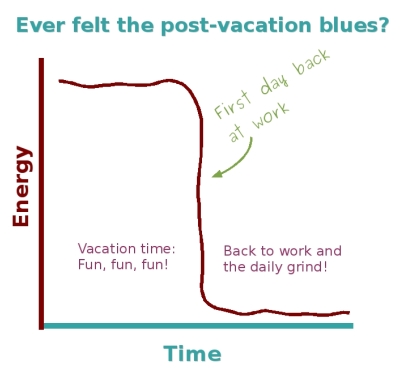
    Do you know that feeling? You come back to work happy and full of energy – but by the end of the first work day, you’re already feeling tired an unhappy. It’s almost like you didn’t have a vacation at all.

    So here are a five tips to help you stay happy when you get back to work.

    1: While you’re away, get away

    Don’t take the company mobile and laptop on vacation. Don’t check your voice mail and email.

    The point of a vacation is to get away and go to a different mental space, and if you’re preoccupied with work, chances are you’ll both enjoy your vacation less and get less relaxation out of it.

    2: Let yourself get behind

    When you get back from your vacation, you will invariably have fallen behind and have a lot of work to catch up on. There will be a ton of voice mails, emails and tasks that need your attention. THAT’S FINE!!! It’s unavoidable and it’s not your fault.

    Look at it this way: If you can leave the company for two weeks and there’s no work waiting for you, you’re not really needed there.

    So don’t expect to have a clear desk on your first day back – allow yourself to be behind and to catch up steadily.

    3: Start with some easy tasks

    When you get back to work, don’t immediately throw yourself at the toughest, hairiest most complicated tasks you have. Ease into work by doing something easy and simple – something you know you can do. Once you’re back in full swing you can go at the tough tasks.

    4: Don’t overwork to catch up

    It can be really tempting to work long hours to catch up after your vacation. DON’T!!! Work regular hours and stick to point 2 above.

    5: Ask for help if you need it

    If you find it difficult to catch up, don’t be afraid to ask your co-workers or manager for help. It’s important for you to be aware of any outstanding tasks that may have become critically late in your absence, and if you could use some help – it’s your responsibility to ask for it! It also greatly increases the chance that you will actually get help.

    If you use these tips, you may find that your vacations feel more like vacations and that you can be even happier at work.

    But on a fundamental level, there is something wrong with the idea that work drains you of energy and weekends and vacations recharge you. I know that this is how most people feel – but that’s not how it should be.

    If work typically drains you of energy – if every week ends up draining you of life so you barely make it to Friday afternoon where you can finally relax – then something’s wrong. Don’t accept that state of affairs just because everyone else does.

    When you’re happy at work, work can actually be a regenerative activity that leaves you with more energy so you leave the workplace with a spring in your step most days!

    And THAT is the ultimate way to beat the post-vacation blues: Have a job you actually like!

    Your take

    Do you ever get the post-vacation blues? What do you do to beat’em? Have you also noticed that vacations these days seem to be more tiring than work (as this article says)?

    Related posts

  • Top 5 reasons to celebrate mistakes at work

    Top 5 reasons to celebrate mistakes at work

    Zappos’ CEO Tony Hsieh recently tweeted this:

    “$1.6 million mistake on sister site @6pm.com. I guess that means no ice cream for me tonight. Details: http://bit.ly/blfLnF

    Apparently an employee had made a mistake while updating the prices on the web site, which meant that for a whole day, no item could cost more than $49.95. Some of their items cost a lot more. Ouch!

    Now what do you do? In many organizations a mistake like this would be the starting point for a witch hunt. Who is responsible? How did they screw up? What would be an appropriate punishment?

    But this is not how they do business at Zappos. At the link above, Tony Hsieh writes:

    To those of you asking if anybody was fired, the answer is no, nobody was fired – this was a learning experience for all of us. Even though our terms and conditions state that we do not need to fulfill orders that are placed due to pricing mistakes, and even though this mistake cost us over $1.6 million, we felt that the right thing to do for our customers was to eat the loss and fulfill all the orders that had been placed before we discovered the problem.

    PS: To put an end to any further speculation about my tweet, I will also confirm that I did not, in fact, eat any ice cream on Sunday night.

    This is not soft or wishy-washy, it’is a great way to handle mistakes in a business. Rather than stigmatizing failure, we should acknowledge and even celebrate it.

    Yes, that’s right, I said celebrate our mistakes. I’ve long argued that we should celebrate success at work, but we should also celebrate mistakes, failure and fiascoes. Here are the top 5 reasons why this is a good idea.

    1: When you celebrate mistakes, you learn more from the mistakes you make

    In one company, the CEO was told by a trembling employee, that the company website was down. This was a big deal – this company made most of its sales online, and downtime cost them thousands of dollars an hour.

    The CEO asked what had happened, and was told that John in IT had bungled a system backup, and caused the problem. “Well, then,” says the CEO “Let’s go see John!”

    When the CEO walked into the IT department everyone went quiet. They had a pretty good idea what wass coming, and were sure it wouldn’t be pretty.

    The CEO walks up to John’s desk and asks “You John?”

    “Yes” he says meekly.

    “John, ” says the CEO, “I want to thank you for finding this weakness in our system. Thanks to your actions, we can now learn from this, and fix the system, so something like this can’t happen in the future. Good work!”

    Then he left a visibly baffled John and an astounded IT department. That particular mistake never happened again.

    When we can openly admit to screwing up without fear of reprisals, we’re more likely to fess up and learn from our mistakes.

    2: You don’t have to waste time on CYA (Cover Your Ass)

    Huge amounts of time and energy can be wasted in organizations on explaining why the mistakes that do happen are not my fault. This is pointless.

    3: When mistakes are celebrated, you strengthen creativity and innovation

    Randy Pausch, was a college professor who became famous after giving his “last lecture” when he’d been diagnosed with terminal cancer.

    In his classes, Pausch would give out an award called The First Penguin to the team that took the greatest risk – and failed. The award is inspired by that one penguin out of a whole flock up on dry land who is the first to jump in the water, knowing full well that there may be predators just below the surface. That penguin runs a risk but if no one jumps in first, the whole flock will starve on land.

    And check out this sign that hangs in the offices of Menlo Innovations, an IT company in Ann Arbor, Michigan:

    Make mistakes faster

    Yep, it says “Make mistakes faster”. They know that mistakes are an integral part of doing anything cool and interesting and the sooner you can screw up, the sooner you can learn and move on.

    4: Failure often opens new doors

    Also, failure is often the path to new, exciting opportunities that wouldn’t have appeared otherwise. Closing your eyes to failure means closing your eyes to these opportunities.

    Just to give you one example: Robert Redford was once an oil worker – and not a very good one. He once fell asleep inside an oil tank he was supposed to clean. But failing at that, opened his way to movie stardom.

    5: When you celebrate mistakes, you make fewer mistakes

    I know that a lot of people stick to the old saw “Failure is not an option”. But guess, what no matter how many times you repeat this maxim, failure remains an option. Closing your eyes to this fact only makes you more likely to fail. Putting pressure on people to always succeed makes mistakes more likely because:

    • People who work under pressure are less effective
    • People resist reporting bad news
    • People close their eyes to signs of trouble

    This is especially true when it’s backed up with punishment of those who make mistakes.

    The upshot

    Peter Drucker provocatively suggested that businesses should find all the employees who never make mistakes and fire them, because employees who never make mistakes never do anything interesting. Admitting that mistakes happen and celebrating them when they do, makes mistakes less likely.

    James Dyson says this:

    I made 5127 prototypes of my vacuum before I got it right. There were 5126 failures. But I learned from each one. That’s how I came up with a solution. So I don’t mind failure. I’ve always thought that schoolchildren should be marked by the number of failures they’ve had. The child who tries strange things and experiences lots of failures to get there is probably more creative…

    We’re taught to do things the right way. But if you want to discover something that other people haven’t, you need to do things the wrong way. Initiate a failure by doing something that’s very silly, unthinkable, naughty, dangerous. Watching why that fails can take you on a completely different path. It’s exciting, actually.

    So my challenge to you is to start celebrating your failures. Next time you or someone on your team messes up, admit it, celebrate it and learn from it. Tackle the situation with humor (as Tony Hsieh did) rather than with fear and shame.

    Your take

    How does your workplace handle mistakes? Is it more like a celebration or a witch hunt? What has been your most spectacular screw-up at work so far? How did you handle it and what did you learn from it? Please write a comment, I’d like to hear your take.

    Related posts