Why “Motivation by Pizza” Doesn’t Work

My store manager implemented an embarrassing (and happily short-lived) safety incentive: Employees caught violating safety procedure were immediately given a two-foot rubber chicken on a string to wear around their necks–in front of customers. To get rid of the chicken, an employee needed to catch another employee behaving “unsafely.”
The practice quickly descended into a game of hot potato, with employees chasing one another around the store in search of the slightest violation to rid themselves of the safety chicken.
Many people don’t feel motivated at work, and there’s a very simple explanation for this: The motivational techniques used by most managers don’t work.
While few companies use rubber chickens (fortunately), most of the standard motivational tools like promotions, bonuses, employee of the month awards, pep-talks and free-pizza-nights are downright harmful to the drive, energy and commitment of employees. It only leaves them feeling manipulated, cynical and demotivated.
The result: According to one Gallup study 60-80% of workers are not engaged at work. They feel little or no loyalty, passion or motivation on the job. They’re putting in the hours, but they’re not doing a great job and they’re certainly not happy at work!
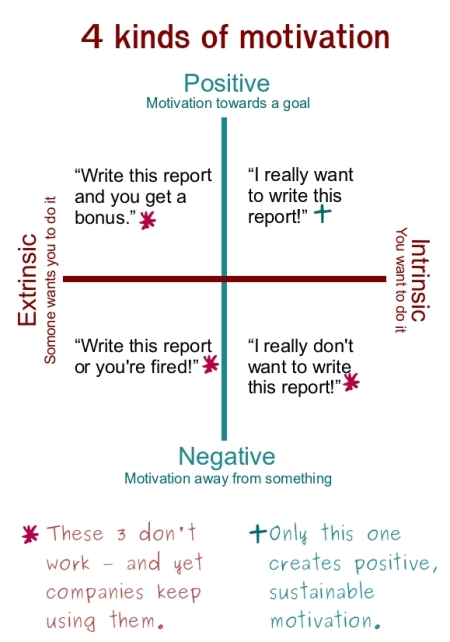
As the illustration above shows, there are four different kinds of motivation. Only one of them works and unfortunately, many managers focus exclusively on the other three. Kinda silly, huh?
These are the four different kinds of motivation:
First, motivation can be intrinsic or extrinsic. Intrinsic motivation is when you want to do something. Extrinsic motivation is when somebody else tries to make you do something.
Secondly, there is positive and negative motivation. Positive motivation is when you want to get something – motivation towards some goal. Negative motivation is away from something you want to avoid.
Combine these two dimensions and we get four kinds of motivation (don’t you just love these four-quadrant models :o). Let’s see why three of the quadrants are useless for creating motivation.
Extrinsic motivation doesn’t work
In the laboratory, rats get Rice Krispies. In the classroom the top students get A’s, and in the factory or office the best workers get raises. It’s an article of faith for most of us that rewards promote better performance.
But a growing body of research suggests that this law is not nearly as ironclad as was once thought… If a reward — money, awards, praise, or winning a contest — comes to be seen as the reason one is engaging in an activity, that activity will be viewed as less enjoyable in its own right.
- Alfie Kohn (source)
Alfie Kohn has studied motivation extensively, and his excellent book Punished by Rewards shows in detail that extrinsic motivation has some serious drawbacks:
- It’s not sustainable – As soon as you withdraw the punishment or reward, the motivation disappears.
- You get diminishing returns – If the punishment or rewards stay at the same levels, motivation slowly drops off. To get the same motivation next time requires a bigger reward.
- It hurts intrinsic motivation – Punishing or rewarding people for doing something removes their own innate desire to do it on their own. From now on you must punish/reward every time to get them to do it.
In one of Kohn’s examples, children in a small town were given points for every books they checked out of the local library during the summer vacation. The points could be redeemed for a free pizza, in an attempt to encourage reading.
The children in the program did indeed read more books than other children. But after the program ended, when reading no longer paid off in pizza, those children read far fewer books than others. Their own intrinsic desire to read books had been subsumed by the extrinsic reward, and when the pizza went away, so did the motivation.
Negative motivation doesn’t work
Heart patients who’ve had double or quadruple bypass operations face a very simple choice: They must stop eating unhealthy food, smoking, drinking and working too much or they die.
That has got to be the ultimate negative motivation and it carries the ultimate price for not doing it.
So guess how many of them actuallly manage to change their lifestyle sustainably. Two years after the operation, how many of these heart patients have managed to stick to their new habits?
C’mon, take a guess.
10%.
Faced with the ultimate negative motivation, 9 out of 10 are still not able to make simple lifestyle changes. Which is why you see many patients coming in for their second or third heart operations. And which is also strong evidence that negative motivation does not work.
One doctor, Dean Ornish, created a program where heart patients were instead taught to appreciate life (rather than fear death). They practiced yoga, meditated, got anti-stress counseling and got a healthy diet, all aimed at making them enjoy life more. The result: 2 years later, 70% of the patients maintained their new lifestyles.
When even the threat of death can’t make people change their lifestyle sustainably, it becomes clear that motivation based on avoiding something is simply not as effective as motivation based on achieving something.
So what does work?
We currently act as if people are not inherently motivated, rather that they go to work each day and wait for someone else to light their fire. This belief is common among managers and employees alike…
It is right and human for managers to care about the motivation and morale of their people, it is just that they are not the cause of it.- From the excellent book Freedom and accountability at work by Peter Block and Peter Koestenbaum.
So with extrinsic motivation out and negative motivation out, we’re left with only one quadrant: Intrinsic positive.
This completely changes the role of the manager as motivator. Rather than being the source of motivation (kind of a ludicrous idea in itself), the manager must help employees to find their own intrinsic motivation.
What enhances intrinsic motivation? This webpage cites some research and lists the factors that create and sustain intrinsic motivation. The list includes:
- Challenge – Being able to challenge yourself and accomplish new tasks.
- Control – Having choice over what you do.
- Cooperation – Being able to work with and help others.
- Recognition – Getting meaningful, positive recognition for your work.
To these I would add:
- Happiness at work – People who like their job and their workplace are much more likely to find intrinsic motivation.
- Trust – When you trust the people you work with, intrinsic motivation is much easier.
So rather than trying to bribe people to want things using pizzas and promotions, managers should help their people to discover meaning and develop skills at work. What some managers don’t realize is that people want to do good work. Create a happy, positive work environment and people are naturally motivated. Even better: They motivate themselves and each other.
And that surely beats the punishments and rewards.
I’ve also made a podcast that explains the same points about motivation. You can find it here.
If you enjoyed this post I’m sure you’ll also like these:


Gary Said,
December 19, 2006 @ 4:04 am
There are some jobs that intrinsically suck. Take most menial jobs. No amount of “positive” encouragement can change that. Exactly how do you motivate someone to sweep that floor better, wash dished cleaner or slaughter animals faster?
If your job sucks, then you need to find a different one. If you can’t, then you need to upgrade your skills to get a better job.
Please, someone tell me I’m wrong.
Jeff Green Said,
December 19, 2006 @ 4:33 am
Gary your wrong. Someone has to take out the trash, slaughter the animals and grow the crops. What we don’t have is equity. Some dipstick who smoked weed, drank beer and spent four years to get a degree that accomplishes no useful purpose expects to be paid a small fortune because he knows marketing. (ooooh) or computers (ahhhh). The minute cities are cut off (New Orleans) the common denominator is real ability. Can you start a fire? Chop wood? Build a shelter? Sanitize water for drinking? Most people would croak in three weeks without the government to hold their sweaty palms. Go to a third world country and see the real world.
Jay Said,
December 19, 2006 @ 8:53 am
Well, I’d have to disagree with you Gary. There’s just something about looking back at something and knowing you changed it that warms the heart. My job in high school was a dishwasher. Before that I cut firewood and helped out some locals around their farms. It’s long, and it’s hard, and it’s repetitive. But it’s also enjoyable if you let it be.
At the end of the day you’ve accomplished something. You can look back and actually see with your eyes the changes you made. It may be small, but it’s something, and it’s yours. The motivation to work harder is to see that difference grow larger.
If you hate it, you hate it. The menial jobs as you say only suck if you believe they suck. I can’t tell you how many times I’ve been sitting in front of a monitor wishing I was cooking or running fence. Then at least there would be tangible proof of my efforts.
h Said,
December 19, 2006 @ 9:21 am
Sucking is subjective; if you don’t care about work, it’s a non-issue and may prefer the 9-5 no worries lifestyle. Similarly, you may care more about people in front of you than on the other coast. Don’t self-project.
However, Jeff Green, though your conclusion may be valid, your reasoning is deceptive. The skills you list can be quickly taught to get somebody to the level of proficiency requisite for survival. *Boy scouts* learn them. Good engineering and the finer points of capitalization through marketing – not necessarily so. A college education may not imply such knowledge, but graduates probably have a better correlation with those skills than those that flunked out or never attended.
For a site called positive sharing, y’all sound rather bitter.
Michael Said,
December 19, 2006 @ 9:26 am
Sorry — You get what you pay for. Companys that give up extrinsic motivation lose their brightest to those that do. I am a personal example of one that did just that. My company now is great at both negative and positive extrinsic and intrinsic motivation & the people that I work with, the atmosphere and the technology are all incredibly great. If these factors change — especially the bonuses, options, and raises — well, sorry, I can easily get a good job elsewhere at a company that _will_ provide those things — and that company _will_ get it’s money’s worth.
Alexander Said,
December 19, 2006 @ 11:29 am
Gary: I have talked to many people who hold menial jobs – and who are happy at work. Even if the job itself holds few challenges, you can still be happy knowing that:
* You do good work
* You help others out
* You contribute to the company’s success
* You have a good time with you co-workers
Jeff Green: It’s true that many people who hold menial jobs have no equity and that this can be a factor that reduces motivation.
Jay: I agree, and I especially like that you write “it’s enjoyable, if you let it be”.
There’s a large degree of choice involved – people have to want to be motivated, and admittedly many people are stuck in a mindset that say “my job sucks and always will!”
h: Sucking IS subjective and though many people work 9-5 and have long since stopped caring about their jobs I would like to see a world where happiness at work is the norm – where people expect to have fun, contribute and excel at work.
Michael: True and I’m not advocating that companies cut out compensation. We just need to recognize that motivation doesn’t come from compensation.
Reading your comment, I get the feeling that the compensation is what made you switch to the new company, but the people, the atmosphere and the technology are what keep you there and keep you motivated and happy at work.
Is that a fair assesment?
Jeff Green Said,
December 19, 2006 @ 1:39 pm
Regarding h said: Hoo boy throw out your thesarus and come down off the mountain, you completely missed my point. (I mean aside from this pointsless exercise of you trying to show me that smart people count) My point was this : If you can use your mind for something useful (engineering) you certainly deserve compensation. If you destroy your physical body because you are not smart enough to be an engineer, you deserve compensation. The point is that Labor is no longer valued in our culture. That’s why the FBI is arresting alleged illegal people in meat plants. When people valued labor (unions), people in meat packing plants received a living wage, had safe working conditions and workmans compensation when they got hurt. Now thanks to the college trained, corporate mobsters of the world, the USA manufactures next to nothing and outsources all it work to China. Put that in your market capitlization pipe and smoke it!
Matthew Willis Said,
December 19, 2006 @ 3:20 pm
Alex,
I appreciate your help correcting the spelling mistakes on my site (I’m sure there was no extrinsic reward in that!) I find it no accident that one square in that quadrant is more motivating than the others; extrinsic or negative motivations are non-definitional, while instrinsic and positive motivations are highly definitional.
In other words, one reason positive thinking is effective is that it’s easy to understand. It allows us to define our future hopes and dreams, and then we naturally follow through on them. Instead of “don’t go right, don’t go left, don’t loop around, and by the way, don’t zig-zag,” positive thinking is direct: “go straight!”
I ended up leaving a job recently for exactly the reasons described in your article. I found it not only important for myself to be intrinsicly and positively motivated, but also to have my superiors communicate their positive and intrinsic motivations with me.
Good luck with your book, and thank you for introducing me to your site. :)
Vamsi Said,
December 19, 2006 @ 3:23 pm
This reminds me of something that i heard long back.
How come your grand ma does not get bored of work? It is basically the difference between the service & work. When you perceive it as a work you will always get bored of it. Its the perception that needs to a make over.
Vamsi Said,
December 19, 2006 @ 3:24 pm
This reminds me of something that i read long back.
How come your grand ma does not get bored of house hold chores ? It is basically the difference between the service & work. When you perceive it as a work you will always get bored of it. Its the perception that needs to a make over.
Rob Said,
December 19, 2006 @ 3:33 pm
Excellent post, but I think the difficult thing is hiring people with the right intrinsic motivation for what you need them to do. The hiring process is such a strange dance, with each party putting on a false front. Sometimes people just want a job. That’s the challenge.
ann michael Said,
December 19, 2006 @ 3:38 pm
Alexander –
There was an interesting article about negative motivation in Fast Company about a year and a half ago. It was called Change or Die.
http://www.fastcompany.com/magazine/94/open_change-or-die.html
Also, David Maister wrote a great manifesto on ChangeThis called Strategy and the Fat Smoker.
http://www.changethis.com/24.StrategyFatSmoker
Both of these highlight your point.
I personally agree with you. No one can motivate anyone else – although we can demotivate others!
http://managetochange.typepad.com/main/2006/11/get_motivated.html
Since motivation is at the heart of change – this is one of my favorite topics!!
Thanks!
Ann
» Motivacin y organizacin democrtica en las redes distribuidas deUgarte.com Said,
December 19, 2006 @ 4:45 pm
[...] Hoy nada ms levantarme, como casi todos los das, desayun leyendo el ltimo post de Julen, a mi juicio uno de los mejores bloggers que escriben en espaol del mundo, que a su vez comentaba un post en ingls sobre la motivacin y la estructura de la empresa. [...]
Steven G. Harms Said,
December 19, 2006 @ 5:48 pm
I have a question for you.
Assume you have a highly motivated employee.
Assume that he is highly intrinsically motivated. He fills out the TPS reports when he has to, he thinks around the corners, he delivers surprises. He’s intrinsically motivated and a great add to the organization
What to do about compensation structures?
I think it’s a real danger for such a person to do 110% work because he loves it, but not get 100% extrinsic reward. He could be missing opportunities that reward at 110% because, well, he’s so heads down he doesn’t notice the world around him.
I think there’s a danger here that an employer would (unwittingly) abuse this position.
Alexander Said,
December 19, 2006 @ 6:13 pm
Matthew: That is exactly the main reason that negative motivations don’t work: You can’t meaningfully create a future based on the things you want to avoid. It’s much more effective to look at what you want!
Vamsi: Good point which is highly related to purpose in work.
Rob: It’s hiring the right people, and also using the people you have right. Just assigning tasks to people may be bad. Letting people choose their own tasks is much better. I wrote about it in another post also.
Steven G.: That’s a great question, and of course providing the right intrinsic motivation is not an excuse to cheat employees and pay them unfairly.
Also, while the perfect compensation can’t make employees motivated, a low or unfair salary can make them demotivated. That’s why compensation is a “hygiene factor” in Herzberg’s motivation theory.
Alfie Kohn’s suggestion is to setup a compensation structure that is as fair as possible and then try to focus as little as possible on compensation.
Jackson Fish Market » Said,
December 19, 2006 @ 7:56 pm
[...] “The practice quickly descended into a game of hot potato, with employees chasing one another around the store in search of the slightest violation to rid themselves of the safety chicken.” [...]
Peter Harkins Said,
December 19, 2006 @ 8:45 pm
“According to one Gallup study 60-80% of workers are not engaged at work. They feel little or no loyalty, passion or motivation on the job.”
Could you provide a citation for this? I’m blown away by this number and want to look into the study. Why would so many people stay at unfulfilling jobs?
Jonathan B. Horen Said,
December 19, 2006 @ 8:49 pm
An interesting and well-written essay. Despite an employee’s (or prospective employee’s) motivations, be they intrinsic, extrinsic, or a combination of the two (which most approaches the reality of Life in America), employers continue to make arbitrary and unilateral decisions, generally with little-if-any regard for their employee’s motivations.
I’m a Unix/Linux systems administrator, with 18-years of full-time, hands-on experience, in corporate and academic settings (including six years at Tel-Aviv University). Yet, when I returned to the US 2-1/2 years ago, I was unemployed for 51 weeks; now I’m unemployed for 31 weeks. Why? Because I don’t have a college degree in Computer Science. Some manager in HR decided it would be an easy way to narrow the field of candidates for those coveted jobs, if they just didn’t bother with non-college-graduates. Easy, yes; good for the employer, nope.
In my lifetime, I’ve dug ditches, washed dishes, delivered newspapers in the wee hours of the morning, spent five years in the US Army Infantry, more years in the Israeli Defense Forces, written dozens of manuals, pamphlets, and courses-of-instruction as a technical writer, and designed, built, and administered computer systems. Today, I can’t even get a job as a file-clerk with the county Department of Health, because I’m “overqualified”.
It doesn’t rest solely with an employee’s motivation — something’s gotta come from the employer, and other than the office environment (A/C and kitchenette) and regular salary payments, there’s not much they can offer, other than the job, itself.
If the salary covers my rent, food, utilities, gas, and auto insurance, I’m a happy camper. But come the end of January, I’ll be moving into my car. Possessions are SO “encumbering”.
Shanti Braford; On Web Apps Said,
December 19, 2006 @ 9:02 pm
Jeff Green: I take it you’re in manufacturing? =)
Steven – this is a common problem. Especially following a period when you do give tremendous effort, but do not feel that you’ve been rewarded properly.
My best advice is to forge ahead on your own entrepreneurial activity, even if it’s only part-time at first. (trust me, I know how hard it can be to get started!)
I remember trying to explain to my ex-cohorts at a former employer how they’ve done studies at universities showing that some programmers can be as much as 10X as productive as other programmers!
i.e. doing the same coding tasks, some developers complete the same tasks, with better code/comments to boot, in 10x as little time.
Of course, you’d be lucky to earn 30% more than your fellow developers, even if you were 5-10x more productive!
The only way to extract that extra value is to be a high-percentage (I’d recommend at least 30-100%) owner in your own startup or web publishing venture. (i.e. positivesharing.com =)
ps. I’m now doing > $5k revenue per month in my web ventures (working only part-time on them) and *you* can do it too – just with a lot of hard work and determination.
Alexander Said,
December 19, 2006 @ 9:12 pm
Peter: Certainly. This article from The Gallup Management Journal says that:
“Our most recent research suggests that 29% of the U.S. workforce is actively engaged, 55% is not engaged, and 16% is actively disengaged. ”
I’m amazed too! In my opinion, the biggest reason peple stay anyway, is that they expect nothing more. Way too many people blithely accept that work is unpleasant or at best “not too bad”. That’s what I want to change!
Jonathan: That’s a terrible situation to be in. Your qualifications keep you from some jjobs, your lack of a degree from others!
And of course you’re right: It doesn’t rest solely with the employee’s motivation, it’s a two-way flow. But ultimately, each of us is responsible for our own motivation. And I guess from your varied experience that you probably have little trouble motivating yourself.
Michael Said,
December 20, 2006 @ 12:32 am
Alexander: Perhaps it may be better to take the side of caution and suppose that there may more than one rule for a person’s primary motivation in the workplace? After all, people are complicated things… Perhaps this is not true for everyone, but I can only speak for myself, I guess, and with my observations on what makes one leave or another highly motivated to achieve great things at the places I’ve worked…
Intangibles /are/ important to my motivation, but marginal to me compared with direct compensation. My primary motivation to stay in the employ of any given company is directly tied to direct compensation. And, _Yes_, my work is fun! Probably, to me, the difference is that I would /make/ my work fun anywhere I went. I am a professional that actively seeks to make a difference & seeks to put the company as far as I can ahead of the competition. If my contributions are overruled for some reason in one area, well the attitude here is, “At least I’m getting paid to work on this crappy peace of junk… and I can make a difference in other ways.” But I had better be compensated (financially) for doing so, relative to my effort, or what’s the point?
I believe that if your company seeks to decouple direct compensation from achievement & places MORE emphasis on intangibles for motivation, your company will not retain it’s brightest. And, by the way — if you get caught in such a company, and if you’re smart, you’ll leave without hesitation, and you’ll be _taking_people_with_you_. I believe that /this/ rule is especially true for the high tech industry.
Motivational policy based/focused upon intangibles (the intrinsic), instead of tangibles (the extrinsic), may make sense in a book, survey, classroom, or with a rat in a lab, but I think it is just downright dangerous for companies in practice that deal with real people’s lives and their own life as a corporation. Yes, by all means, have the intrinsic, but place great care and emphasis on getting the extrinsic right. I cannot think of a company that I have been involved with that got the extrinsic right & failed at the intrinsic. Companies that get the extrinsic right, value their employees.
Jeff: You’re right, and it is sad… Labor is not valued in this country. The jobs that your mom and dad did caring for us as we grew up, yup, those are being carted off to other countries, and it is sad to see them go. But, on the other hand, it is important to take a realistic view, not a nostalgic or sentimental view, of the future…
My argument for you: Labor /in-and-of-itself/ should _not_ be valued! Labor that produces a public good should be rewarded in accordance with the benefit. (I’m taking this as a general rule, not making a value judgment about, say, ship manufacturing and its importance to national defense.) Also, as a correlary, jobs that were here for our moms and dads /should/ become less and less valuable in the world of the future, and should eventually be replaced with more productive jobs.
Your example about Sales doesn’t hold water with me. The ability to represent a product/company well is a significant public good. Salespeople and Skilled Customer Relations people hone relationship/trust building skills that may or may not require you to have the highest IQ. Such people buffer the often abrasive environment of the internal world of the company with external realities. Oftentimes the risk-to-reward ratio of the salesman’s work is very high, and the pressure and stress is, well, insane. Such peoples’ compensation may seem to be high relative to their contribution, but they keep us employed, and keep the public’s requirements met…
If you are targeting the low end of the labor pool with work that can be done by the low-skilled and and/or the untrustworthy, expect to pay low wages, plan for more management, and expect turnover — just like they do in Asia. If you can’t handle the turnover, your compensation structure had better be an improvement over the market, or you will not meet your retention goals. If you have one bright shining star employee that you must retain, make absolutely /sure/ he is compensated in accordance with his benefit to the organization with an eagle-eye to the market.
Steven: Amen. Companies should not use the excuse of a policy focused on intangible (intrinsic) reward to abuse high performing workers with mediocre direct compensation. But highly motivated and skilled employees will not tolerate this kind of /abuse/ forever. There comes a tipping point, an unstated line in the sand, and then they move on to bigger and better things — sometimes to start companies that end up directly competing with their former employers, and sometimes taking many other highly motivated and skilled employees with them.
Rex Said,
December 20, 2006 @ 2:27 am
It’s a rather simplistic view and likely to be one that would only work on another 10% of the people that were not motivated by the death aspect of a heart attack. At least now you have 20% motivated and your moving in the right direction.
Many of the above comments fall into the other continuing 80% category and will continue to be unmotivated at work, no matter what the boss says.
I also think it’s a sad state that these ‘bosses’ are not qualified to be one. You can own/run a business and manage people without any qualification or standards level maintained, how is this the case when I need qualifactions and a safety audit to cook fries or change a light bulb? I think a national/iso standards for managing, running and owning people is long overdue.
Jeff Green Said,
December 20, 2006 @ 2:43 am
In a very short period of time this debate will be pointless. The United States is in debt up to its eyeballs with no end in sight. GW’s gonna get us all killed with his giant sucking war machine. We will soon have an economic problem that will make the Depression look like Disney. We will all suffer because every man, women and child owes Uncle $156,000.00 you had better be ready to pay. The current levels of taxation cannot support the country. Be prepared for a good soaking from the guvment. I didn’t know this web site was called positivesharing . com. I think we might be okay eventually but the next generation of kids is probably going to be thinking euthenasia for the boomers might not be a bad idea. I don’t believe positive thinking is going to do the trick. No amount of skill will stop a tsunami.
Alejo Said,
December 20, 2006 @ 5:49 am
I believe the quadrant for Negative Intrinsic shouldn’t read “I really don’t want to write this report”, that makes no sense. Something along the lines of “I really don’t want to feel bad about not having written this report”, “I really don’t enjoy the way I feel without writing this report”, “I will feel guilty if I don’t write this report” would be better.
Thanks for the nice article, btw. :-)
Zaldy Baguinon Said,
December 20, 2006 @ 8:18 am
I am in the same position as Jonathan B. Horen. I only have a technical degree in Electronics. But my interest shifted to software development. The point is, I love my job now and the only thing I worry about is my security of tenure and funding emergencies. Motivational tools such as free lunches and bonuses really help me motivated. In a way, for people who loves their work, but not well compensated really tips them off. It is because, you can’t say you love your work but you don’t love your company. If your company doesn’t love you or recognize you as one of their “prized” work force, I think it will be very difficult to return the favor. Unless, you declare yourself desperate and you can’t go anywhere from them. The best way to motivate employees is to recognize them as part of the company, as stockholder using their labor as their share, with full benefits and profits being shared. Your employee will then be your first PR agent to market whatever your products are.
disordered thought processes » fatness and the tragedy of efficiency Said,
December 20, 2006 @ 9:19 am
[...] Interestingly, this comes on the heels of reading about why motivation by external rewards does not work. And negative feedback—motivation by threatening consequences—certainly does not work. The example of how the threat of death rarely motivates patients with terrible cardiac disease to change their lifestyles is invoked as well. It is impossible to motivate someone. Motivation comes from within, end of story. [...]
Hirmaga » Blog Archive » Links for 2006-12-20 Said,
December 20, 2006 @ 2:19 pm
[...] 3 – Why “Motivation by Pizza? Doesn’t Work (tags: happiness motivation work) [...]
holdandmodify.com » Blog Archive » links for 2006-12-20 Said,
December 20, 2006 @ 4:08 pm
[...] Why “Motivation by Pizza? Doesn’t Work (tags: motivation social work psychology) [...]
Curious Cat Management Improvement Blog » Why Extrinsic Motivation Fails Said,
December 20, 2006 @ 4:10 pm
[...] Why Motivation by Pizza Doesn’t Work This completely changes the role of the manager as motivator. Rather than being the source of motivation (kind of a ludicrous idea in itself), the manager must help employees to find their own intrinsic motivation. [...]
Alexander Said,
December 20, 2006 @ 4:57 pm
Michael: Thanks for a great comment, I think I understand your position better now.
I have in fact seen many companies that get the extrinsic factors right and completely neglect the intrinsic. Every attempt to motivate people is through yet another bonus or incentive scheme. And it fails completely. Employees are disengaged and leave the company the second they get a better offer.
On the other hand, I’ve seen companies who pay market average, no more, no less, and who get the intrinsic factors just right and therefore still manage to hold on to their star performers, simply because they like working there so much.
Treating employees should never be an excuse for paying them poorly. But in many companies the opposite is going on: Paying employees well has become necessary because they are treated poorly.
Each and every employee should be paid what he is worth – or as close as possible to that. But let’s not think that that’s going to make them happy or motivated, that comes from the intrinsic factors.
I especially like your attitude of “I will make my work fun wherever I find myself” – that is the key to happiness at work.
rex: That’s hilarious – you need education to fry chips, but not to be a manager.
Alejo: I’m glad you liked the post, but I’m not sure I understand what you mean about the negative intrinsic quadrant. Can you explain a little more?
Zaldy: I agree, co-ownership is a great tool for creating happiness at work as more and more companies are finding.
Alejo Said,
December 20, 2006 @ 5:15 pm
Well, in your diagram above, in the negative intrinsic quadrant, you say “I really don’t want to write this report”. The negative side corresponds to things that motivate you to get the report done to avoid something (to get “away from something”, in your words). The extrinsic negative motivation of “Write this report or you are fired” does make sense: you write the report to get away of something external (being fired). However, the intrinsic negative should be a motivation to write the report to get away of something bad internal. For example, “If I don’t write this report, I will feel guilty or stressed”, which is, being motivated in order to get away from something internal (feeling guilty).
The way it is right now, “I really don’t want to write this report” is not a motivation to write the report at all, not even a negative extrinsic one. In contrast, all other three do serve as motivations to write the report (albeit, as you explain, two won’t really work well in practice).
Alexander Said,
December 21, 2006 @ 2:52 pm
Alejo: I get it now, thank you!
Here’s what I think: In the extrinsic quadrants, the motivation is not really the thin in itself, but the reward or punishment associated with doing something.
In the intrinsic quadrants, it’s about the goal itself – which is where your motivation should be. Your seeking out or avoiding the thing itself.
It is of course true, that what you’re really avoiding in the negative intrinsic quadrant is not the action itself but the negative feelings (boredom, stress, frustration) you think you will experience while performing the action but to our minds those two are almost interchangeable.
Therefore I think it makes sense to say “I don’t want to do this report” though the real meaning is “I really don’t want to experience the negative feelings I will have while doing this report”.
Does that make sense?
为什么胡???加大棒?起作用 » 生活帮-LifeBang Said,
December 21, 2006 @ 3:45 pm
[...] 所以,作为一个管?者,如果你需?明白你的员工到底需?什么,并且创造一个轻?愉快,积??上的工作环境,你会得到回报。 “为什么物质激励?起作用? [...]
Huh? Said,
December 21, 2006 @ 4:06 pm
[...] Why “Motivation by Pizza” Doesn’t Work [...]
Alejo Said,
December 21, 2006 @ 4:35 pm
Well, not to me. :-/
I would say that the negative cuadrant (both intrinsic and extrinsic) is avoiding the problem of *not* doing the activity. In the extrinsic sense, you avoid “external? consequences of *not* doing the activity (eg. getting fired) whereas in the intrinsic you avoid “internal? consequences of *not* doing the activity (eg. feeling stressed). So, to paraphrase you, I would say the real meaning is “I really don’t want to experience the negative feelings I will have if I *don’t* do this report?, which clearly is indeed a motivation (albeit one that might not work in practice) to do the report. Clearly, this is not the same as “I don’t want to do this report?, which no body would consider a motivation, not even one that doesn’t work in practice.
Jonas Haurum » Blog Archive » links for 2006-12-22 Said,
December 22, 2006 @ 6:34 am
[...] Why “Motivation by Pizza? Doesn’t Work (tags: motivation) [...]
Why do YOU do your best work? » Confessions of an Executive Restaurant Recruiter Said,
December 22, 2006 @ 3:00 pm
[...] There is a great article over on the Chief Happiness Officer blog, written by Alexander Kjerulf. The article is called “Why “Motivation by Pizza? Doesn’t Work.” [...]
The Ankle Biter @ Quibbling.net » Blog Archive » links for 2006-12-23 Said,
December 23, 2006 @ 6:22 am
[...] Why “Motivation by Pizza? Doesn’t Work I can think of a few companies who could stand to learn this (tags: motivation mpoj workplace psychology) [...]
Andreas Said,
December 23, 2006 @ 4:51 pm
Great post. The research in this area of study is well documented and quite solid. I think is is Bruno Frey that has shown how intrinsic motication is crowded out by extrensic (the book is called succesfull management by motivation). Some of the early motivation resarch also distinguish between rewards given after delivery (carrot on a stick) og before delivery (carrot in hand). The lasts approch has something todo with trust and sense of duty offcause. And as such extrensic motivation might actually lead to intrinsic motivation, if it is given early,.
Incentive Intelligence Said,
December 24, 2006 @ 1:55 am
The Case for Incentives
In my surfing I bounced against this post in the blog for Chief Happiness Officer. In the post the author included this diagram. Since I make a living helping companies develop programs to influence behavior in a target audience I
??晚五-如何热爱你的工作 - topost Said,
January 1, 2007 @ 7:08 pm
[...] [...]
Most popular posts of 2006 Said,
January 2, 2007 @ 5:42 pm
[...] Why “Motivation by Pizza? Doesn’t Work [...]
Ask the CHO: Motivation for production workers? Said,
January 8, 2007 @ 10:33 am
[...] Why “Motivation by Pizza? Doesn’t Work [...]
Kika Said,
January 21, 2007 @ 5:03 am
You may all be interested in checking this out.
It is an incentive program based around recognition:
http://www.kudosnow.com
10 seeeeeriously cool workplaces Said,
January 25, 2007 @ 11:18 pm
[...] Why “Motivation by Pizza? Doesn’t Work [...]
The Feel Factor - Why no workplace can afford to ignore emotions Said,
February 14, 2007 @ 11:05 am
[...] Why “Motivation by Pizza? Doesn’t Work [...]
Peer Production and intrinsic motivation » P2P Foundation Said,
February 20, 2007 @ 2:54 pm
[...] According to this interesting blogpost by Alexander Kjerulf, which is accompanied by an excellent graphic , there are four kinds of motivation: extrinsic (from the outside) motivation depending on rewards, extrinsic because of the fear of punishment, negative intrinsic motivation (not wanting to do something) and positive intrinsic motivation. The authors then cites research showing that the first three, even rewards, ultimately don’t work, or work a lot less well than the last alternative. [...]
Five reasons to forget about money and focus on what makes you happy at work Said,
February 28, 2007 @ 11:38 am
[...] Why “Motivation by Pizza? Doesn’t Work [...]
Top 10 reasons why happiness at work is the ultimate productivity booster Said,
March 27, 2007 @ 9:50 am
[...] Why “Motivation by Pizza? Doesn’t Work [...]
Scott Said,
March 27, 2007 @ 2:30 pm
In the Tech Industry I always found free pizza quite appreciated and positive – this may be an indication of just how low the bar is.
The Internet Journalist » 10 Reasons Why Being Happy Increases Your Productivity Said,
March 27, 2007 @ 6:25 pm
[...] 6: Happy people are way more motivated Low motivation means low productivity, and the only sustainable, reliable way to be motivated at work is to be happy and like what you do. I wrote about this in a previous post called Why “motivation by pizza? doesn’t work. [...]
Billy Said,
April 12, 2007 @ 3:25 pm
I work in a small company. The happiest times by far are when I plug in my Ipod and concentrate on one task alone.
Menial tasks like stacking product on shelves and packing boxes have to be done. There are only 5 of us and I take no calls and I get an amount that everyone can measure done. Orders either ship or they do not. A half baked order without documentation or the wrong product causes and has caused world war 3.
Doing the basics prevents the unstructured and time consuming crap that comes with making mistakes and sending these mistakes to customers. So doing the menial tasks can be boring and time consuming but its converse is too horrible to contemplate.
Personally I think the rubber chicken idea is a fantastic idea. If only to show how absurd the work world has become. If management cannot play the diplomatic immunity card though.
Doing the menial stuff does mean that when I do get back to my desk I can have an idea or be sent a link and implement the idea that day. We did that wits Basecamp. We did that with Printeranywhere. We did that with a lot of things.
The other thing that makes me happy at work and it is a small thing. We get thrown out at 5pm. No ifs buts or maybes. Thats it. The day is over. It forces us to do things to a deadline every day.
Ma peng Said,
May 1, 2007 @ 8:13 am
Happniness comes from challege,which can help people feel what the life is.
Roland Jeffries Said,
May 15, 2007 @ 10:51 pm
My bosses always motivate me by saying “Let’s see if you can do ONE thing right before I fire you.” It’s weird me having worked for so many people who all have the same catchphrase.
I’m such a loser.
http://loserville.typepad.com/loserville/
Punishing by Rewards -- Motivational Techniques That Don't Work | I'd Rather Be Writing Said,
June 11, 2007 @ 5:04 am
[...] also blogged about his ideas here, but his post doesn’t explore the results side of [...]
Judy Glick-Smith Said,
June 15, 2007 @ 3:13 am
It is impossible to impose our will on someone else successfully. We cannot make people do what we want or feel what we want them to feel. The best leaders and managers use their own lives–their own actions–as the example.
Work environments are reflections of the inner core of the people managing those environments: When leaders are authentic and joyful in their own work, the attitude trickles down to their employees, which results in a positive work environment. Conversely, when leaders are unhappy with themselves, they tend to be more blaming of others, which sets up a negative work environment.
Personal awareness of your feelings within the work environment is your barometer for whether this is a good place for you. We always have choices. Choose happiness.
Joe Johnson Said,
October 11, 2007 @ 12:37 pm
Okay, to revive a long ago article, I wanted to add one comment that I think is missing from the article, but is touched on a little bit in the comments I’ve gone through.
As with anything in life, there needs to be a balance–to properly motivate the *typical* employee there needs to be a balance of intrinsic/extrinsic motivation.
The graph gives the false impression that as long as your employees are intrisically (self) motivated, everything is all good. But I think this assumes that all other things are equal (i.e., at or slightly below market value, safe/clean work environment, smart/friendly peers, etc.). It’s a combination of all of these factors; self-motivation is important, but so is being compensated, being promoted/praised for a good job, etc.
Shukri Said,
January 27, 2008 @ 10:45 pm
Hi,
I am in Washington DC, I work and I am also a part time graduate student. I was actually writing a short paper on motivation at work and came across your website in my search for ideas. I am so happy to have come across your page. I agree with most of recommendations, do you ever come to give seminars around here in Washington DC?
- Walk 500 miles « Leaf - Stitch - Word Said,
February 16, 2008 @ 5:25 pm
[...] Alex Kjerjulf at Chief Happiness Officer, considering the contemporary workplace, claims, “Many people don’t feel motivated at work, and there’s a very simple explanation for this: The motivational techniques used by most managers don’t work.” His blog post, which includes a vivid illustration, is titled, “Why Motivation by Pizza Doesn’t Work.” [...]
Por qué la motivación por pizza no funciona Said,
April 9, 2008 @ 1:50 pm
[...] he hecho un podcast que explica las mismas ideas sobre motivación. Lo pueden encontrar aquí. Original de Alex Difunde el mensaje: These icons link to social bookmarking sites where readers can share and [...]
U P B E - Where the science of happiness meets ancient wisdom Said,
April 10, 2008 @ 12:03 pm
[...] 6: Happy people are way more motivated Low motivation means low productivity, and the only sustainable, reliable way to be motivated at work is to be happy and like what you do. I wrote about this in a previous post called Why “motivation by pizza” doesn’t work. [...]
Frode Said,
July 8, 2008 @ 1:02 am
This is one of the greatest posts about motivation. I have learned a lot from this, and also my staff has learned a lot from this.
I have also written a blog post about this subject, based on my experience after reading and testing the stuff I read here:
http://properpants.blogspot.com/2008/06/true-motivation.html
My department is motivated by “just being the best” – If someone else does stuff, we will try to make it better. One department does get a bonus for tasks we also do without the bonus, who do you think produce the best results?
I need motivation to go on with my life : Buy Better and Have a Better Life Said,
August 21, 2008 @ 2:43 pm
[...] Regarding work motivation mine runs under: “Write this report or you’re fired”. [...]
The happiness factor | Talking Talent Said,
September 22, 2008 @ 2:21 am
[...] Happy people are way more motivated. Low motivation means low productivity, and the only sustainable, reliable way to be motivated at work is to be happy and like what you do. That’s why “motivation by pizza” doesn’t work. [...]
Consultoría artesana en red » Motivación en el trabajo Said,
October 25, 2008 @ 1:43 pm
[...] artículo en Chief Happiness Officer, el blog de Alexander Kjerulf, un tipo optimista: Why “Motivation by Pizza” Doesn’t Work. Si sufres frecuentes depresiones, puede ser una buena terapia leerlo diariamente. Yo llegué a él [...]
Intrinsic Motivation | Atlas Network Said,
December 16, 2008 @ 8:52 pm
[...] talk about economic and political incentives all the time, but what about personal incentives? This article, by the self-proclaimed “Chief Happiness Officer” challenges you to rethink how you [...]
Intrinsic Motivation | Think Tank Toolkit Said,
February 10, 2009 @ 9:23 pm
[...] talk about economic and political incentives all the time, but what about personal incentives? This article, by the self-proclaimed “Chief Happiness Officer” challenges you to rethink how you [...]
Happy people are more productive « The Streamlined Office Said,
March 7, 2009 @ 3:23 am
[...] 6: Happy people are way more motivated Low motivation means low productivity, and the only sustainable, reliable way to be motivated at work is to be happy and like what you do. I wrote about this in a previous post called Why “motivation by pizza” doesn’t work. [...]
Management Friday: Keeping Morale High in Tough Times « The Mama Bee Said,
March 21, 2009 @ 6:27 pm
[...] Incent team members with interesting projects. The Chief Happiness Officer blog created this amazing graph on employee motivation: I love this chart because it expresses a very [...]
You… are great! Said,
March 25, 2009 @ 11:56 am
[...] Why “Motivation by Pizza” Doesn’t Work [...]
Lynn Ferguson Said,
April 7, 2009 @ 5:45 pm
I truly enjoyed reading your posted and believe you are bang on. By the number of comments you have received, I am obviously not alone. I didn’t read all the comments and you may have clarified this but your assertions are not that you get people to want to do a job for no money, of course people need to make a living and I believe as long as that salary meets their basic needs then the engagement comes from the intrinsic positive motivating forces.
Perhaps like Maslows heirarchy of needs once your food and shelter are taken care of we get to focus on the self actulization which is fed from inside and focused on moving towards something not moving away from something. I work with teams and will definately be incorporating your thoughts into my debriefs. Thanks for making it so clear.
Lynn
Team Enthusiast
Jared Earle Said,
April 24, 2009 @ 10:57 am
I’ve spotted a fundamental flaw. People won’t work for free, but that’s the logical conclusion of your position. Paying people works; not paying doesn’t.
Want good results? Pay people a decent salary and treat them with respect. It’s no big secret, but it won’t generate page hits.
WLDM Said,
April 29, 2009 @ 1:31 am
I wish, wish, wish I could somehow anonymously send this to both my supervisor and the head of our department. My department’s upper management has never understood, nor do I doubt they ever will.
I really think this is an excellent article. Happiness begins with the person, we’re only responsible for our own happiness, but at the same time it would be nice to be trusted by my supervisors (my co-workers are awesome) and then have consistency to continue the happiness level in which we all work. Right now there’s this awful pendulum of mood changes. *sigh*
How NOT to lead geeks Said,
June 12, 2009 @ 9:49 am
[...] Why “Motivation by Pizza” Doesn’t Work [...]
rama Said,
June 25, 2009 @ 11:01 pm
Although extrinsic motivation pose some threats especially to intrinsic motivation, extrinsic motivation is still essential in so far as it is purportedly combined with intrinsic motivation. The combo of extrinsic an intrinsic motivation works far better than when they are used separately.
http://www.selfmademiracle.com/motivationmodel/is-extrinsic-motivation-effective/
The One and Only True Motivation. | Never Mind the Manager Said,
July 1, 2009 @ 5:35 pm
[...] there is one article all people should read, it is Why “Motivation by Pizza” Doesn’t Work (Mandatory reading) from the Chief Happiness Officer blog. I have used this theory at work almost [...]