• Random Acts Of Workplace Kindness Are Awesome

    Random Acts Of Workplace Kindness Are Awesome

    If you want to create some workplace happiness today, here’s a super simple and easy thing you can do: Perform a Random Act Of Workplace Kindness.

    This is where you do something nice for someone else at work, out of the blue.

    If you’re stuck for ideas, here are a few suggestions:

    • Bring someone a cup of coffee, without them asking
    • Leave candy on someone’s desk
    • Write a nice, hand-written note of appreciation for a co-worker
    • Offer to help someone

    Do you have more suggestions? Ever done something like this? Write a comment!

    Positive surprises make us happy

    Why are random acts of kindness so effective at work?

    According to research, we become a happier when good things happen to us (duh!) but the effect is even bigger when good things happen to us unexpectedly:

    Emory University and Baylor College of Medicine researchers used Magnetic Resonance Imaging brain scans to measure changes in human brain activity in response to a sequence of pleasurable stimuli.

    They used a computer-controlled device to squirt fruit juice or water into the mouths of 25 research participants. The patterns of the squirting were either predictable or unpredictable.

    The researchers found that the MRI scans showed a brain area called the nucleus accumbens to be much more active when the subjects received unpredictable patterns of juice and water.

    So here’s what we know:

    • Something nice happens that you expect = good
    • Something nice happens unexpectedly = even better

    This is interesting in the context of happiness at work because many of the things companies do to make their employees happier are utterly predictable: Summer parties, Christmas parties, bonuses, team events, and so on happen on a fixed schedule, which makes them less effective.

    This is why we advocate also doing random acts of workplace kindness. According to this research, a small well-meant surprising gesture towards an employee or a team may make them much happier.

    Kindness also bolsters relationships at work

    The other reason why random acts of kindness are so effective is that they promote good relationships at work.

    When we do nice things for each other, we show that we care about other people and are interested in their wellbeing.

    If we never do this, we risk creating a selfish culture at work where everyone is just looking out for number one. This is of course how some people think of work, but research shows that teams and workplaces are much more effective when people respect each other, like each other and take care of each other.

    Companies tend to massively undervalue the importance of good workplace relationships. That’s a mistake because the research CLEARLY shows that organizations that foster good relationships get better results, because people like each other, trust each other, work better together and communicate better.
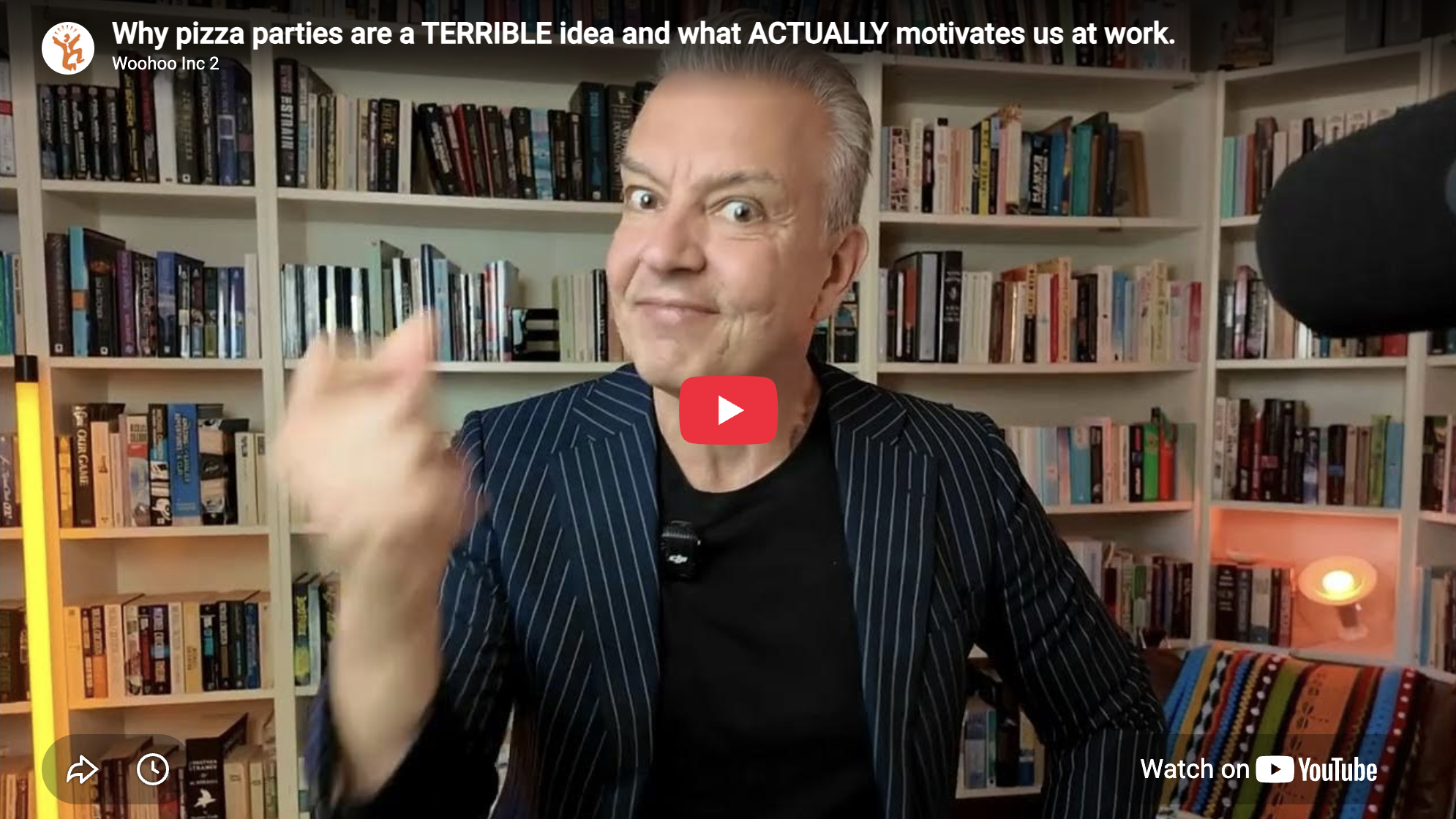
    In this video, we show why good workplace relationships are crucial and how to build them,

    Check out this great example

    Here’s a great example: I did a workshop for a client here in Denmark and afterwards their two managers did an amazing random act of kindness where they handed out breakfast (unannounced) one Monday morning.

    So try it out today and report back how it went.


  • Effort vs. Results: Who Really Deserves recognition?

    Effort vs. Results: Who Really Deserves recognition?

    Imagine two salespeople at the same company.

    Johnson is a consummate professional. She’s an accomplished rep who is always ready to support her clients and colleagues. However, due to circumstances beyond her control—perhaps a major account goes bankrupt or her region hits a recession—she misses her quarterly target.

    Smith, on the other hand, is lazy. He’s incompetent and never goes the extra mile. Yet, by pure luck, he hits his numbers. Maybe a massive order falls into his lap by chance, or his territory is experiencing an unrelated boom.

    Which of them deserves recognition? To me, the answer is clear: it is fairer and more beneficial for the company’s future to reward the person who delivered the superior effort.

    The “Luck” Bias

    Most companies do the exact opposite. They give out recognition and rewards based on results alone, probably because results are easier to measure.

    But there’s also something else going on: a systematic bias we chronically underestimate: the “luck factor.”

    Daniel Kahneman is the only psychologist who’s been awarded a Nobel Prize. He won it in economics, since there is no Nobel Prize in psychology, for his work in identifying how humans make decisions and founding the field of behavioral economics.

    One of his most intriguing findings is that we massively overestimate the effect of our own actions while ignoring the role of chance. When things go well, we take the credit—even if we mostly just got lucky.

    It is demoralizing for high-effort employees to watch less competent, luckier colleagues walk away with the accolades and the checks.

    The Problem with Bonuses

    Some companies try to fix this with more complex bonus structures, but these rarely work. Experience shows that bonus schemes are either so simple they are unfair, or so complicated that no one understands them. Research even suggests that heavy reliance on these rewards can lead to poorer results and lower motivation.

    The solution is simple: Leaders must focus more on rewarding effort than on raw results. We must recognize those who do an amazing job and, crucially, those who help others improve.

    A Better Way

    Next Jump, a New York-based company, provides a brilliant example. Their most prestigious award isn’t based on sales performance, but on who helped their colleagues the most.

    In this video you can see their 2014 awards ceremony:

    Shifting focus this way isn’t easy—results are easily measurable, while recognizing effort requires leaders to have a closer connection with their employees and deeper insight into daily work.

    But there are three reasons why it’s worth the extra energy:

    1. Effort is not reliant on luck: While results can be a fluke, great effort is a product of talent and attitude. These are the traits that should be celebrated.
    2. Effort wins the long game: We shouldn’t just optimize for this month; we should be optimizing for the next many months.
    3. It prevents suboptimization: If I am only rewarded for my own sales, why would I ever help a teammate? Focusing on effort builds a culture of long-term health rather than short-term greed.

    The Upshot

    Leaders should acknowledge the work, not just the win. In the long run, this creates more fairness, higher motivation, and—ironically—better results.


    Your Take

    What is valued most in your workplace—results or effort? How does that approach affect your engagement and your team?

    Leave a comment below—we’d love to hear your take.


  • March 31 is International Quit Your Crappy Job Day

    March 31 is International Quit Your Crappy Job Day

    Too many people are stuck in jobs they hate that are wearing them down.

    We want to inspire many more people to get out of jobs that are making them unhappy, so we’ve declared March 31 to be International Quit Your Crappy Job Day and have created a web site to match at www.internationalquityourcrappyjobday.com.

    On the site you can take a test to see if it might be time to quit and you can get our best tips on how to actually quit.

    There are also a ton of stories from people who found the courage to quit bad jobs. This one is my favorite.

    So if you are not happy at work, take a look at the site. Or if someone you know and love is stuck in a crappy job, consider sharing the site with them.

    We want more people to quit, but more than that we want many more people to realize that they have that option. Because if you hate your job, but believe that you are not free to quit and get away, the situation gets much, much worse.


  • Do you want to be a Chief Happiness Officer?

    Do you want to be a Chief Happiness Officer?

    We have just announced the next Chief Happiness Officer Academy: June 2-5, 2026 in Copenhagen.

    Join us in the world’s happiest city for this in-depth training that will give you:

    • A thorough background in the latest science and research in happiness at work
    • Simple, proven tools that you can use to make workplaces happier and more successful
    • An international network of people who are as passionate about workplace happiness as you are

    It is also a ton of fun and incredibly highly rated. Over 200 previous participants have rated it 9.6 / 10.

    The training is perfect for:

    • External consultants who want to build a business delivering happiness trainings to clients
    • HR professionals, managers and internal facilitators who want to get the knowledge and tools to make their organization happier


    Read more and apply here.


  • How happy (or unhappy) are you at work? Take our test and find out!

    The first step to improving anything is knowing just where you stand.

    Take our quick test and discover how happy (or unhappy) you are at work. After you submit your answers, you will see a video explaining your result and what you can do about it.

    The test only has 10 questions and takes no more than 2 minutes to fill out. It is completely anonymous and free.


  • Free online course starting soon: How to be happy at work!

    Work does not have to suck. There are proven ways to transform your career from crappy to happy and get a work life that you can actually enjoy.

    In this free online course the world’s leading expert on happiness at work takes you through the research that shows exactly what it takes to be happy at work (it’s NOT what most people think) and gives you the practical resources and simple tools you need to get there.

    Your happiness at work is your responsibility and if you take that responsibility seriously, you can completely transform your work life and become less stressed, healthier, happier AND more successful.

    Here’s why you should sign up right now:

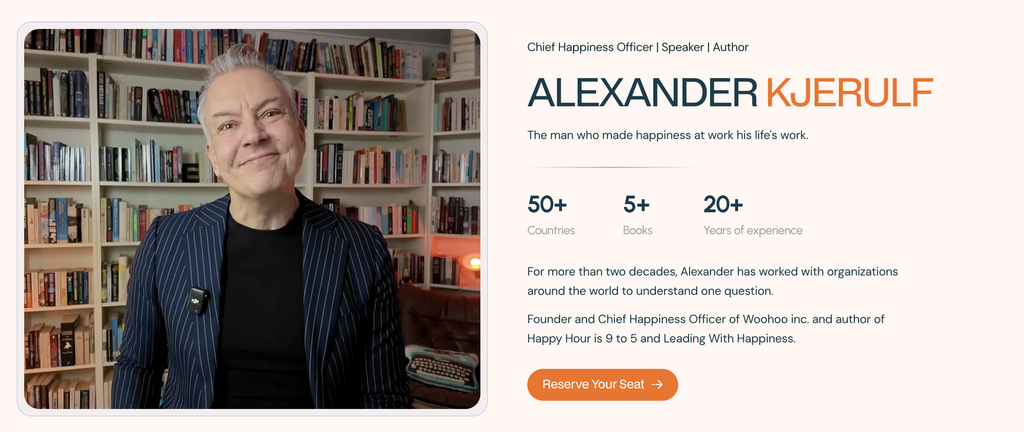
    1. It’s taught by Alexander Kjerulf, the world’s leading expert on happiness at work with over 20 years of experience speaking on the topic all over the world.
    2. It’s 100% evidence-based. Everything is supported by science and research.
    3. It’s practical and hands-on. It gives you effective, simple actions you can take and assemble into a plan that’s specific to your needs and circumstances.
    4. It’s fun and entertaining. No dry boring theoretical lectures – it’s snappy, to the point and has lots of laughs.
    5. And of course: IT’S FREE!

    Still not convinced? Here are some of the (many) things you’ll learn in the course:

    • The two things that really make you happy at work and why most people get it wrong.
    • What are the main things that make us unhappy at work and what to do about them.
    • Why being happy at work is great for your health, your private life and your career goals.
    • The harmful effects of being miserable at work.
    • The mental traps that keep people stuck in bad jobs and how to avoid them.
    • How you can craft a specific achievable plan to become happy at work.
    • Measure your current happiness at work and track your progress.

    But wait – there’s more :)

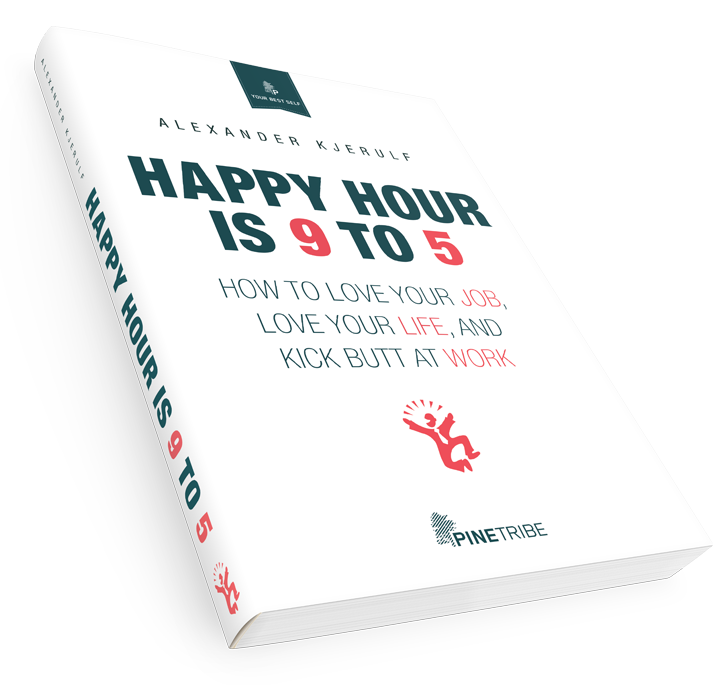
    When you sign up you also get a free copy of Alex’s book “Happy Hour Is 9 To 5” AND you get access to an online forum where you can share experiences and tips with fellow attendees and ask questions of Alex.

    The course opens on January 26. Sign up now and be the first to get access. And did we mention: It’s FREE :)


  • 10 Simple Questions To Make 2026 Your Happiest Year At Work

    10 Simple Questions To Make 2026 Your Happiest Year At Work

    The beginning of a new year is a great time to take stock of your work life. Are you happy or unhappy at work? What would you like to change?

    It’s important to evaluate, because how you feel at work has such a large influence on you at work AND at home. When you’re happy at work, you have better job performance and more career success. You also have better health and a happier private life.

    Unfortunately most people look back and think exclusively in terms of what went wrong. The things they should have done. They goals they ought to have achieved. The progress that didn’t come.

    We gain much of our happiness at work (and in life) by appreciating the good things we have and do. Sure, you should also make sure to improve your circumstances and address any problems but it is just as important to be able to appreciate the things that do work.

    This is hard. Negativity bias is one of the most well-established psychological phenomena and it means quite simply that our minds devote more mental focus and cognition to the bad than the good. Our thoughts automatically go to problems, annoyances, threats and fears but remembering and appreciating the good in our lives takes effort and focus.

    We think you can achieve much more by turning that around 180 degrees, so here’s our suggestion for a simple new year’s exercise in happiness at work.

    Think back at your work life in 2025 and answer the following 10 questions. It works best if you take some time to think about each question and if you write down your answers.

    1. What went really well for you at work in 2025?
    2. What did you do that you were proud of?
    3. Who did you make a difference for at work?
    4. What new skills have you learned professionally?
    5. How have you grown and developed personally at work?
    6. Who has helped you out at work in 2025? How can you thank them?
    7. Who have you admired professionally? How can you let them know?
    8. Which 5 things from your work life in 2025 would you like more of in 2026?
    9. Which 5 things from your work life in 2025 would you like less of in 2026?
    10. What will you specifically do to become happier at work in 2026?

    Some people think that they must work hard to become successful – and that success will make them happy. The truth is the opposite: being happy makes you more effective and successful at work.

    So this year, make happiness at work your #1 career goal – because being happy at work will make you more successful in your career.

    And that may require some tough decisions. If you find that you’re just not happy at work, maybe it’s time to find a new job. Fortunately, International Quit Your Crappy Job Day is just around the corner.

    I wish you a very happy new year at work!


  • Free webinar December 17: How to create a happy finance workplace

    Free webinar December 17: How to create a happy finance workplace

    Happy companies make more money and tons of studies prove it.

    I see an increased focus on employee happiness in many industries – including in finance. I have personally worked with so many banks, pension companies and insurance companies that came to the realization that happier employees lead to a better bottom line. That’s great!

    However, workplaces in this sector also face a number of challenges that can cause frustration, stress and burnout if we don’t address them.

    In this webinar we will cover:

    • Why happy employees are great for the bottom line in finance
    • The biggest challenges and stressors in the industry
    • How exactly to make finance workplaces happy
    • Great examples from some of the happiest companies I know in the sector

    We’ll keep the whole thing fun and snappy and be done in just 30 minutes.

    Date and time: Wednesday December 17, 9AM ET / 3PM CET.

    Sign up right here.


  • How Performance Goals Can Boost Employee Happiness And Productivity

    Many workplaces have an unhealthy obsession with measuring the performance of their employees. Everyone must have goals and KPIs and be evaluated on whether or not they meet them.

    In practice, this often ends up demotivating employees and fostering a large number of unhelpful and unproductive behaviors.

    In this webinar we uncover what the research says about productivity goals (it’s NOT pretty) and show how workplaces can measure performance in way that actually make employees happier, more motivated and more productive.

    Content includes:

    • How performance goals foster the wrong behavior and LOWER performance
    • What to measure and what NOT to measure
    • 5 tips to measure performance in a better way
    • Great examples from happy workplaces around the world

  • AI and happiness at work – can the two coexist?

    AI is being introduced in many workplaces but what’s been missing is a discussion on how to do it in a way that doesn’t kill the happiness, motivation and creativity of employees.

    In this free webinar we showed companies can introduce AI in ways that make employees’ jobs more fun and interesting instead of just making people afraid to lose their jobs.


Get our newsletter

“I can’t believe it – a newsletter actually worth reading!”
– Subscriber

Over 6,000 people subscribe to our newsletter with tons of tips about happiness at work.


Get our books

“It’s very, very good. It’s incredibly well written, full of insights, and there are exercises to improve your own happiness at work. You can’t ask for more than that!”
– David Maister, author of Practice What You Preach

“What an inspiring book. Every leader should read it. This type of leadership has been integral to our success and I know it will boost your results too.
– Garry Ridge, CEO WD-40 Company


Get Our Free Newsletter

Over 6,000 people already get our free newsletter with useful tips, videos, links and articles about happiness at work.
Subscribe to our newsletter here.