Category: Leadership

Leadership is an insanely important discipline. Here you’ll find the thought, tools and tricks of the trade of great leaders.

  • 3 reasons why leaders should recognize effort instead of results

    3 reasons why leaders should recognize effort instead of results

    Here’s a thought experiment for you: Imagine two sales people working for the same company but in different regions.

    Johnson slaves away in her area. She does a great job, she’s a professional and accomplished sales rep and she’s always ready to help her clients and colleagues. However, due to circumstances beyond her control she doesn’t reach her sales target this quarter. Maybe her biggest account goes bankrupt or maybe there’s just less economic activity in her region.

    Smith, on the other hand, is lazy. He is not very competent and he never bothers to go the extra mile to help his colleagues or his clients. But due to circumstances beyond his control he achieves his sales target nonetheless that quarter. Maybe a big order drops in completely by chance, or maybe the growth in his region is increasing, or maybe his sales target just wasn’t ambitious enough from the start.

    Which of the two deserves praise and recognition? Johnson, who does a great job, but performs below target or lazy Smith, who just got lucky this budget year?

    To me it’s pretty obvious that it’s both better, more fair and more helpful to the future results of the company to acknowledge and reward the employees who have delivered the bigger effort.

    And of course most companies do the opposite and reward only results, partly because results are easier to measure, but also because of we have a systematic bias for underestimating the ‘luck’-factor.

    Daniel Kahneman is the only psychologist who’s been awarded a Nobel Prize. However he won it in economics, since there is no Nobel Prize in psychology. He got the prize for his work with identifying how humans make decisions and founding the field of behavioral economics.

    One of the intriguing results of his research is that we highly underestimate the impact that luck has in many situations, and we massively overestimate the effects of our own actions. Good results are often due to luck (at least in part), but we choose to take credit for them anyway.

    It’s extremely demotivating to those employees who have made an extra effort but don’t get recognition for it, to stand by and see their less competent (but luckier) colleagues receive both accolades and financial rewards.

    Some companies try to solve the problem by creating more complicated bonus structures, but that’s rarely a good solution. Experience shows that bonus schemes are either so simple that they’re almost sure to be unfair to somebody, or so complicated that no one can make heads or tails of them. The study also shows that bonus schemes and rewards on the whole lead to poorer results, less motivation and inferior efforts. I’ve blogged about this before in this column.

    To me the solution is simple: Leaders must focus just more on the effort of employees than on just their results. We must recognize not only those who reach their goals, but especially those who do an amazing job and even more so those who help others to become better at their job.

    One great example if this is the New York-based company Next Jump. Their most important and prestigious employee award is not given based on performance but based on who helps others the most. In this video you can see their 2014 awards ceremony:

    It’s not so straightforward, as results tend to be more measurable and visible. Encouraging a great effort will require that we as leaders have more insight and show more interest in our employees’ daily work. However there are three good reasons why we should do it anyway, even if it’s more demanding on us.

    Effort is not reliant on luck
    While good results may be due to luck, great effort is always due to the employee’s talents and attitude – and those employees who consistently demonstrate and improve skills, should clearly be recognized and celebrated.

    A strong effort will – in the long run – always lead to better results
    It’s no good if we only optimize for this quarterly result. We are optimizing for the next 20 or 30 quarterly results.

    We avoid suboptimization
    If we only recognize the employee’s results, we’re creating a culture in which we’ll do anything to obtain results – instead of doing what’s right for the clients and for the long term targets of the company. If I only get rewards for achieving my own sales targets, why on earth should I spend time and effort helping my colleagues?

    The upshot

    So leaders must encourage and acknowledge effort rather than results. In the long run it will create more fairness, more motivation and – ironically – better results.

    Your take

    What is valued most in your workplace – results or efforts? What does that approach do for your motivation and engagement? How has it affected you and your coworkers?

    Write a comment – we’d love to hear your take.

    Related posts

  • How always being busy kills productivity – and 5 ways to avoid it

    How always being busy kills productivity – and 5 ways to avoid it

    “Your car is having trouble and will need repairs at a cost of around $1,500. How would you handle that situation?”

    Scientists from the University of Warwick led by professor Anandi Mani stopped customers at a New Jersey mall and asked them that question. Next the subjects took an IQ test and the results was stunning: For financially well-off participants, this question did not affect their IQ scores in any way. But people who were struggling financially underperformed by 13 IQ-points simply because their money worries had been brought to their attention.

    This experiment is described in the excellent book “Scarcity – Why Having Too Little Means So Much” by professor of economics Sendhil Mullainathan and professor of psychology Eldar Shafir, in which the two scientists clearly lay out the negative cognitive effects of scarcity.

    When we have too little of something that is important to us we become a little dumber, less disciplined and we make poor choices. This helps explain – among many other things – why poor people keep taking out pay-day loans, even when they should know better and even though those incredibly expensive  loans just put them deeper in the hole.

    And this is not only about lack of money; the book gives plenty of examples of how time scarcity has the same kind of effects, making us dumber and worse at managing what little time we do have effectively.

    So, knowing this, why is it that so many workplaces mercilessly keep putting their employees under massive time pressure? Why do leaders consistently create time scarcity?

    This happens when:

    • Employees are routinely expected to increase their productivity year after year with little or no additional support, training or resources.
    • A manager commits to their team doing more work with the same staff.
    • A company is growing and taking on new clients/projects without a commensurate increase in staff and resources.
    • An organization lays off staff but expects the reduced staff to the same amount of work.
    • Schedules are filled to capacity with meetings and tasks before the work week even starts, leaving no time for ad-hoc or unexpected tasks.

    Some leaders think that these situations create a burning platform that pressures employees to work effectively and creatively towards the company’s goals, but the truth is the opposite: Time scarcity reduces employees’ cognitive resources and makes it much harder for them to do their jobs well.

    And what’s worse, this can become self-reinforcing. Here’s an example: An organizations reduces headcount leading to increased time pressure and scarcity among those left. This weakens their cognitive capacity and productivity drops, leading to even more busyness and scarcity.

    Is this something you see happening in your workplace? Here are 5 things we can do about it.

    1: Take time pressure off employees

    Instead of giving employees hard-to-reach productivity goals and filling their work week to the brim (and beyond) we need to give them more realistic goals and leave some slack in their schedules so any ad-hoc task that comes along (as it inevitably will) does not topple the whole load.

    Most employees actually get more work done when they have productivity goals that are reasonable and within their capacity.

    Here’s a great example: The IT company Menlo Innovations in Ann Arbor only lets employees work 40 hours a week and then only schedules 32 hours of work per employee per week. That way there is no time scarcity and always time for unexpected tasks. This is described in the excellent book “Joy Inc” by Menlo’s CEO Rich Sheridan.

    2: Celebrate good performance

    We also need to constantly praise and appreciate people and teams for the good work they do. This give employees a sense of accomplishment and purpose that goes a long way towards combatting time scarcity.

    Some workplaces do the opposite though: First giving people unrealistic goals and then hitting them over the head for not reaching those goals.

    3: Leave time for learning and development

    Every single employee must have time to get better. To learn new professional and personal skills. To reflect on what is working well and what can be improved in the workplace.

    This becomes near-impossible under time scarcity, preventing employees from getting better at their jobs.

    The IT company Next Jump in New York give each employee significant time every week to develop their skills with a mentor, in weekly meetings or on their own. That way employees always have time for growth and development, which they deem essential to their success. Here’s a great article on how they do it.

    4: Maintain good workplace relationships

    One of the first things to go in a workplace facing time scarcity is the workplace relationships.

    When we are very busy it becomes exponentially harder to care about other people, to help and support co-workers and to maintain a habit of helping each other.  Needless to say, this just makes the effects of busyness that much worse.

    Instead we need to make sure that there is always time to create and maintain relationships between employees. There should always be time for a coffee break and a chat with a co-worker. No one should eat lunch alone at their desk. Even something as simple as saying a cheerful “good morning” to your team mates in the morning can make a positive difference – and can be neglected and forgotten under time scarcity.


    5: Avoid permanent overwork

    Some companies try to solve this by making people work more hours. Don’t!

    First of all – overwork can kill you:

    … those working a 55-hour week face 33% increased risk of stroke than those working a 35- to 40-hour week.

    And to make matters worse, all those extra hours don’t even mean you get more work done:

    [Overwork] … doesn’t seem to result in more output.

    So overwork is killing employees while not improving business results. Can we stop it already?

    It’s a topic I’ve talked about a lot on this blog.

    The upshot

    Simply put, many workplaces put employees in a situation of near-permanent time scarcity, thinking this will pressure them to work harder. The truth is the opposite: It makes them more stressed, more sick, less happy and less productive.

    Instead, we should do our very best to reduce time pressures because that way, the organization will be more successful.

    Your take

    Do you see any of this happening in your workplace? Is time a scarce resource and how does it affect you?

    Write a comment, we’d love to hear your take.

    Related posts


  • 5 lessons you can learn from Denmark’s happiest call center

    Call centers are notoriously tough workplaces.

    But City Call Center in Copenhagen is different. Very different. They were recently named one of Denmark’s best workplaces in the Great Place to Work Survey and people love working here.

    In this interview, their founder and CEO Pouline Mangaard explains how she has created the (nearly) impossible: A happy call center.

     Her ideas are simple, effective and are relevant in any kind of workplace.
  • Book review: Payoff by Dan Ariely

    screen-shot-2016-09-16-at-10-08-45

    Payoff, The Hidden Logic That Shapes Our Motivations, is a short book with an important message: “We suck at motivation.”

    Based on fascinating research from workplaces and psychology labs  all over the world, the book documents how we consistently fail to understand what really motivates ourselves and others and consequently end up  killing motivation off, when we try to strengthen it, much of the time.

    Nowhere is this more obvious than in the workplace, where a blind belief in the power of bonuses, raises, promotions and perks has kept managers doing the wrong things for (or to) their employees for decades.

    Dan Ariely, a professor of Psychology and Behavioral Economics at Duke University, is the perfect person to convey this message. As a researcher he has conducted fascinating and very elegant experiments to uncover what motivates and demotivates us. He shared two of these in this TED talk:

    In Payoff he uses his own research and that of others to get to the truth of motivation. And while he clearly shows that performance bonuses can actually reduce performance, he also shares the factors that motivate us to do better. These include things like praise, meaningful work and a real connection to the people you work with.

    This is a short book (120 pages) but that just counts in its favor, in my opinion. It is a captivating read, incredibly useful and highly entertaining – in fact I laughed our loud several times while reading it.

    In short, I hope I have motivated you to read this book :)

    Related posts


  • Why workplaces should let employees choose their own manager

    If you don’t have a good relationship with your manager, you will never be happy at work. But how can a workplace ensure that every employee has the right manager – someone they trust, like, respect and communicate well with?

    London-based training company Happy have come up with a radical but simple solution: Let every employee pick their own manager.

    That way, anyone who is not happy with their boss can simply pick a new one. Incidentally, bad bosses quickly find themselves without employees, eliminating that particular problem.

    In this inspiring speech their founder Henry Stewart shares how they do it along with two other great practices that have made Happy so… happy :)

  • Bob Sutton’s EXCELLENT advice on dealing with a bad boss

    How should you deal with a bad boss? Here’s some EXCELLENT research-based advice from Stanford Professor Bob Sutton (51 mins into the video).

    On a related note, a journalist once asked me during an interview why employees put up with bad bosses.

    Without thinking about it I blurted out “Stockholm syndrome.”

    I only later realized I may have been right.

    Related posts

  • Podcast with Søren Lockwood – a (very happy) financial CEO

    Michal Srajer, one of our Partners in Prague, is currently travelling the world and interviewing many different people for his podcast about happiness at work. His first interview was with me and you can hear it here.

    His second podcast features Søren Lockwood, the CEO of SEB Pension in Denmark, who took his company of 300 serious financial professionals in dark suits through a transformation that has resulted in happier employees, lower absenteeism, happier customers and better results.

    You can hear the podcast here:

    https://soundcloud.com/happinesspodcast/02-happiness-at-seb-pension-with-soren-lockwood-ceo

    Søren Lockwood also spoke at our conference this year in Copenhagen, where examined the classic question of whether  you can prove that happiness at work is good for the bottom line. He gave the best answer EVER:


  • At IKEA, umbrellas are CHEAPER when it rains

    Complete this sentence: “When it rains, the price of umbrellas goes __.”

    If you guessed up you’d be right in most places. But at IKEA stores, you’d be wrong.

    Here’s how they price their umbrellas depending on the weather:

    ikea-umbrella

    Yes, on rainy days, umbrellas are cheaper :o) What a nice way to make customers happy.

    This is no coincidence – happiness matters at IKEA. Their founder, Ingvar Kamprad, once said this:

    Work should always be fun for all colleagues. We all only have one life. A third of life is work. Without desire and fun, work becomes hell.

    To me, this attitude only makes sense. Making your employees happy makes the business more profitable and making your customers happy keeps them coming back.

    It ain’t rocket surgery, and fortunately more and more companies are figuring this out and committing themselves to happiness at work.

  • 3 advanced tips for creating a happy workplace from Henry Stewart

    Henry Stewart is the found of Happy, a company in London that does computer and happiness trainings. They are also (naturally) a very happy workplace.

    In this speech, Henry shares 3 more advanced tips for creating a happy workplace:

    1. Let employees choose their boss
    2. Give pre-approval on big projects
    3. Celebrate mistakes
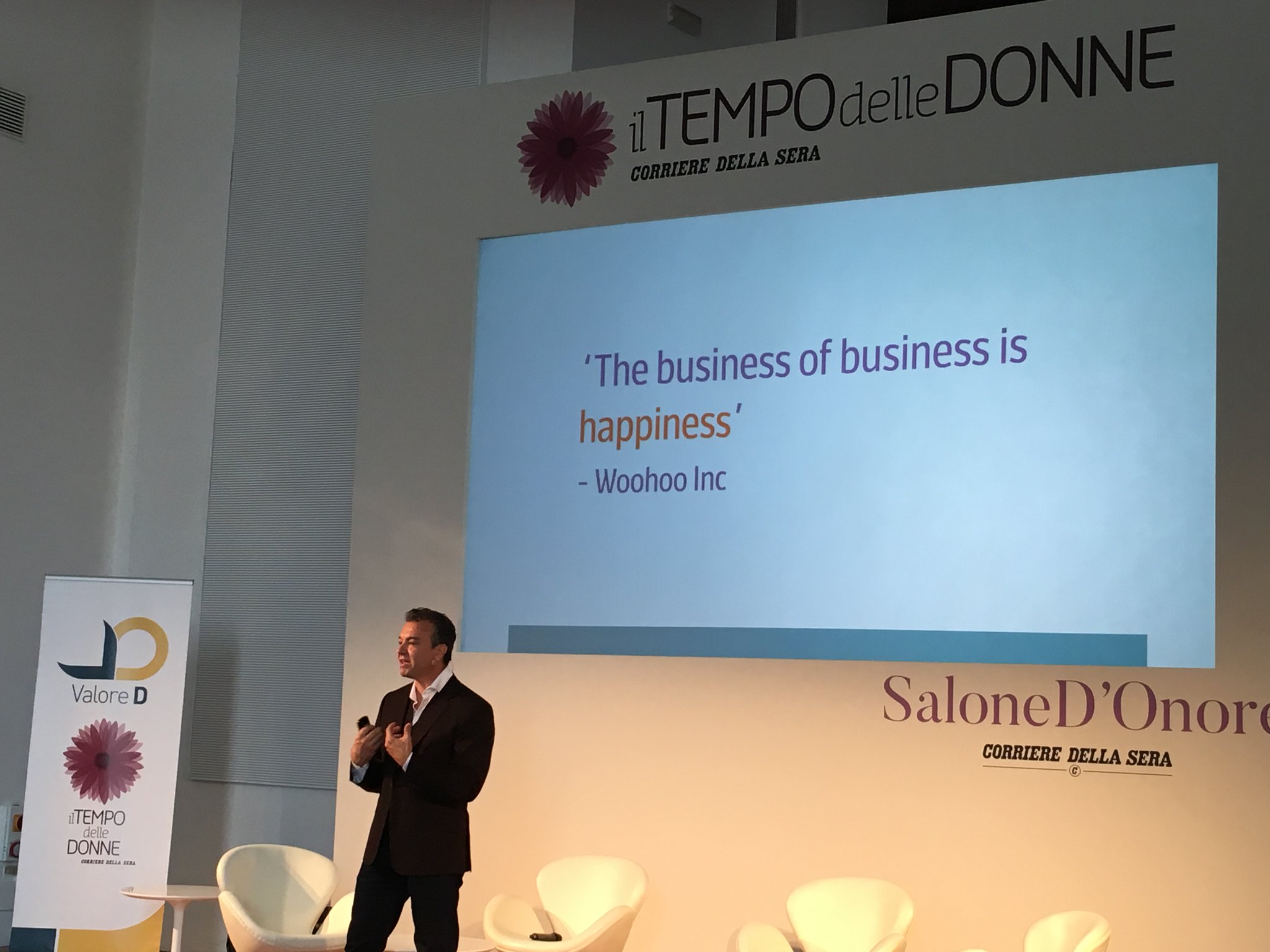
  • The business of business is business? Not so fast!

    The economist Milton Friedman famously once said that “The business of business is business.”

    We respectfully disagree.

    cr5rdluueaazsj_

    Here’s why.