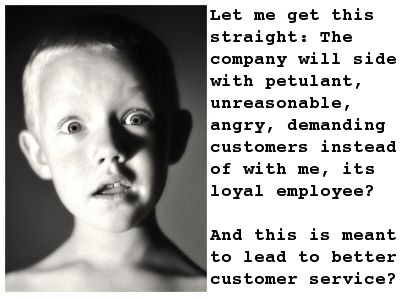
Top 5 reasons why “The Customer Is Always Right” is wrong

When the customer isn’t right - for your business
One woman who frequently flew on Southwest, was constantly disappointed with every aspect of the company’s operation. In fact, she became known as the “Pen Pal” because after every flight she wrote in with a complaint.
She didn’t like the fact that the company didn’t assign seats; she didn’t like the absence of a first-class section; she didn’t like not having a meal in flight; she didn’t like Southwest’s boarding procedure; she didn’t like the flight attendants’ sporty uniforms and the casual atmosphere.
Her last letter, reciting a litany of complaints, momentarily stumped Southwest’s customer relations people. They bumped it up to Herb’s [Kelleher, CEO of Southwest] desk, with a note: ‘This one’s yours.’
In sixty seconds, Kelleher wrote back and said, ‘Dear Mrs. Crabapple, We will miss you. Love, Herb.’”
The phrase “The customer is always right” was originally coined by Harry Gordon Selfridge, the founder of Selfridge’s department store in London in 1909, and is typically used by businesses to:
- Convince customers that they will get good service at this company
- Convince employees to give customers good service
Fortunately more and more businesses are abandoning this maxim - ironically because it leads to bad customer service.
Here are the top five reasons why “The customer is always right” is wrong.
1: It makes employees unhappy
Gordon Bethune is a brash Texan (as is Herb Kelleher, coincidentally) who is best known for turning Continental Airlines around “From Worst to First,” a story told in his book of the same title from 1998. He wanted to make sure that both customers and employees liked the way Continental treated them, so he made it very clear that the maxim “the customer is always right” didn’t hold sway at Continental.
In conflicts between employees and unruly customers he would consistently side with his people. Here’s how he puts it:
When we run into customers that we can’t reel back in, our loyalty is with our employees. They have to put up with this stuff every day. Just because you buy a ticket does not give you the right to abuse our employees . . .
We run more than 3 million people through our books every month. One or two of those people are going to be unreasonable, demanding jerks. When it’s a choice between supporting your employees, who work with you every day and make your product what it is, or some irate jerk who demands a free ticket to Paris because you ran out of peanuts, whose side are you going to be on?
You can’t treat your employees like serfs. You have to value them . . . If they think that you won’t support them when a customer is out of line, even the smallest problem can cause resentment.
So Bethune trusts his people over unreasonable customers. What I like about this attitude is that it balances employees and customers, where the “always right” maxim squarely favors the customer - which is not a good idea, because, as Bethune says, it causes resentment among employees.
Of course there are plenty of examples of bad employees giving lousy customer service. But trying to solve this by declaring the customer “always right” is counter-productive.
2: It gives abrasive customers an unfair advantage
Using the slogan “The customer is always right” abusive customers can demand just about anything - they’re right by definition, aren’t they? This makes the employees’ job that much harder, when trying to rein them in.
Also, it means that abusive people get better treatment and conditions than nice people. That always seemed wrong to me, and it makes much more sense to be nice to the nice customers to keep them coming back.
3: Some customers are bad for business
Most businesses think that “the more customers the better”. But some customers are quite simply bad for business.
Danish IT service provider ServiceGruppen proudly tell this story:
One of our service technicians arrived at a customer’s site for a maintenance task, and to his great shock was treated very rudely by the customer.
When he’d finished the task and returned to the office, he told management about his experience. They promptly cancelled the customer’s contract.
Just like Kelleher dismissed the irate lady who kept complaining (but somehow also kept flying on Southwest), ServiceGruppen fired a bad customer. Note that it was not even a matter of a financial calculation - not a question of whether either company would make or lose money on that customer in the long run. It was a simple matter of respect and dignity and of treating their employees right.
4: It results in worse customer service
Rosenbluth International, a corporate travel agency, took it even further. CEO Hal Rosenbluth wrote an excellent book about their approach called Put The Customer Second - Put your people first and watch’em kick butt.
Rosenbluth argues that when you put the employees first, they put the customers first. Put employees first, and they will be happy at work. Employees who are happy at work give better customer service because:
- They care more about other people, including customers
- They have more energy
- They are happy, meaning they are more fun to talk to and interact with
- They are more motivated
On the other hand, when the company and management consistently side with customers instead of with employees, it sends a clear message that:
- Employees are not valued
- That treating employees fairly is not important
- That employees have no right to respect from customers
- That employees have to put up with everything from customers
When this attitude prevails, employees stop caring about service. At that point, real good service is almost impossible - the best customers can hope for is fake good service. You know the kind I mean: corteous on the surface only.
5: Some customers are just plain wrong
Herb Kelleher agrees, as this passage From Nuts! the excellent book about Southwest Airlines shows:
Herb Kelleher […] makes it clear that his employees come first — even if it means dismissing customers. But aren’t customers always right? “No, they are not,” Kelleher snaps. “And I think that’s one of the biggest betrayals of employees a boss can possibly commit. The customer is sometimes wrong. We don’t carry those sorts of customers. We write to them and say, ‘Fly somebody else. Don’t abuse our people.’”
If you still think that the customer is always right, read this story from Bethune’s book “From Worst to First”:
A Continental flight attendant once was offended by a passenger’s child wearing a hat with Nazi and KKK emblems on it. It was pretty offensive stuff, so the attendant went to the kid’s father and asked him to put away the hat. “No,” the guy said. “My kid can wear what he wants, and I don’t care who likes it.”
The flight attendant went into the cockpit and got the first officer, who explained to the passenger the FAA regulation that makes it a crime to interfere with the duties of a crew member. The hat was causing other passengers and the crew discomfort, and that interfered with the flight attendant’s duties. The guy better put away the hat.
He did, but he didn’t like it. He wrote many nasty letters. We made every effort to explain our policy and the federal air regulations, but he wasn’t hearing it. He even showed up in our executive suite to discuss the matter with me. I let him sit out there. I didn’t want to see him and I didn’t want to listen to him. He bought a ticket on our airplane, and that means we’ll take him where he wants to go. But if he’s going to be rude and offensive, he’s welcome to fly another airline.
The fact is that some customers are just plain wrong, that businesses are better of without them, and that managers siding with unreasonable customers over employees is a very bad idea, that results in worse customer service.
So put your people first. And watch them put the customers first.
UPDATE:
This post has spawned a great discussion here and one some other websites.
Digg
“One of the consistent back up statements of “The Customer is Always Right” is the amount of dollars it costs to replace a customer. It costs more to replace a customer than to retain one most times. However, it also costs a lot more to recruit, hire, and train a new employee than it does to keep one happy.”
Kinkoids Unite - a site for Kinko’s workers
“In my region, when an employee is mentioned in a customer complaint, he/she has to apologize to all 11 center managers in a conference call whether they were wrong or wronged.”
AdultDVDTalk (huh?)
“Unfortunately though, most companies in the customer service arena no longer even teach the basics of customer service. They just assume that it is a common-sense thing. Having spent 20 years interviewing job applicants, I can also say that there is no such thing as common sense! Just take a look at the high school and college grads showing up for job interviews in jeans and tee-shirts or chewing gum…or my favorite was the young lady who excused herself to answer her cell phone and carry on a brief but totally unnecessary conversation!”
Reddit
“On a very, very small number of occasions in my various service roles over the years, I’ve asked customers to leave the establishment because they were incorribly belligerent, hostile and abusive, and flat-out refused to accept any attempt to satisfy them. In these cases, the people were shopping for a fight rather than a commodity.”
If you liked this post, there’s a good chance you’ll also enjoy:
Permalink
Spread the message:
reddit
del.icio.us
digg


sonitus.org » Blog Archive » Why “The customer is always right? results in bad customer service Said,
July 12, 2006 @ 2:30 pm
[…] Positive Sharing […]
kareem Said,
July 12, 2006 @ 7:49 pm
In “Losing My Virginity“, Richard Branson outlined his philosophy of taking care of his employees first, so they would take care of his customers.
It was counter-intuitive and yet made so much sense to me. You can’t force good customer service. An employee must have an intrinsic desire to do the right thing on behalf of the company, and the only way to encourage that intrinsic desire is to treat employees right!
Jason Said,
July 18, 2006 @ 1:06 am
This fact was never more apparent to me than when I compared my job as a camp counsellor teaching sailing to my job as a sales clerk at Wal-Mart. Teaching sailing, I never had problems with my kids, since I had the full authority and trust of my managers behind me… I had more troublesome *adults* at Wal-Mart because they have been led to believe they could act like children whenever they pleased, and there was nothing I could do about it since management would invariably side with the customer.
Guess what job I liked more and worked harder at?
Chaz Said,
July 18, 2006 @ 1:06 am
A moment of truth for this philosophy comes for those firms with a small number of clients holding a large percentage of the revenue. You cannot simply tell a top 5 client to “fly someone else” when there are satisfaction issues. In some respects you are forced to cater to those large clients, sometimes to the detriment of your relationship with your employees.
Osmanthus Said,
July 18, 2006 @ 1:12 am
You might as well argue against barking up trees because you’ll loose your voice from all that barking. The phrase “The customer is always right” is an idiom. Arguing against its literal meaning exposes a certain illiteracy in the author.
Julio Nobrega Said,
July 18, 2006 @ 1:34 am
I live from 9-5 on number 2. My boss said to our costumers that they can ask whatever they want (ooops) for our software and that we would implement it in days, if not in hours (oooops number 2).
In fact, my boss gets super-mad when a client complains that something they asked is late. Not that we give deadlines, or document, or have any kind of follow-up to requests. I don’t have time to do these stuff. It’s always code, code, code.
We can never scale this way. 3 of our clients are *very* “abusive”. They want their stuff, their way. Up to the point that I had to code some conditions, “if client = 1 do ‘X’ else do ‘Y’”.
These 3 clients take the majority of my daily activities. When a nice client asks for something and I tell my boss about it, he says something like “But you gotta do X because the client is screaming at us”.
So the features asked by the nice clients are put away, until they start to complain.
I tell ya, It’s a vicious circle of evil.
Dan Walsh Said,
July 18, 2006 @ 3:01 am
All good points, for mine, point 2 deserves some more attention.
As a consumer and/or business partner I was taught early on that the ’squeaky wheel gets the oil’. This can be taken at two levels, and there is an important distinction between the two.
Face Value = Good customer interaction: At its base level it’s reasonable to assume that speaking up if something’s not as expected is a positive. By another name this is called ‘feedback’ and a clever organisation will act on it appropriately.
Manipulation = Bad customer interaction: A caniving customer will use this to accentuate their own service. They do this at the expense of your staff and by extension your other customers. An employee spending time responding to an innapropriate request can not respond to appropriate ones.
If a higher level of care is factored in to cater for ‘manipulating squeaky wheels’ this must come from your profit or higher prices imposed on good customer.
Aurora Said,
July 18, 2006 @ 3:14 am
@ Osmanthus:
Wrong. Illiterate is someone who A) uses “loose” improperly, and B) confuses “idiom” with “axiom”.
It’s rather the pot calling the kettle black. Now *that’s* an idiom.
3 reasons why customer reps who complain about their customers are crap | Money Matador Said,
July 18, 2006 @ 3:14 am
[…] I got inspired by these 5 reasons about why “The customer is always right” is wrong. I have thought about 3 reasons why customer service representatives who complain about their customers are crap. […]
Bruce Barr Said,
July 18, 2006 @ 4:12 am
Excellent post and I agree with everything except the last Continental exec’s excerpt. He/the company have the right to tell the customer to shove-off, every company has that right. However, no matter what you think of the offensivness of the cap, the FAA regulations argument is a pile of crap. When I fly, and I do on a regular basis, I do not give up my first ammendment rights as part of the ‘crew-member instructions” clause.
Tim Martin Said,
July 18, 2006 @ 4:58 am
Bruce Barr you have the right to walk as well.
If you were on my aricraft that is what you would be doing if you think your right to free speach overrides other peoples right to comfort and dignity under my watch.
If 20% of my customers are taking 80% of my time, I get rid of them and then have lots of time for my respectfull customers.
cmc Said,
July 18, 2006 @ 5:24 am
No kidding.
Ages ago, I worked customer service for a hardware store (nuts, bolts, ladders, paints, nails, etc.). One customer had the tenacity to argue “isn’t the customer always right?” when was dead wrong about a particular scheme. He was about to injure himself and/or someone else. This clearly falls under #5: “Some customers are just plain wrong.”
If a customer wants (even unintentionally) to harm his or herself or someone else, they can go to hell. They still get excellent service, but not assistance to do something stupid. This is not up for debate - nobody has time or the soul for lawsuits that attempt to hold some poor schmuck at $7/hr at the local True Value culpable for the insistent actions of the idiotic customer who really wanted to use his Ryobi nailgun for something other than its approved purpose.
Economysizegeek Said,
July 18, 2006 @ 5:30 am
In my line of work - we used to ask people the question - “Is the customer always right?” - The point of the question was actually that the real answer is that being “right” is rarely the point. Treat people fairly - both customer and employee - and you’ll come out a lot farther ahead than just listening to griefers.
BOB Said,
July 18, 2006 @ 5:36 am
Osmanthus,
“You might as well argue against barking up trees because you’ll loose your voice from all that barking. The phrase “The customer is always right? is an idiom. Arguing against its literal meaning exposes a certain illiteracy in the author.”
Your comment exposes a certain naivete. You obviously have not had to work for managers or companies that do take the idiom literally. Such as the one above, WalMart. This article strikes at the root of a huge problem in the U.S. Companies do not value their employees, everything now focuses on next quarters profits instead of long term goals, which includes treating your employees with dignity and respect so that the company can in turn benefit from the employees increased productivity.
Joe Idar Said,
July 18, 2006 @ 5:50 am
Here’s a twist to your article. I am a salesman at a company which always tells it’s salesman not to give in to customers requests, complaints, gripes and such. So they put us on the front line to draw the fire from the customer, but the instant the customer gets past our defensive line and gets to a manager the company policy becomes “THE CUSTOMER IS ALWAYS RIGHT!!!!”. This makes us look like the bad guys and the manager as the company hero.
Osmanthus Said,
July 18, 2006 @ 6:38 am
Aurora, its not so bad that you pedantically pick at a typo (lose,loose), but then you incorrectly say that the word is ‘axiom’; no my dear, the word I mean to use is indeed ‘idiom’. See http://dictionary.reference.com/browse/idiom meanings 1. and also 5.
Anonymous Said,
July 18, 2006 @ 7:55 am
Top 5 reasons why “The Customer Is Always Right? is wrong
The phrase “The customer is always right? was originally coined by Harry Gordon Selfridge, the founder of Selfridge’s department store in London in 1909.
dreamcatching » Blog Archive » When the customer is not right Said,
July 18, 2006 @ 8:15 am
[…] A very insightful post. […]
AD Said,
July 18, 2006 @ 8:30 am
You got some very good points. I usually say “the customer is always right” but I should probably say “the customer is usually right”. I love good customer service and value it highly. But I don’t like stupid and arrogant people to abuse it. And as your post mentions, it happens every now and then
I think it’s great to put the employees first as long as it also means great customer service. Some of your quotes in the post are from people famous for outstanding service and working hard to give customers what they want. That gives a lot more credibility to the faulty argument that customers are always right no matter what.
AD
English Said,
July 18, 2006 @ 8:54 am
Customers, like employees are humans who are a mix of good and bad. The fact that employees are screened but there is little choice in selecting customer leads to instances where some customers can be unreasonable. So, it’s always a matter of good judgement when it comes to serving an irate customer.
As important as it to treat employees, it’s equally, or more important to ensure the customer service processes are improved. At least twice when I had episodes of bad service due to the ‘process’, and terminated my account, the rep’s final question was ‘Is there anything else we can do for you?’
Osmanthus:…Never mind…
links for 2006-07-18 » One Born Every Minute Said,
July 18, 2006 @ 11:10 am
[…] Positive Sharing » Top 5 reasons why “The Customer Is Always Right? is wrong Her last letter, reciting a litany of complaints, momentarily stumped Southwest’s customer relations people. They bumped it up to Herb’s [Kelleher, CEO of Southwest] desk, with a note: ‘This one’s yours.’ In sixty seconds, Kelleher wrote back an (tags: interesting useful work retail) […]
Toby Said,
July 18, 2006 @ 12:18 pm
Very interesting debate, I agree that the Customer is Always Right approach probably isn’t.
However I have been looking at reputation recently and it seems that we need a customer reputation engine so that the abusive customers can be readily identified and avoided by all businesses, while great customers can be treated properly by all businesses without having to “earn” the right to great service through loyalty to each business.
Just a thought…
tachyon Said,
July 18, 2006 @ 1:12 pm
I used to work in a service department. Well that’s what it was called, when indeed it was more of a repair workshop.
I was constantly frustrated because the management wanted me to please everybody but didn’t give me the ability to do that quickly and painlessly, without fear of repercussion later. This is because they were in actuality more concerned with stock levels- having enough stock to supply to potential customers that might possibly pay them, rather than satisfy the people whose money they had already taken.
The adage “The customer is always right” should possibly be retaught as “Most customers are worthy of listening to, because they don’t know or care about all your paperwork and procedures, they have just bought something that has ceased to work properly”
joe Said,
July 18, 2006 @ 1:26 pm
we were told in school that the customer isnt always right, you just need to let them think they are. this makes me feel a lot better when i think of it as a customer is having a fit.
Alexander Said,
July 18, 2006 @ 1:42 pm
Thanks for all the great comments. I find it interesting that some people say that “This was never meant to be taken literally” while other can tell stories from work where things go badly precisely because it is taken at it’s face value.
I agree that it should never be taken seriously - but then why use it at all? I think this is one business maxim that needs to go.
Joe Idar: Thanks for your example. That is precisely one of the worst results of “The customer is always right”.
Toby: A customer reputation engine. What a great idea! Why are we only rating suppliers and products?
Big Al’s Excellent Adventure » Customer is not always right Said,
July 18, 2006 @ 2:14 pm
[…] I just read an excellent article about why customer is not always right. Frankly in my industry, I personally think that customer is almost always wrong because they don’t even know what they really want in the first place! Keeping customers happy at any cost - will cost a lot more than its worth in the long run. […]
Deva Sagayam Said,
July 18, 2006 @ 3:14 pm
In India you have public sector units - Owned by the Govt. The employees are Govt employees paid even if the company is making losses.
The customer is right started because of those organisations which did not have to compete.
In acompetitive environment interests of employees and customers balance like guns vs butter. You pamper employees you lose customers, you pamper customers you lose employees.
Organisations will find their own level depending on the competition and availability of necessary labour.
Ernie Jenkins Said,
July 18, 2006 @ 3:44 pm
Actually, the author is missing the point. The Customer (notice the caps) is always right. Not “A Customer”, meaning a single individual, but The Customer, the group.
Having held customer service positions for a half dozen companies over a dozen years, in every capacity from front-line-grunt (my characterization) to VP of Customer Services Worldwide, I can agree with everything this author is saying in principle.
There are certain situations where A Customer is The Customer and as a result, A Customer is always right. Without that customer, that project, endeavour or initiative is dead on arrival. Granted, sometimes that is not a bad idea. There are situations where your company should never have pursued a project in the first place, but then you need to calculate the costs of abandoning that project. Sometimes costs don’t appear as a line item.
Ignacio Said,
July 18, 2006 @ 3:47 pm
One more reason: for any consulting to be of interest, the customer is in need of being right but is currently wrong (at something). That doesn’t make the customer a moron or somebody unworthy of business, but the contrary.
seedsoftherebellion Said,
July 18, 2006 @ 3:48 pm
This is actually why Starbucks is so sucessful. They have a very employee oriented company policicy, but at the same time do what is needed to make customers happy. At my old job, running photo for a Walgreens, I got chewed out every day, my coworkers as well. And there was nothing we could do about it. However, at Starbucks, I think we’ve had maybe 5 really unhappy people once or twice in my time there. Even those people we were able to get out of the store quickly by just remaking their drinks or whatever the case was. What it boils down to is happy employees= happy customers. Which means the profits the company wants.
Ernie Jenkins Said,
July 18, 2006 @ 3:51 pm
About the customer review idea, the one where customers can be identified as someone you should avoid:
Here’s another reason I wish that I’d gone into law instead of technology. I would sue the owner of the website into the stone age for slander, libel and a host of other charges.
Michael Haymore Said,
July 18, 2006 @ 4:15 pm
Instead of “The customer is always right”, I always liked the idea of giving the customer the benefit of doubt. Give them a chance, and see if their demand/request is appropiate and responsible, and then help out the best you can. That is what customer service is really about. For those customers that are always happy, you just do every properly and by the books, and a good employer will protect their own.
MogBlog » Blog Archive » The Customer Is Not Always Right Said,
July 18, 2006 @ 4:20 pm
[…] link […]
Linisus Blog » Top 5 reasons why “The Customer Is Always Right” is wrong Said,
July 18, 2006 @ 4:32 pm
[…] Alexander Kjerulf at Positive Sharing writes an insightful article, reasoning why being a slave to your customers is not the greatest option for a company. It focuses on the employee and its role for delivering service, rather than the “the customer is the only reason why you exist” mentality. […]
Edd Couchman Said,
July 18, 2006 @ 5:38 pm
I agree with everything on this page. I used to work in a bar in London. A cheap bar, where people would come in to have their skinfull of beer and go clubbing. It was the type of pub where people would demand the earth but pay for dirt.
This was the type of pub where the customers were *never* right. Unruly, rude customers would promptly be refused service and shown the door. Polite customers would be served quickly.
After a few months of this policy, our number of nice customers went up exponentialy. The nasty ones found elsewhere to get drunk.
I ended up working in a very pleasant (but still cheap) pub, with customers I liked. All for telling one or two (or ten) customers to leave.
Yabrembre Said,
July 18, 2006 @ 5:49 pm
El cliente NO siempre tiene la razón
La famosa frase “el cliente siempre lleva la razón” fue acuñada Harry Gordon Selfridge, …
Bill Nelson Said,
July 18, 2006 @ 5:53 pm
There seems to be a lack of understanding of what the phrase “The Customer is Always Right” means.
If your customers want to fly to Wichita, then they are right — and you are wrong if you insist on flying planes to Tacoma instead.
If your customers prefer Pepsi, then they are right — and you are wrong for providing Coke instead.
The entire idea of a business is to exchange your goods and services for their money. Therefore, if you want their money, you need to listen to what they want. That is, they are always right.
m0t0r’s Society » Customer Service Said,
July 18, 2006 @ 7:15 pm
[…] [“The Customer Is Always Right? is wrong] Article printed from m0t0r’s Society: http://m0t0rsociety.org URL to article: http://m0t0rsociety.org/index.php/2006/07/18/customer-service.html Tags […]
melrox Said,
July 18, 2006 @ 7:48 pm
Osmanthus….dude…why argue with about semantics, and put down the author. If you don’t agree, great. Don’t agree. Whether he was responding to the literal meaning, the implied meaning, the idiomatic meaning, or the voices in his head, doesn’t change the truth in what he was saying, which was….treat people - specifically employees - the way you want to be treated, and you’ll get the best results - specifically then, for the customers. Did you even read the entire article?
I’m going to somehow get this article to the principal of our school. We are loosing excellent teachers left and right because she believes the…ahem…idiom/axiom/cliche/call-what-you-want-it-still-doesn’t-respect-the-employees. No one with a healthy self-respect will stay in an environment like that.
Andy B Said,
July 18, 2006 @ 7:48 pm
What does “corteous” mean? It’s not in my dictionary.
English is not my native language, and I can’t figure out if it’s a typo.
Moby Said,
July 18, 2006 @ 8:19 pm
There are some shirts, hats or people I find offensive, but if that flight was in the USA, the first amendment takes precedence over any FAA regulations and the guy should sue the airline for violating his right of free speech.
Margaret Wang » Business philosophies Said,
July 18, 2006 @ 8:21 pm
[…] This morning a co-worker sent me a link to a blog, Daily reports from the Chief Happiness Officer. Sounds a little too feel-good, right? Well, I will tell you that I think this guy is right on the money and understands the key factors to having healthy, happy, productive, and maybe even loyal employees. A few of his topics include: Top 5 reasons why “The Customer is Always Right” is wrong, The cult of overwork, and The cult of overwork (again). […]
Blue Iris Said,
July 18, 2006 @ 8:28 pm
Starwood Hotels and Resorts should take a look on how they treat their employees. For this company its all about revenue first, customers second and employees last.
No wonder so many good employees are leaving this company!
Peter Said,
July 18, 2006 @ 8:30 pm
Andy B:
They probably meant “courteous,” which means “polite, respectful, or considerate in manner.”
hacker not cracker Said,
July 18, 2006 @ 8:32 pm
Oh my stars! You are sooo right! People these days grow up with the notion that the customer is always right and they abuse customer relations with that myth! After I’ve started working in a customer relations job, it has showed me that the customer is not always right. In fact, the customer is often stupid, irate, and confused! More power to you!
lightkeeper54.com » Blog Archive » When the customer isn’t right - for your business Said,
July 18, 2006 @ 9:00 pm
[…] Positive Sharing » Top 5 reasons why “The Customer Is Always Right? is wrong Here are the top five reasons why “The customer is always right? is wrong. [link] […]
melrox Said,
July 18, 2006 @ 10:16 pm
Chaz said
“In some respects you are forced to cater to those large clients, sometimes to the detriment of your relationship with your employees.”
…but rarely…and if handled deftly, probably never.
Christian Said,
July 18, 2006 @ 10:17 pm
Osmanthus, it’s not an idiom. The meaning of “the customer is always right” is most certainly deducible from the phrase’s individual words. An idiom’s meaning cannot be deduced in this way. The reader knows what a customer is and most likely understands what it means to be right. The definition is literal and obvious, and can be extracted by simple examination of the subject and predicate. “Raining cats and dogs” does not mean that there are literally cats and dogs involved. “Barking up the wrong tree” does not mean that there are literally trees involved. “The customer is always right” does in fact mean a customer is involved.
It is as the author correctly stated, a maxim: “a short, pithy statement expressing a general truth or rule of conduct.”
Andy B Said,
July 18, 2006 @ 10:27 pm
Peter:
Thanks!
Escolhendo lados | blog.ftofani.com Said,
July 18, 2006 @ 11:05 pm
[…] Hoje no almoço estava lendo sobre “As 5 Razões pelas quais o Cliente tem sempre a razão é errado”, em inglês aqui. E uma das razões me chamou bastante a atenção e ela poderia ser traduzida como: Isso deixaria os funcionários infelizes. Fiquei pensando sobre essa idéia da empresa prestar mais atenção no cliente do que no funcionário e acabei concordando muito com a lógica do artigo. Imagina um exemplo que foi o mais próximo da minha realidade que consegui encontrar. […]
Escolhendo lados | blog.ftofani.com Said,
July 18, 2006 @ 11:05 pm
[…] Hoje no almoço estava lendo sobre “As 5 Razões pelas quais o Cliente tem sempre a razão é errado”, em inglês aqui. E uma das razões me chamou bastante a atenção e ela poderia ser traduzida como: Isso deixaria os funcionários infelizes. Fiquei pensando sobre essa idéia da empresa prestar mais atenção no cliente do que no funcionário e acabei concordando muito com a lógica do artigo. Imagina um exemplo que foi o mais próximo da minha realidade que consegui encontrar. […]
Dennis Carr Said,
July 19, 2006 @ 12:26 am
@Bill Nelson:
Bill, I think you’re missing the whole point of the article. Yes, the whole point of the old line TCIAW states that one must listen to their customers, but the point of the article is revolving around customers who abuse it (or are, indeed, just plain wrong), or companies who cater to said customers. As a for instance, FedEx is well known for their overnight deliver services in the United States, but there are a few stipulations: for instance, they’ll deliver by 10:30 tomorrow to Los Angeles from New York (or you get a refund), but if foul weather holds up the planes in Memphis, you can pretty much kiss that guarantee good-bye. Anyone who would argue that point doesn’t understand that it’s just not safe to fly into, say, a hurricane.
Re: the guy with the hat Said,
July 19, 2006 @ 1:22 am
For everyone screaming about First Amendment rights, you might recall that those aren’t absolute. Certain types of disruptions are not protected, and that concept applies to an extreme in situations like airports and airplanes. You will also note that hate speech is also pretty much not protected. You could be refused service or entry into a public place for wearing the same type of hat or shirt.
Leslie Linevsky Said,
July 19, 2006 @ 2:12 am
Alex,
I agree, in part, to what you say. As a business owner and a “Mom/Consumer”, I believe 90% of the time cusomers are right (see my recent blog posting if interested) and I’d say 10% the client is typically right. It’s a fine balancing act, and within the last 2 weeks I have 2 excellent examples where the customer was right (me, of course).
The tricky part is when you have customers who make complaining a hobby, or a habit. I personally prefer to tell Catalogers who aren’t happy (after I’ve tried to make them happy & satisfied at least 3x) “Thank you for your initial interest, but I don’t think this program is for you. I wish you the best of success for the future.” And I cut my losses and my headaches, all at the same time!
Leslie
Axman’s Blog » Archive du blog » links for 2006-07-19 Said,
July 19, 2006 @ 4:22 am
[…] Positive Sharing » Top 5 reasons why “The Customer Is Always Right? is wrong A really good article about why the costomer is not always right. (tags: Business work) […]
Blog » Blog Archive » links for 2006-07-19 Said,
July 19, 2006 @ 11:18 am
[…] Top 5 reasons why “The Customer Is Always Right” is wrong (tags: customer service) […]
zqwerty Said,
July 19, 2006 @ 11:19 am
Well if you don’t like the saying you quoted then how about this one:
“He who pays the piper calls the tune”.
joshshill.wordpress.com » Blog Archive » Top 5 Reasons why “The Customer Is Always Right” is wrong Said,
July 19, 2006 @ 12:04 pm
[…] read more | digg story […]
Alexander Said,
July 20, 2006 @ 9:35 am
Thanks again for all the great comments.
Deva: Good point. Governments, and indeed all large monopolies, have a tendency to be indifferent to the needs of their customers. In other companies that compete in the market, pampering the employees means better customer service means keeping you customers.
Ernie: Interesting distinction between “A customer is always right” and “Your customers as a group are always right”. I think that last one can more accurately be phrased as “The market is always right”. Which is of course a tautology because “right” in this case means they select which products become succesful - which is part of the definition of a market.
Edd, seedsoftherebellion: Thanks for the great stories!
Bill: That’s a nice definition of the maxim. This is how it SHOULD be.
Leslie: Exactly! Some customers are just not right - at least for your business. Somewhere out there, another supplier may be a perfect fit for this customer. And if not, at least they will be making life hell for one of your competitors instead of for you :o)
Tuesday Begins Said,
July 20, 2006 @ 5:24 pm
Who are the customers Really
In most businesses, one should at least give the customer some sort of security in order to keep them loyal; however saying that all customers are alike is a fallacy. Some customers are much …
Chris Adams Said,
July 20, 2006 @ 5:24 pm
In most businesses, one should at least give the customer some sort of security in order to keep them loyal; however saying that all customers are alike is a fallacy. Some customers are much better to service than others and some customers you may not want at all.
This is escalated in the fact that as a web based service provider I have no clue who my customers really are— sure I can check the information they give me when they register, but how many people do you know that lie?
Anonymous users have no right to complain, and as long as there are preferred customers there will be dissatisfaction somewhere, from employees or even from other customers.
Top 10 Ways to De-Motivate Geeks at Nate Kohari Said,
July 20, 2006 @ 5:50 pm
[…] First, it’s important that you remember that the customer is not always right. Sometimes customers make stupid requests because they don’t understand what they want, or they don’t understand what they’re asking for. Some customers think using the telephone, and ask for something that they feel will solve a problem before reasoning out the situation on their end. It’s important that you don’t make geeks field too many of these requests. Unless everyone is sitting around playing World of Warcraft because there’s no work to be done, one of your jobs as manager is to triage the resources that you have available. […]
Anonymous Said,
July 21, 2006 @ 1:05 pm
The Customer Is Not Always Right
The “customer is always right” mantra can lead to bad customer service.
neil turpin Said,
July 21, 2006 @ 8:16 pm
I tend to find that the level of customer service provided, is based more on the cost effectiveness of the resolving the situation the customer is complaining about.
I have worked in a situation where I have to tell a customer they are wrong at least 40% of the time, as they have not understood the product/service they have used. The pricing of the services, the economies of scale, and the logistics mean they don’t get the service they were expecting when they encounter a problem.
Ernie Jenkins Said,
July 21, 2006 @ 8:32 pm
Neil- > I can see the wisdom of what you’re talking about, however, as an executive in charge of customer services, I see what you describe as a failure of sales and/or marketing (depending on the market you serve). When customers purchase a product or services with an incorrect understanding of the required performance or deliverable, that creates stress on the customer service organication who are put in the unenviable position of trying to be mediator.
This is generally (in my experience) caused by a sales staff who is undertrained or has unrealistic sales quota expectations placed upon them.
At the enterprise tools level (software, hardware, whatever), this is most often caused by the sales staff having an incomplete understanding of the capabilities of the product. Often, they are talking with highly technical individuals who may or may not have a tremendous amout of contextural experience and present questions to the sales staff at that level.
Some people in sales may answer questions which they are not qualified to answer as they are afraid to appear ill-informed and thereby fail to “punt” to the sales engineers in order to get a signature. Worse (and far more dangerous) is the supervisor (”decision maker”) who feels they have a grasp of the technologies involved, feel very informed and make a decision when nothing could be farther from the truth.
neil turpin Said,
July 21, 2006 @ 9:03 pm
Ernie > I absolutely agree with everything your saying, and part of the problem could be put down to sales/marketing, and to the companies credit they are trying to improve that.
They also have plenty of problems having being a state run monopoly into a profit making company in a deregulated industry as well to deal with.
However it is a little bit more complex in the situation I am in.
A little difficult to describe without revealing who I work for.
This would be a service that almost everybody has used domestically for most of thier life, and taken for granted, an institution. Have used it sometimes Internationally, but it’s usage has increased internationally over recent years.
As the customers are so used to using the service domestically, they use it internationally without seeking sales advice, and fail to understand what thier responsibilities are in regards to our company, and the regulations of other bodies/companies involved. Let alone our responsibilities to the hundreds of other countries involved in the service.
Positive Sharing » Pepole are talking about “the customer is always right” Said,
July 22, 2006 @ 9:09 am
[…] The post listing the Top 5 reasons “The Customer Is Always Right” is wrong has spawned a lot of great comments in the post itself and one some other websites including these: […]
Andrew Said,
July 24, 2006 @ 8:05 am
I manage an athletic footwear store, a franchised chain that is regarded highly throughout Australia as one of the best customer service providers in the country. We have a system of fitting athletic footwear that is tried and tested and 95% of the time ensures the customer/athlete/whatever is in the correct footwear for their particular foot type and whatever their particular requirements for their activity might be. This involves a certain amount of the caveat emptor logic though - sometimes the customer doesn’t like the colour or shape of the product we recommend. In every circumstance that involves this, we inform the customer that… “no, sorry the pink ones won’t be suitable for your foot type. You are certainly most welcome to try them on if you like, but I can guarantee the shoes won’t be as good as the ones you are currently trying on.” At that point, our guarantee of fitting correct footwear is essentially null and void. If the customer persists and decides against all logical argument to buy based on fashion rather than function, it is on their own head. We guarantee our product and service when the customer buys a product we suggest (and we are only ever suggesting product suitable to their needs) after an involved foot-scanning, measuring and qualifying process, when they decide they want something else, they are welcome to it, but the guarantee goes out the window and we put an “SF” on their receipt for “Self Fitted”. What I’m saying here is that the customer is almost always wrong in my industry. I spend most of my time with customers educating them and correcting their misconceptions about feet/footwear before I’ve even looked at their feet. And they welcome it.
Alexander Said,
July 24, 2006 @ 9:35 am
Andrew: I would say hat is a great way to balance the customers’ needs and your staff’s expertise.
Imagine the problems “The customer is always right” would cause in such a system.
Another Andrew Said,
July 24, 2006 @ 9:53 am
Andrew,
If you subscribe to Bill Nelson’s definition of ‘the customer is always right’ then I don’t think you can argue that the customer is almost always wrong. Rather, you should be making the pink ones in their size/fit.
k Said,
July 24, 2006 @ 5:28 pm
Said Ernie Jenkins : “About the customer review idea, the one where customers can be identified as someone you should avoid:
Here’s another reason I wish that I’d gone into law instead of technology. I would sue the owner of the website into the stone age for slander, libel and a host of other charges.”
If you’d gone into law you’d probably know that it’s not slander to make factual statements.
On privacy issues, you might be able to make an argument.
Life After Coffee » Why the cusomer is not always right Said,
July 25, 2006 @ 3:37 am
[…] Alexander Kjerulf, the Chief Happiness Officer over at Positive Sharing has a great article outlining why the customer is not always right! […]
Andrew Said,
July 25, 2006 @ 4:05 am
The thing is, we don’t have to have the pink ones in their fit. We control the sale from start to finish. In time, eventually feedback to our suppliers indicates that some colourways are more positively received than others, but on a case-by-case basis, no one colour scheme is ever “better” perceived than any other. We sell on function, not fashion. Our largest selling product (and by that I mean a shoe in M and W fit that suits a variety of foot types) has come in varied colours and styles over the last five years. Technology updates, colour updates etc. have not hindered the shoe’s sales one bit. If the sales person is confident and well-trained/informed on their product, they will be perceived (generally) as knowing what they are talking about, certainly having superior product knowledge compared to other retailers, and be perceived as an expert in their particular sales field. This inspires a trust in the customer that they will be purchasing a product that suits their needs, regardless of whether or not it matches a gym outfit. How many times have you bought something, or not bought perhaps, where you’ve left a store not entirely confident that you got what you needed, because the sales staff couldn’t give you a direct and confidant sales pitch regarding their product?
I digress, but us selling the product in the colour they want gives them a little too much control regarding the actual sales system we use, so we recommend against picking on aesthetics. We rarely, if ever, lose sales based on the colour of the shoe when sticking to the sales system. In summary - the customer is always wrong. WE are always right, because we know more about their feet by looking at them standing than they could know if 50 years of walking around on them, and we have the knowledge and werewithal to make sure that the customer is in the right footwear.
Lozza Said,
July 25, 2006 @ 6:08 am
In reference to this post. After having worked in customer service and running my own small business I have concluded that the customer is often wrong and needs to be asked to leave or declined further business. I will no longer tolerate being spoken to like a bad dog, nor will I allow my staff.
Customer who want to breach privacy laws, have special treatment because they are rich, poor, can shout and jump up and down, throw things around, cause a public disturbance are all welcome to take their business elsewhere, I don’t care if it costs me a commission any more.
Resonable people will get great service and great service/compassion when thing go wrong and need a resolution.
With reference to a few comments about freedom of speech issues.
This wasn’s a discussion about freedom of speech. The world is bigger than Amercia and the rest of us (non Amercians) can feel at time that it is plain silly that you defend the indefensible with a reference to 1st Amendments rights.
Dennis Carr Said,
July 25, 2006 @ 7:12 am
Lozza:
The thing is, I’m not sure where people get off talking about the first amendment when a private citizen tells ‘em to shut up. It says, after all, that CONGRESS shall not pass laws that impinge on ones’ freedom of speech. Now, if I tell somebody to shut up, I ain’t congress - let alone passing some gedankin’ law.
Do forgive the rantishness of this, it’s just that when people throw the first amendment out like you point out they do, I get upset at the stupidity of it all.
Don Said,
July 26, 2006 @ 1:38 am
Lozza
I would not say that the customer is often wrong. But yes, he is sometimes. However, for companies which have few high worth clients it becomes very difficult to say no to demanding customers. My personal experience something to talk about. The client being a big business group always did things their own way. They wanted us to be at their office whenever they had an idea (no matter how irrelevant or wild they were) to discuss. No talks via telephone. Moreover, whenever we worked on their brief they would insist us to be available throughout the night so they may contact us anytime to give their feedback. I spent many nights on the office lounge in the reception waiting for that fax which gave instructions on what to do further. It was very frustating. No one had the courage to tell the client how we work and ask him to mend ways. The end result I quit the job and took up something which was low paying but did not stretch beyond normal time.
Bruce Barr Said,
July 26, 2006 @ 2:10 am
Since I started the whole First Amendment point, I will point out to Mr. Carr that I, at least fully understand his point about individuals. I fully believe that the OA (Offended Attendant) and the 1st Officer were making a personal decision about the offending item. What I objected to was the FEDERAL AVIATION AUTHORITY regulation on which they based their order. I do believe there is congressional oversight and that the agency in question is fully part of the government. When does it end. Put it this way:
The crew doesn’t like your political candidate and tells you to take off the campaign button. Is that ok?
OR
Suppose Continental decides that they are incurring personal-injury lawsuit exposure when passengers wear flip-flops on flights. Something goes wrong, passengers get cuts on their feet, they sue the airline (deep pockets) for not warning them. The big C then decides they can force customers to wear alternate footware as a safety issue, based on the FAA crewmember telling you so. Is that ok?
At least the last supposition has the pretense of safety, and that is important. Safety is the reason for the regulation and the basis for my relinquishing certain control over my own person during a flight.
Period.
Isaak’s Thoughts · Isaak’s Links - Taking ‘Non’ Out of Non-users and Others - 21 July 2006 Said,
July 26, 2006 @ 3:03 am
[…] Top 5 Reasons Why “The Customer is Always Right” is WrongQuite an interesting read and it includes a little background on who coined the phrase “The Customer is Always Right”. And it goes on to dispel the phrase through 5 points: 1. It makes the employees unhappy; 2. It gives abrasive customers an unfair advantage; 3. Some customers are bad for business; 4. It results in worse customer service; and 5. Some customers are just plain wrong.(via reddit) […]
johnopedia » Blog Archive » The customer is (not) always right Said,
July 26, 2006 @ 6:00 am
[…] Found this discussion about customer service, and why always putting the customer first may not result in good customer service. Based on some of the jerks I’ve watched who think they’re entitled to everything they want, I’d love to see more companies rethink their CS policies. Anyway, here’s the link to positive sharing’s ‘Top 5 reasons why “The customer is always right” is wrong,’ 1. It makes employees unhappy […]
Lonestitcher Said,
July 26, 2006 @ 12:18 pm
First thing…..I really enjoyed reading the 5 points and ALL the comments that followed.
Perhaps the phrase should be altered slightly..as we used to say….”the customer is always right……….Except when they are WRONG!!”
Re:The First Amendment and the FAA….
Perhaps if the object was so offensive, other customers on the flight might have been getting angry and upset. In this instance, the object may have been the cause of an “air-rage” incident, which may have put ALL of the passengers and the crew in danger. Surely in this instance, the FAA rules would have come into play.
(Also, depending on the age of the child, I dread to think of the kind of life they must lead, if the parent saw no problems with them wearing that.)
Crusader Coyote Said,
July 26, 2006 @ 2:24 pm
I worked for Starbucks for a while, and when I was promoted to a supervisor, I let my baristas know that I had their back.
Once, when coming out from the back where I’d been washing dishes, I heard the beginnings of an argument between one of my best people and a customer. I stayed out of sight for a moment, to see what the matter was without my interferene. The customer wanted something that–in the time frame she was demanding– violated basic thermodynamics (it had to do with the amount, stiffness, and heat of foam). At least, with the mere espresso machines we had (I’m sure lazers might have helped. . .). I came out and put my hand on my barista’s shoulder, right about hte time the customer said “Well, I don’t have any problem doing it at home!”
At which point I responded, “Fine, go back to your home in the Twilight Zone where your expresso machine warps the rules of physics. Rule breaking is against company policy, and I’m sorry we couldn’t help you with this. Would you like a free coffee?”
There were many other instances of customers who would steal things, then “bring them back” for a refund, or customers who would come in on our busiest days– Thanksgiving, for one– with the sole purpose of picking a fight so they could get a free drink. Or a lady who wanted us to hurry her drink (after a long line of people) because she’d left her baby in the car. Which is, by the way, illegal in this area.
I agree with those who say “Give the customer the benefit of the doubt.” Most of the complaint we got were valid, caused by simple human error, we were properly chagrined, they were polite, and they got coupons and a free drink. But at the Starbucks where I worked, about one in thirty was an ass. Maybe it was just there area (full of aging yuppies), but there you have it. The market may always be right, and one should give the customer the benefit of the doubt. But the employee (if trained at all) is the expert, and is paid because the customer wouldn’t otherwise know what they were doing.
Alexander Said,
July 26, 2006 @ 3:16 pm
Coyote: Thanks for the great stories, I really like your approach.
It seems like Starbucks is one company that gets this and backs up its employees. Is that fair to say or was that just you? :o)
Kevin F Said,
July 26, 2006 @ 4:34 pm
This has been a valuable discussion. The maxim ‘TCIAR’ is certainly only a useful rule insofar as it appears to address the majority of customers. But the question here rides on the minority of customers who are NOT right. They ask for the impossible, or their behavior is unacceptable. And so far, the advice here has been laudable.
However, their is a problem. Some customers are clearly not worth it, and can be easily sloughed off, to the benefit of all. Yet some customers are the lifeblood of the enterprise and need to be catered to, even when they behave like prima donnas. The employer must answer whether it’s worth it in the end, and treat the employees forced to deal with such painful people with extra care (via pay, benefits, etc.), because it’s harder and more valuable work. Otherwise, people who are good at dealing with the demanding customers you want to keep end up getting “rewarded” by receiving MORE such customers. Employees who are bad at it don’t have to do it. (The Tome Sawyer approach, where insolence is rewarded). Good employees leave, and then, likely, so do the painful rich customers.
So it depends. An obnoxious customer who can be “fired” without consequence SHOULD be expelled. But how do you manage the obnoxious RICH customer whose work you need, without alienating or buringin out your workers? There’s where true genius lies.
Ken Said,
July 26, 2006 @ 6:47 pm
When you agree with a customer, you reconfirm their notion that they were right and you were wrong. This confirms their bad impression of you. Sometimes firmly stating the truth about how things are (and the fact that you are not wrong) can change the relationship around for the better. We have found that blunt truth instead of lots of apologise makes things better.
jaleach Said,
July 26, 2006 @ 8:27 pm
Very cool site. I think I’ll bookmark it.
Crusader Coyote brings up a very good point, i.e. the illegality and/or impossibility of some customer requests.
I worked at a gas station while going to school (I also managed one for a number of years back in the 1990s). One day, a grungy looking chap saunters in demanding a pack of cigarettes. No problem, right? Well, he wanted to pay for them with food stamps. This is blatantly illegal. But the customer is always right, right? I should of just handed over the smokes in exchange for the stamps and wished him a happy day? Get out of here!
In the time I worked in retail, I told a very, very small number of people to get the hell out and never come back. These were folks that became emotionally and even physically violent (swearing like a drunken sailor, throwing items in the store at me or the cashier, etc.). My favorite incident involved a shrill young woman who, after flinging packs of cigarettes about, demanded to speak to the manager. I responded, “I am the manager. Now get out before I call the cops.” The look on her face was priceless. The fight went right out of her when she realized she wasn’t going to bully anyone at the store. Fortunately, these folks are the exception. I had far more customers who were friendly, appreciative, and fun to joke around with. I had several who would come in because they knew we could trade good-natured barbs and have a lot of laughs. Then there were the really hot chicks…
Anyway, the customer is NOT always right. Not even close. There are limits. If you don’t think there are, you’re either:
1) One of the people who cause problems in retail establishments.
2) Dumber than a box of rocks. Go ahead and throw a fit about your meal at the local restaurant. I shudder to think what will happen to your food back in the kitchen. Go ahead and scream at that clerk who just happens to know your credit card number. Bad behavior can cause some unintentional consequences, let me tell you.
Many retail establishments are already cracking down on TCIAR, at least around here. I see more stores adopting the “you MUST have a receipt policy for returns” policy. Why? Because the “always right” customers would take stuff they didn’t even buy at the store back for a “refund.” It’s long past time to discard this hoary old falsehood.
Frank Drebbin Said,
July 26, 2006 @ 8:35 pm
The boneheads that act as if they discovered a dead-sea scroll when they say not to abuse their own employees are laughable. Typical US MBA types. Literal minded as all get out. (I am american in California). The phrase was coined in a day when “carriage trade” meant something. The customers were for the most part rich enough or prominent enough so they yes, they were always right. They weren’t one of millions. They weren’t wackos wearing KKK uniforms. They were Mr. Bemis who insisted he had paid when he hadn’t and would be treated well, and come back when he realized he was wrong. No one ever said it meant “treat your employees like crap.” The “customer IS always right” in most businesses for the 20% that pay the 80% of the revenue. We’ll do backflips to keep someone like that happy. But no one with a brain ever should have assumed it meant to endlessly indulge the jerks or .000001% revenue generators who are jerks (but we are very nice to the .000001% who are nice). Are you all going to discover now that CPA’s arent the best CEO’s like you thought in the 80’s and that employees aren’t fungible? And maybe the law of gravity? What other blinding discoveries are made here?
KrankyOldGuy Said,
July 26, 2006 @ 8:42 pm
This is an extremely interesting article. As one who sells product on the net, I’ve had my dealings with various customer types over the years, and I have to say, in the last 20 years I’ve only blown away one customer who was truly obnoxious.
Anyway, someone above mentioned that time-worn phrase “…the squeaky wheel gets the grease…”. Well, I like to follow that up with “…and sometimes the squeaky wheel gets replaced!”.
Qbert Said,
July 26, 2006 @ 11:11 pm
I loved the article. I used to work for KMart and I remember there would be plenty of customers who came in on a regular basis and abused the employees and complained every time they were there. Why do these people continue to go to places like that? Because the employees getting paid minimum wage try to do their job and when the customer doesn’t get what they want, they throw a fit and the manager of the store comes and gives them whatever they want. As an employee, I always felt betrayed when a manager would step in and go against policy to keep a rude customer.
Alexander Said,
July 27, 2006 @ 1:29 am
Kevin F: Good point. In the case where your best, biggest and most important customer can’t figure out how to behave my solution would be:
1) Try to educate them about what they do wrong and how it affects others
2) If that doesn’t work, fire them. I’m serious. They’re draining your company’s energy, motivation AND they’re distracting you from finding new, fun customers.
If 1 and 2 won’t work, I suggest being open with the employees as in “Hey, we know that customer X is generating all these problems, but without the revenue for them, we’d be out of business in 3 months. Please keep that in mind when dealing with that customer”.
Ken: Great point. I remember one situation where I finally blew up at a difficult customer. From that moment on I had their respect and I became their favorite contact at our company.
Frank Drebbin: I agree. No one should be taking TCIAR literally. And yet some do, both customers and companies, to the detriment of the employees, the customers AND the bottom line.
KrankyOldGuy: The squeaky wheel gets replaced… you’re cracking me up, here! I’m going to remember that one for my presentations on this topic!
Qbert: Thanks for the real-life confirmation that these things go on in the real world. That’s exacty the betrayal that Herb Kelleher was talking about.
Kevin Carson Said,
July 27, 2006 @ 2:51 am
I used to work at Mazzio’s, which stressed the “customer is always right” angle. I thought then, and think now, that it was horseshit.
Come on, it’s common sense–the old 80/20 rule. The customers who cause the most trouble are people you’re losing money on anyway.
At Mazzio’s all the company literature talked about the cost of the dissatisfied customer’s word of mouth, with elaborate stats about how many friends he’ll tell about it and how much they would have spent otherwise. What the propaganda didn’t mention was that the guy’s “friends” are probably well aware of what an asshole he is, and roll their eyes through his litany of complaints. And if not, they’re probably money drains themselves. A business would be better off *paying* these deadbeats to tell their worthless friends to stay away.
We had two regular customers that complained about everything every single time they came in. They complained they were shorted on cheese with their nachos, even though the cheese was weighed on every order. And they were rewarded for those complaints with lifetime 20% discounts. Way to make money!
I knew a guy who took a test to become assistant manager. One of the questions involved a group of people who bought pizza and then sat out in the lot with a cooler full of beer, harassing other customers and throwing empty cans on the lot. My friend said he’d warn them of the penalty for loitering. The regional manager, in grading the test, wrote in red ink: “They’re not loitering, they’re *customers*.” In other words, they’re God and you’re shit.
Aprille Clarke » The customer is always weird Said,
July 27, 2006 @ 4:22 pm
[…] Ken shared this article with me, which challenges the service model that “the customer is always right.” It’s very interesting and worth consideration. I don’t work in the commercial sector, and I’m glad my workplace doesn’t ask me to subscribe to that notion. We try to treat clients well, of course, and help them as much as we can, but when it comes down to it, I am a serving the University of Iowa, not the random person who wanders in with a project only tenuously linked to instructional technology. That means that if somebody is hogging up our scanners with their vacation photos and robbing others of the opportunity to use them for instructional projects, I don’t feel any need to make Hoggy McHoggerson feel “right.” […]
The Seven Realms Said,
July 27, 2006 @ 6:03 pm
Top 5 reasons why “The Customer Is Always Right? is wrongAlexander Kjerulf, Chief Happiness Officer
…
jach Said,
July 27, 2006 @ 6:55 pm
I was talking about this article and someone told me this story:
“I was working as a waiter, when one of the clients asked for the check. He payed me with a 50, but when I gave the change to him, he said he paid with a 100. I had to double check but the results were the same.Then he started yelling and complaining all around. I went to the manager and explained the situation. He told me that I shouldn’t worry about a thing. He then went with the client. When the client complained about the missing money, he tooked a 50 from his wallet and gave it to him. When the client left the restaurant, he went to the guy in the door and said -don’t let this guy enter here again-”
That’s elegance!
Alexander Said,
July 27, 2006 @ 7:39 pm
jach: That IS elegant, I like it! He backs up his employee and gets rid of a difficult customer at the same time. Nice!
Simeon Drakich Said,
July 31, 2006 @ 8:31 pm
As a small business owner I have always held the philosophy that the customer was always on the scam.Make your worse customer someone else’s customer.
Biggie Rection Said,
August 1, 2006 @ 1:50 am
My experience in the Wireless Industry, in particular in my current position as store manager has shown me a lot of these examples. I have gone as far as to tell a customer threatening me that I would accept his challenge and go outside with him. The guy comes in once a week now, brings me coffee sometimes, and he has even refered business to me. Sometimes putting your foot down at the right time, and the right way will actually win you additional business. Other times the customer is upset and will not return - I take care of my guys first and foremost. They’re the guys making the company money, they are all intelligent, reasonable people - and i’m not going to have anyone being rude to any one of them. I’d rather have my guys selling than dealing with some idiot who doesn’t understand that they signed a contract and should have read it before they signed it..
Jim Whyte Said,
August 1, 2006 @ 5:28 pm
Wise words, Biggie.
Axiom from my time in the geotechnical/environmental consulting business: “If the customer was always right, he wouldn’t need a consultant.”
I got paid to keep people out of trouble. You wanna stay out of trouble, do as I tell you. Or you’ll end up having to do as your lawyer tells you instead; and he charges more for his time, and has more expensive instructions.
Viral Marketing Lessons » eCommerce Cache :: Varien eCommerce Blog :: A blog focused on the design, marketing, and implementation of online commerce Said,
August 2, 2006 @ 1:30 am
[…] 5: Plagiarize something that was dugg a really long time ago slightly rewording it and post it as your own. This almost always works. Take this story for example: Top 5 Reasons why “The Customer Is Always Right” is wrong. Currently it has 668 diggs and is on the second page of most popular this week. Wait a couple of weeks and post a similar article. […]
Positive Sharing » Top 5 business maxims that need to go Said,
August 2, 2006 @ 10:10 am
[…] No. No, no, no. This tired business maxim often means that loyal hardworking employees are scorned in favor of unreasonable customers. It also, ironically, results in bad customer service. I recently wrote a post outlining the 5 reasons “The Customer Is Always Right” is wrong concluding that sticking to “The customer is always right” makes employees unhappy and that unhappy employees almost always give bad customer service. […]
Sam Alex Said,
August 2, 2006 @ 11:34 pm
LOTS of replies, but I just wanted to put my two cents worth. This is an awesome article, and after my experience working fast food for 7 years (5 of which as manager while going to college) it is totally dead on.
The way I look at it, the customer is choosing to use the services of the establishment, whether it’s a restaurant, airline, train service, store, whatever, and not unlike I have rules at home each business should have their own rules and guidelines. If someone comes into my home and acts like a turd they will be asked to leave, so why don’t businesses do the same?
It does go both ways though, and if I go into an establishment and get bad or rude service (without any action from me), I simply leave and choose smoeone else.
Sam
Keith Sketchley Said,
August 3, 2006 @ 4:31 am
A business dependent on a few customers has a business-plan problem unless those are great customers. (Great business and great customers are a solid combination.)
Some very large companies are too dependent on a few customers. For example, if you make parts for very large airliners there are only two makers: Airbus and Boeing. Some companies do bow out of that squeeze, instead concentrating on smaller makers and military airplanes though those big-two are in military markets as well.
But it can happen - years ago in Seattle electrical building contractors were shunning Boeing despite hard times in their industry because Boeing was not treating them properly.
…..Keith
Newcybertech Weblog » Blog Archive » Top 10 Ways to De-Motivate Geeks Said,
August 3, 2006 @ 4:43 am
[…] First, it’s important that you remember that the customer is not always right. Sometimes customers make stupid requests because they don’t understand what they want, or they don’t understand what they’re asking for. Some customers think using the telephone, and ask for something that they feel will solve a problem before reasoning out the situation on their end. It’s important that you don’t make geeks field too many of these requests. Unless everyone is sitting around playing World of Warcraft because there’s no work to be done, one of your jobs as manager is to triage the resources that you have available. […]
Newcybertech Weblog » 2006 » August » 02 Said,
August 3, 2006 @ 4:52 am
[…] First, it’s important that you remember that the customer is not always right. Sometimes customers make stupid requests because they don’t understand what they want, or they don’t understand what they’re asking for. Some customers think using the telephone, and ask for something that they feel will solve a problem before reasoning out the situation on their end. It’s important that you don’t make geeks field too many of these requests. Unless everyone is sitting around playing World of Warcraft because there’s no work to be done, one of your jobs as manager is to triage the resources that you have available. […]
Jeff Said,
August 3, 2006 @ 7:18 pm
Greatly misled thoughts.
The customer IS always right.
It is up to the manager to address the feather-smoothing with the employee after the fact.
“Sorry you had to deal with that. You were in the right and that guy was being a total jerk. Try not to let it get to you. If you want to take an extra half hour off to unwind however you want, please do, and let me know if there’s anything I can do.”
George’s Employment Blawg » Customers vs. Employees : The Customer Isn’t Always Right Said,
August 4, 2006 @ 5:33 am
[…] The Chief Happiness Officer blog: “Top 5 reasons why ‘The Customer Is Always Right’ is wrong” […]
Bill Said,
August 4, 2006 @ 12:39 pm
OK, try and get the employee to pay the bills instead of the client.
The squeaky wheel gets the grease but the quacking duck gets shot but business goes where it’s wanted and it’s cheaper to keep a customer than to find a new one. Truisms. I would suggest to my problem customers that my competition could help them better - I liked to share the pain.
Porter Said,
August 8, 2006 @ 7:22 pm
I’m glad somebody finally addressed this.
I used to work at a hardware store, and like cmc said in a previous post, customers would demand unreasonable and in some cases unsafe things.
There is a difference between a customer who has a legitimate and reasonable complaint and goes about lodging their dissatisfaction in a manner that is consistent with a basic respect for civil ethics (ie. being courteous, refraining from swearing etc.) and a customer who feels that he has been “wronged” and proceeds to rave at the company in question with both guns blazing.
In my former job, I spent roughly 40% of my day dealing with “problem customers”, that is a small percentage of customers who cause as much trouble as they can because they know they’ll be catered to — discounts, free stuff, and so on to keep them quiet. My superiors never understood that these people were abusing the spirit of customer service, and that ironically by taking up so much of my time, are in fact hurting customer service as a whole.
One fellow, a self-professed “handyman” would come into the store at least once a week with some new problem… usually the door he bought wouldn’t fit properly due to a “design flaw” or the windows were deficient in some bizarre manner, like the glass was “too brittle” because the windows I was trying to sell him were “too old”, even though the date of manufacture was clearly stamped on the spacer bar. I would spend two hours out of my week with this one customer who was never satisfied with any purchase he has ever made with the company I worked for. But somehow he could make the doors and windows he bought “work” if we applied a discount or free items. One day I told him to shop my competition because obviously the products we sell aren’t satisfactory. He cried to management and they gave him gift certificates! I ended up quitting.
What most consumers don’t understand is that they end up paying for this in the long run. Most stores have a percentage of their budget worked in to placate unreasonable customers, but it is also reflected in the prices you pay, like the same principle with shoplifting. Most stores aren’t going to let these customers eat away at their bottom lines, they’ll just raise prices or cut staff to compensate.
All in all, as a consumer I feel that when I go shopping it is an equal exchange. They have something I want, I have something they want. If I feel that the good or service they have is worth my money, I’ll buy it. If not, I’ll shop elsewhere.
If I have a bad experience, I won’t complain. I’ll just not patronize their services anymore.
Consumers need to educate themselves as to what they want when they go shopping. If I walk into McDonald’s, I don’t expect gourmet cooking. I expect cheap food delivered quickly. I don’t expect service beyond a hello and a thank you. If I go to a five star restaurant, then I expect another level of service, but I also expect to pay for that service.
Kevin Carson Said,
August 8, 2006 @ 8:12 pm
Btw, Alex, your observation that disrespected employees provide bad service is right on the mark. When I worked at that same Mazzio’s, we mightily resented the company ethos of “The customer is God; you’re lower than dirt.” An awful lot of obnoxious regular customers got some “additives” in their food from people who were sick of their demeaning behavior and not being backed up by management. One guy who worked there was a former bartender, and he used the old trick of putting Visine (tetrahydrozyline is a powerful laxative) in his customers’ drinks.
As for the “Nacho Lady” who kept complaining about her nachos (despite the fact that all the ingredients were weighed to spec) until she got a 20% discount, one of us (I’m not saying who) serendipitously discovered where she lived. Needless to say, she got a lot of extra orders of nachos (topped with dog turds, fish hooks, and a lot of other stuff) left at her house.
Contra Jeff above, no, the customer is not always right. Commerce is an exchange between equals. And it’s not cheaper to keep a customer than to get a new one when you’re losing money on the one you got.
Bill Said,
August 8, 2006 @ 9:50 pm
Kevin,
That’s the stupidest thing anyone has ever written in a public forum and this is the reason the customer is always right and not the employee. Would anyone want this guy working for him?
Alexander Said,
August 8, 2006 @ 11:18 pm
Kevin: That’s horrible - I’m never complaining about my food again ever :o)
When people are put in a bad situation that they feel powerless to change