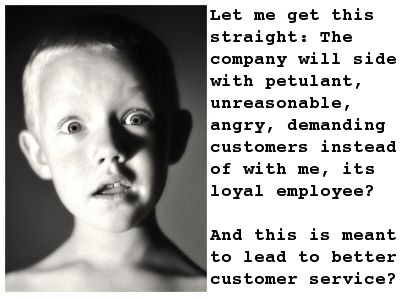
Top 5 reasons why “The customer is Always Right” is wrong

The customer is always right?

When the customer isn’t right - for your business

One woman who frequently flew on Southwest, was constantly disappointed with every aspect of the company’s operation. In fact, she became known as the “Pen Pal” because after every flight she wrote in with a complaint.

She didn’t like the fact that the company didn’t assign seats; she didn’t like the absence of a first-class section; she didn’t like not having a meal in flight; she didn’t like Southwest’s boarding procedure; she didn’t like the flight attendants’ sporty uniforms and the casual atmosphere.

Her last letter, reciting a litany of complaints, momentarily stumped Southwest’s customer relations people. They bumped it up to Herb’s [Kelleher, CEO of Southwest] desk, with a note: ‘This one’s yours.’

In sixty seconds, Kelleher wrote back and said, ‘Dear Mrs. Crabapple, We will miss you. Love, Herb.’”

The phrase “The customer is always right” was originally coined by Harry Gordon Selfridge, the founder of Selfridge’s department store in London in 1909, and is typically used by businesses to:

  1. Convince customers that they will get good service at this company
  2. Convince employees to give customers good service

Fortunately more and more businesses are abandoning this maxim - ironically because it leads to bad customer service.

Here are the top five reasons why “The customer is always right” is wrong.

1: It makes employees unhappy

Gordon Bethune is a brash Texan (as is Herb Kelleher, coincidentally) who is best known for turning Continental Airlines around “From Worst to First,” a story told in his book of the same title from 1998. He wanted to make sure that both customers and employees liked the way Continental treated them, so he made it very clear that the maxim “the customer is always right” didn’t hold sway at Continental.

In conflicts between employees and unruly customers he would consistently side with his people. Here’s how he puts it:

When we run into customers that we can’t reel back in, our loyalty is with our employees. They have to put up with this stuff every day. Just because you buy a ticket does not give you the right to abuse our employees . . .

We run more than 3 million people through our books every month. One or two of those people are going to be unreasonable, demanding jerks. When it’s a choice between supporting your employees, who work with you every day and make your product what it is, or some irate jerk who demands a free ticket to Paris because you ran out of peanuts, whose side are you going to be on?

You can’t treat your employees like serfs. You have to value them . . . If they think that you won’t support them when a customer is out of line, even the smallest problem can cause resentment.

So Bethune trusts his people over unreasonable customers. What I like about this attitude is that it balances employees and customers, where the “always right” maxim squarely favors the customer - which is not a good idea, because, as Bethune says, it causes resentment among employees.

Of course there are plenty of examples of bad employees giving lousy customer service. But trying to solve this by declaring the customer “always right” is counter-productive.

2: It gives abrasive customers an unfair advantage

Using the slogan “The customer is always right” abusive customers can demand just about anything - they’re right by definition, aren’t they? This makes the employees’ job that much harder, when trying to rein them in.

Also, it means that abusive people get better treatment and conditions than nice people. That always seemed wrong to me, and it makes much more sense to be nice to the nice customers to keep them coming back.

3: Some customers are bad for business

Most businesses think that “the more customers the better”. But some customers are quite simply bad for business.

Danish IT service provider ServiceGruppen proudly tell this story:

One of our service technicians arrived at a customer’s site for a maintenance task, and to his great shock was treated very rudely by the customer.

When he’d finished the task and returned to the office, he told management about his experience. They promptly cancelled the customer’s contract.

Just like Kelleher dismissed the irate lady who kept complaining (but somehow also kept flying on Southwest), ServiceGruppen fired a bad customer. Note that it was not even a matter of a financial calculation - not a question of whether either company would make or lose money on that customer in the long run. It was a simple matter of respect and dignity and of treating their employees right.

4: It results in worse customer service

Rosenbluth International, a corporate travel agency, took it even further. CEO Hal Rosenbluth wrote an excellent book about their approach called Put The Customer Second - Put your people first and watch’em kick butt.

Rosenbluth argues that when you put the employees first, they put the customers first. Put employees first, and they will be happy at work. Employees who are happy at work give better customer service because:

  • They care more about other people, including customers
  • They have more energy
  • They are happy, meaning they are more fun to talk to and interact with
  • They are more motivated

On the other hand, when the company and management consistently side with customers instead of with employees, it sends a clear message that:

  • Employees are not valued
  • That treating employees fairly is not important
  • That employees have no right to respect from customers
  • That employees have to put up with everything from customers

When this attitude prevails, employees stop caring about service. At that point, real good service is almost impossible - the best customers can hope for is fake good service. You know the kind I mean: corteous on the surface only.

5: Some customers are just plain wrong

Herb Kelleher agrees, as this passage From Nuts! the excellent book about Southwest Airlines shows:

Herb Kelleher […] makes it clear that his employees come first — even if it means dismissing customers. But aren’t customers always right? “No, they are not,” Kelleher snaps. “And I think that’s one of the biggest betrayals of employees a boss can possibly commit. The customer is sometimes wrong. We don’t carry those sorts of customers. We write to them and say, ‘Fly somebody else. Don’t abuse our people.’”

If you still think that the customer is always right, read this story from Bethune’s book “From Worst to First”:

A Continental flight attendant once was offended by a passenger’s child wearing a hat with Nazi and KKK emblems on it. It was pretty offensive stuff, so the attendant went to the kid’s father and asked him to put away the hat. “No,” the guy said. “My kid can wear what he wants, and I don’t care who likes it.”

The flight attendant went into the cockpit and got the first officer, who explained to the passenger the FAA regulation that makes it a crime to interfere with the duties of a crew member. The hat was causing other passengers and the crew discomfort, and that interfered with the flight attendant’s duties. The guy better put away the hat.

He did, but he didn’t like it. He wrote many nasty letters. We made every effort to explain our policy and the federal air regulations, but he wasn’t hearing it. He even showed up in our executive suite to discuss the matter with me. I let him sit out there. I didn’t want to see him and I didn’t want to listen to him. He bought a ticket on our airplane, and that means we’ll take him where he wants to go. But if he’s going to be rude and offensive, he’s welcome to fly another airline.

The fact is that some customers are just plain wrong, that businesses are better of without them, and that managers siding with unreasonable customers over employees is a very bad idea, that results in worse customer service.

So put your people first. And watch them put the customers first.

Related posts

If you liked this post, there’s a good chance you’ll also enjoy:

NB: This is a re-run of a previous post while I’m away from the blog for a day.

Spread the message:


195 Comments »

  1. The stakeholder movement and corporate governance | Managing Leadership Said,

    March 10, 2008 @ 2:03 pm

    […] “customer is king” days. But it is also one that has flaws, perhaps in both senses. Please see this excellent post by Alexander Kjerulf, the Chief Happiness Officer, about the problems with this concept (my […]

  2. Hayden Tompkins Said,

    March 10, 2008 @ 4:41 pm

    This is also, inexplicably, the kind of thinking that teachers have to put up with.

  3. Jo Said,

    March 10, 2008 @ 6:21 pm

    I find myself disagreeing Alex! Your clients are depriving their staff of one the chief satisfactions of a customer service profession - making people happy!

    It’s fun figuring out what is really bothering people. A person writes a letter of complaint because they want to fly with us. It takes time and energy to write that letter. They are hanging on to the relationship. They are putting their difficulties with the relationship on the table so we can address them.

    How does that become a matter of taking sides? We only have to find out what started the whole thing, which was probably ten or twenty steps earlier, acknowledge it and explain all round.

    And then buy both sides a drink! They will be feeling pretty sheepish at that point!

    We could say that this is better for business. I just do it because it is more fun!

  4. PJ Said,

    March 10, 2008 @ 7:42 pm

    I’ve got a problem with the hat example - not because I’m a neo-Nazi, but because I’m a strong advocate of free speech. Is wearing a hat, however offensive, “intefering with the duties of a crew member” ? “Causing other passengers and the crew discomfort” is way too vague for my tastes. What if it was a yarmulke instead of a neo-nazi-embellished hat? or a turban? Catering to the least common denominator is always a lose - people need to grow thicker skin, IMHO.

  5. Rebecca Said,

    March 10, 2008 @ 7:58 pm

    At my company, we do our very best to make people happy, especially since our customers are mostly teachers, and we know that Hayden’s comment is accurate. But we also remember that not everyone is our customer. I like the idea of balancing respect for our workers with respect for our customers.

  6. Jo Said,

    March 10, 2008 @ 10:11 pm

    @ PJ I had the same thought! These things are tricky. I once took a a cell phone away from a student in class - nicely and gently and she freaked out on me. I was puzzled and asked the young camera man, who had it all on tape, what he thought (our lectures were filmed). He suggested that there might have been a smutty comment on the screen. I hadn’t thought of that. It was a moment of insight to me that a lecture room is an essentially social experience to a young student (under 25 or so - I used to teach post-grads.) I never touched a phone again and when they went off and students expected someone to be kicked out, I just commented mildly that it was 2006 and we all knew what a phone was. The relief in the room was palpable. It was a novel idea that they could make a sensible decisions themselves to switch it off or take the call outside.

    @Rebecca, I couldn’t agree more. When I get lousy customer service, I rather suspect I am being treated the way the staff are treated by their managers. There is a spiral effect which students also appreciate quickly. They were fascinated by self-fulfilling prophecies and self-efficacy and quickly grasped that they could make or break a lecturer, particularly an inexperienced lecturer, through their expectations and reactions. It had never occurred to them that had that much power over the atmosphere on the campus (2 x 450 classes).

    I fly a lot and I’ve noticed the atmosphere on a flight begins early. Once confusion begins, it escalates. The first stage of those five group formation stages is important. People depend on the staff for cues and direction and if staff appear confused or disorganized, the passengers become disoriented or anxious. And yes, we should expect some storming. The worst possible response is to try to quell the storming. It signals lack of confidence in the airlines’ arrangements, and exacerbates any unease.

    You have me started and I shouldn’t take over Alex’ blog. I’ve watched behavior on long haul flights for years and it is fascinating.

  7. Drinkin’ Guinness in the 416 | Two reasons to love five reasons Said,

    March 11, 2008 @ 2:16 am

    […] kind of love this post with five reasons why “the customers are always right” is wrong over at the Chief Happiness Officer (who I have quite the internet crush on) as well as this post […]

  8. Ask M Said,

    March 11, 2008 @ 10:19 am

    Re PJ’s quote, I would disagree with that. Yes, free speech is very important, but do you really want people saying and doing what they like, no matter who gets hurt or upset?

    What if there had been descendants of a Holocaust survivor, or relatives of someone murdered by the KKK, on that plane?

    No, I’m with the crew member on this one. And had I been a passenger on that plane, I would have written a letter of thanks to that crew member and another of commendation to their manager when I got home.

    People (customers) don’t have the right to behave rudely or aggressively and expect others (employees) just to put up with it.

    As an accountant, I knew one client who was always rude to his staff and to his suppliers, but treated his customers like royalty. Talk about double standards. I’d have given a month’s salary never to have to work with that man again.

    M

  9. Rob Said,

    March 11, 2008 @ 11:11 am

    Excellent article, love the sentiment. One thing though, the modern way of looking at customers is internal as well as external also lets think about replacing the word ‘customer’ with ’stakeholder’. Customers, suppliers, community etc as well as employees are all stakeholders. The stakeholders child with the nazi hat was clearly not concerned with the other stakeholders and lets get real i’m all for free speach but the hat was advertising illegal and banned organisations. Get real PJ

  10. michael cardus Said,

    March 11, 2008 @ 2:33 pm

    This falls into the three parts of a team theory - if you split the team and customer base into three parts. 1) the champs these are the yes we love your ideas and mean it people the “early adopters” they love your company and everything you do is greate. 2) the undecideds they are not with you and not against you - they are not sure how they feel and need more information. 3) the sh*@ heads - these are always against you and no matter what you do you are wrong. We as leaders and cutomers satisfaction always pay more attention to the sh*@ head (even when they are the smallest faction). By paying attention to the challengin group the undecided go that way because they are getting attention. THey the champs leave your company and go elsewhere for their businesss.

  11. Ron Pemberton Said,

    March 11, 2008 @ 6:57 pm

    What an excellent article. Well done. I was just writing an article for my site about this very subject - but couldn’t possibly do as good a job as you have done. Kudos!

  12. Amanda Said,

    March 12, 2008 @ 12:52 am

    Number 2 resonates with me. As a customer I have always wondered why people who are abusive and complain about everything as a way of life get the better deals and customer service. Something about it just doesn’t seem fair.

  13. Evil HR Lady Said,

    March 12, 2008 @ 3:02 pm

    I agree with you 100%. If management sets a policy, then the employees should receive nothing but support for following that policy.

  14. HRagitator Said,

    March 12, 2008 @ 4:44 pm

    I don’t disagree with your points here but I’m concerned with the message that this sends to employees. In a time of communication bombarding from all sides, it seems to me that the simple axiom “the customer is always right” is still useful no matter how flawed the logic. I think that management needs to determine when the exceptions are to be made.

    Imagine trying to train a customer call center on the catch phrase “some customers are wrong, some are abrasive, and some are bad for business, so be careful which ones you please, because we don’t want you to be unhappy or provide worst customer service”.

    That should be some interesting training!

  15. The Customer is Sometimes Right « Get Some Hairapy! Said,

    March 17, 2008 @ 2:07 am

    […] Read the rest here. […]

  16. Links I liked - volume 1 : bettergoalsetter.com Said,

    March 19, 2008 @ 1:10 am

    […] Top Five Reasons Why “The Customer is Always Right” is Wrong at the Chief Happiness Officer … I never buy ebooks, but made an exception for this guy, and it’s really good (buy it!). I love this post, because nobody ever seems to write this stuff. Reasons number one won me over from the start … employees deserve every support in their efforts to implement the policies of Those Who Must Be Obeyed. […]

  17. MisseLaneius Said,

    March 19, 2008 @ 3:34 pm

    These reasons are fantastic.

    I’ve worked in customer service for about 6 years now, and in that time one of the things that I have learnt is that most of the time, people are pretty good. If they have a complaint, they will deal with it in a mature and intelligent manner, and if you try to meet them halfway, or explain why they can’t have what they want, and are treated with dignity and respect, they treat people in customer service roles with dignity and respect.

    I believe that all people have the right to be upset when things haven’t gone their way. They have the right to express the way they feel. They do not have the right to demand the ridiculous, and that is sadly the way that service is going in the world. We are spending less and less on first level service, and more and more on complaints handling, so that the people who do all the yelling and abuse get all the service.

    That’s going to make the ordinary, quiet, friendly customer go elsewhere. If they go one place for service and don’t get the service they want, they aren’t going to complain. They’ll just leave.

    The problem is that in our current corporate culture, businesses value the money that customers bring in more than the capital they have in their employees. Employees understand the value of the customer. However, they also know that for every 100 customers, there are one or two that are simply not worth your while. They are dead weight.

  18. 2xyn1xx Said,

    March 19, 2008 @ 3:56 pm

    While working in retail during college, I got a piece of advice that pertains to this very subject. My boss told me ” The customer is not always right, but the customer is always the customer.” He was able to keep his employees happy and loyal while also keeping his customers happy and loyal. Maybe a few more customer service departments should keep this in mind.

  19. jeff Said,

    March 19, 2008 @ 4:05 pm

    HRagitator Said,
    March 12, 2008 @ 4:44 pm
    I don’t disagree with your points here but I’m concerned with the message that this sends to employees. In a time of communication bombarding from all sides, it seems to me that the simple axiom “the customer is always right” is still useful no matter how flawed the logic. I think that management needs to determine when the exceptions are to be made.

    If you tell your employees to adhere to one set of policies, then train your managers to make exceptions, you’re entirely reinforcing the model that is described in this article. Employees resent being represented to the customers as wrong for adhering to the policies, and quit attempting to enforce those policies. . . your managers are tied up all of the time listening to complaints because your employees don’t have the ability to enforce the company’s policies nor make decisions that are in the company’s best interests. . . and you reinforce aggressive customer behavior because if they complain loud and long enough, someone will give them what they want to shut them up.

  20. ChannelNate Blog and ReBlog :: Top 5 reasons why “The customer is Always Right” is wrong Said,

    March 19, 2008 @ 4:40 pm

    […] Top 5 reasons why “The customer is Always Right” is wrong  : Here are the top five reasons why “The customer is always right” is wrong. […]

  21. 5 razones que explican por qué el concepto “el cliente siempre tiene la razón” no funciona | eleZeta - Lucas Zallio Said,

    March 19, 2008 @ 4:57 pm

    […] un concepto que tiene más de 100 años y fue elaborado por Harry Gordon Selfridge en 1909. Estre blog, enumera 5 razones que demuestran que este concepto no tiene […]

  22. Tom Danver Said,

    March 19, 2008 @ 5:04 pm

    I’ve never approved of pandering to the whims of customers. Customers take my services on my terms or not at all. I run a training school and if a customer makes an unreasonable complaint I kick them straight out the door and refund the money.

    Customers know where they stand with me. I’m not a pushover and can’t be bullied. If they step out of line, I’ll give them a piece of my mind and then they’re out. Nothing gives me greater satisfaction than dragging some dumbass loser who is giving one of my trainers a hard time out of the training room and shoving him into the street.

    If more businesses acted liked this, we’d soon put a stop to these professional whiners, who waste so much of our valuable time and money.

  23. Badger Said,

    March 19, 2008 @ 6:49 pm

    Tom Danver please publish the name and location of your training school so those who won’t kiss your a** will know not to give you their business.

  24. fire-pixel.com Said,

    March 19, 2008 @ 6:50 pm

    A caveat should be posted with this - extreme abusive customers. True customer service is just about non-existent now… they all have their canned lines to try and appease you while telling you to take a long walk off a short pier. *COUGH* KitchenAid *COUGH*… I WAS an avid consumer of their products until I got dead ended with their CSR regarding a 2 year old $400+ mixer that I used about 8x and broke. Ridiculous. We need quality brought back to our products and we’d probably have less reason to put up with seasoned whiners… but when the valid complaints continually get jacked (like most do) I don’t buy into all the hype a company pushes about the customer being important. Put up or shut up. Because in the end of the day, good customer or bad, it’s their cash that supports your products. If you have enough of the good to not put up with the bad, that’s the best spot to be in.

    Anyway, sorry for the rant… here’s another good article you might like:

    Top 10 Awesome Websites That Sell Cool Products You Probably Have Never Visited But Need To.

    http://www.comember.net/blogs/firepixel/

    Take care!

  25. Bruce Temkin Said,

    March 19, 2008 @ 6:54 pm

    Nice post. I wrote a post in my blog (Customer Experience Matters) called “The Customer Is Not Always Right — Now What?” I developed 5 principles to use in place of ”the customer is always right.”

    My blog: http://experiencematters.wordpress.com/

  26. The Customer Is Always Right? Said,

    March 19, 2008 @ 7:01 pm

    […] http://positivesharing.com/2008/03/top-5-reasons-why-the-customer-is-always-right-is-wrong/ […]

  27. Mich Said,

    March 19, 2008 @ 7:04 pm

    Having worked in customer service for some time, I feel pretty confident saying “fuck people”.
    Bad customers, which are the only ones that will get blown off, don’t deserve to be made happy. They want something for free and they don’t care how nasty they have to be to get it.
    That is not how I treat my employees now. They strive to make our customers happy, until some pedantic jerk comes through, and we send that one packing.
    Letting a few bad customers slide so you can keep the good ones happy, and your employees cheerful, is by far a better model for success than bending over for every dickhead that you run into.
    Period.

  28. Aphoenix.ca » The Customer May or May Not be Frequently Not Right Said,

    March 19, 2008 @ 7:19 pm

    […] just read The Top 5 Reasons Why the Customer is Always Right is Wrong and it’s interesting, but there’s a whole part of customer interaction that they have […]

  29. d0k Said,

    March 19, 2008 @ 7:20 pm

    The customer is always right. Period.

    The customer pays for a service and that service is bound under the terms and conditions of the company providing the service.

    If the company does not protect itself from the litigious claims made by customer, well that is its problem.

    The company is wrong to try and put the ‘customer is always right’ mantra just to create pressures on its employees without protecting them.

    Nice try though.

  30. larry davidson Said,

    March 19, 2008 @ 7:48 pm

    Working in a specialty, alternative green grocery in boulder, co gives you an idea of how unreasonable, overbearing, cheap, bratty, and ultimately inauthentic the elitist, yoga/buddha health folks can be. They are supposed to be nicer, setting an example with their ‘enlightened’ ways, from the calm happy that exercise and/or yoga gives them. Instead, they just piss on employees when they themselves are wrong; they have an abject inability to apply common sense while simultaneously filling their space with righteous smug, making everyone in their wake wrong because they have to always be right.

    Anyway, working in retail means you have to deal with developmentally disabled people. sometimes you can tell right away and of course you feel good about helping *them*. The other times, you have to wait for them to ask you a question most frequenters of mass market groceries would have the sense and pioneer to figure out for themselves, but then they have to be mean about it when you endeavor to answer with grace.

  31. Leo Said,

    March 19, 2008 @ 7:50 pm

    I agree with everything except the hat example. The hat should have been OK. Yes, it’s obnoxious and annoying but airlines as well as other people should tolerate some degree of obnoxiousness. If your employees have no tolerance at all for even a little bit of rudeness, then what you got there is intolerant jerks. People can be rude for a good reason, like if their stomach hurts, or if the eye hurts, or if they just broke up, etc. Not all rude people are bad people. Good people can have a bad day. Not everyone wearing swastika is a Nazi. Maybe the guy was trying to make a free speech statement? And if we don’t allow swastikas then what else shouldn’t be allow? This opens a whole can of worms. Should we allow Islamic symbols? Should we allow the star of David? Why yes? Why not?

    Even though today companies have the right to block free speech, it is not good, especially if those companies engage in highly public activities or services. As the days go by, government is becoming less and less relevant in day to day life and the censorship provisions in the Constitution do not protect our free speech enough. When every chunk of land is privately owned and when free speech is only guaranteed on government owned land, you have no free speech.

    I detest nazis and KKK. They are the scum of the earth. But nonetheless, I love free speech so much that they should have been allowed to fly. If you want to do something, maybe hang a sign right over their seat that says “ASSHOLE”. That’s your free speech. So if he has offensive symbols you can hang some offensive symbols of your own over his head. That’s fine. But you have to let them fly.

  32. larry davidson Said,

    March 19, 2008 @ 8:05 pm

    The business-to-customer relationship should be like the host to guest relationship. At a certain point, the host is being too reasonable and the guest too unreasonable. What is lacking most in this is familiarity. In our corporate culture, we are used to hitting the reset button on this relationship every time the customer enters the store. this makes for a very transactional experience. businesses need to do a much better job at customer relationship management.

    From the POV of the corporation, transactional experience is great…everything is standardized and therefore predictable. This process-orientation makes for speed and sales. It’s very industrial revolution, business one-point-oh. From the POV of the customer, it’s very impersonal, so there’s never any loyalty built. This makes for churn or customers trading standardized, transactional experiences by way of trying-out other brands.

    Imagine if corporations actually remembered it’s customers (beyond a number) but actual preferences…how much attention the customer needs- a lot or none at all, potential purchases, special orders, etc. Sometimes all it takes is to remember a person’s name and tell them it’s good to see them to keep them coming back.

    Nowadays, retail is becoming even more standard and impersonal. Sure, they have these membership cards which are nothing more than a way to track cash transactions and enforce that you carry their advertising everywhere you go. Automated checkout counters in groceries say ‘thank you *valued customer* for shopping at *name_of_grocery*” Customer service!

  33. Jo Said,

    March 19, 2008 @ 8:29 pm

    The range of opinions expressed here are similar to those expressed by university lecturers. Lecturers would like to be liked and when something goes wrong, they get very upset with students who become distressed. And then, very often, they ‘deny service’ - arbitrarily and usually un-contractually. Do you remember any of that? Do you remember how you came to hate those lecturers?

    I was at Euston Station in London last night. All services were delayed/canceled and I mean ALL out of a major commuting station. Two people were in a little kiosk trying to answer the questions of hundreds if not thousands of commuters. I managed to engage eye contact and I complimented them on the way they were trying to engage and then suggested they get the management on the line for us so we could request them to provide more resources. Guess what - the management were un-contactable. THERE WAS NO WAY FOR PEOPLE ON THE FRONT LINE TO TALK TO THE MANAGEMENT. This is very common. Watch what happens next time you see a service failure. The front line person will have little backup. They are trying to do a good job but don’t have the resources to do it.

    In the end every passenger makes an individual decision. What will I do about the kids who haven’t been collected from school? etc. etc. This is what the ’system’ wants - for us to absorb the costs of its failures. Outwardly passengers become docile, which is what the system wants. They stop engaging because they believe it is futile AND THAT NOTHING BETTER CAN HAPPEN. Learned helplessness sets in and they become angry. Like many of the people who are commenting here. And they hand on that anger to their customers in their next service encounter.

    So what can we do here? We can thank Kamila and Mohammed who were on duty at Euston Station last night handling hundreds if not thousands of people who were very worried. I doubt they will read this. They are exhausted right now. So am I. But I took the day off to recover. So double thank you.

    I think we can build up knowledge on how to handle people who are distressed. While Kamila was checking out options to reroute, Mohammed provided practical advice in a way that was respectful and useful. He simply recounted his experience of the last stoppage and extrapolated heuristics which the passengers could apply. That allowed us to make decisions in an orderly way. As a result I actually decided not to try to get on first train out because I didn’t have kids to pick up and realistically I could wait provided there was no risk of subsequent trains being canceled.

    After a similar experience just two weeks ago, I have resolved to build a gratitude mashup - where we can log on to say “Kamila and Mohammed were fantastic at Euston Station last night”. PS a guard on platform 16 was also pretty good.

    Anyone want to help?

  34. Jeniffer Gradie Said,

    March 19, 2008 @ 8:31 pm

    You know what, sometimes we don’t have a choice but to deal with you. Sometimes the market has no competition, perhaps your company got some of the govt pie and we can’t do anything about it. Perhaps you’re the only one who can service us. Perhaps you made a promise. I find too often you like to pretend the customer is irrational, petulant and stupid, but we’ve been putting with your crap for far too long.

    You’ve gotten free rides far too long.

  35. HRagitator Said,

    March 19, 2008 @ 8:55 pm

    Jeff said:
    If you tell your employees to adhere to one set of policies, then train your
    managers to make exceptions, you’re entirely reinforcing the model that is described in this article. Employees resent being represented to the customers as wrong for adhering to the policies, and quit attempting to enforce those policies. . . your managers are tied up all of the time listening to complaints because your employees don’t have the ability to enforce the company’s policies nor make decisions that are in the company’s best interests. . . and you reinforce aggressive customer behavior because if they complain loud and long enough, someone will give them what they want to shut them up.

    So your opinion is to NEVER make exceptions. I’m sorry, but that’s unreasonable. The problem is not that exceptions are made, it’s that they’re made arbitrarily or without consideration for precedent.

    Exceptions will always need to be made. There’s no perfect policy. Check out the Constitution and it’s amendment process (i.e., a formal exception system).

    I’m not suggesting that managers make a lot of exceptions, I’m just saying that exceptions should be meted out by a few rather than many. The more people you have being lenient with the rules, the more you open yourself up to unnecessary waste, expense, litigation, etc.

    My point is simply that you shouldn’t lose sight of the principle or meaning behind the motto just because it doesn’t work perfectly in 100% of cases. The golden rule is logically flawed, but it will always be a good rule of thumb at heart. That’s why it endures centuries.

  36. Grig Larson Said,

    March 19, 2008 @ 9:31 pm

    The biggest thing that people get wrong is “The Customer is Always Right.” That comment was never supposed to be taken literally, but was meant as an attitude you should have with the customer. You TREAT them as if they are right, even when wrong, because that’s how you maintain control over the call or sale. Let me address your points from that angle:

    1: It makes employees unhappy
    Non-supportive management makes the employees unhappy. An example from my past: we had a very abusive customer who didn’t care for women or black people. His order got screwed up (he got the wrong style headboard on a bedroom set), and so he called the delivery guys “useless as a bunch of niggers” and threw them out of his house. Then he decided to threaten to kill the store manager, called the police to tell them the manager was a thief, called the district manager a “mattress-backed whore” in her answering machine, and was so horrible to the head of our customer service department to the point she broke down crying. The customer demanded to speak to the company president. The president said, after seeing his head of customer support crying, “I am not speaking to anyone who treats people that way.” The vice president called the guy back, and said, “While a mistake was made, that was no excuse for your abusive behavior. We’ll fix the problem if you call everyone you spoke to back, and apologize. Otherwise, I have been authorized by the company president to have a cease and desist order drawn against you in a court of law. Be a man, and do the honorable thing.” We fixed this guy’s problem AND got his apology. An argument could be made that the company could have told him to go to hell, or kowtowed to him, but they didn’t do either. So while the customer was abusive, the employees knew management had their back, even though a mistake had been made in the delivery.

    2: It gives abrasive customers an unfair advantage
    No more than non-abrasive ones. Never tell any customer what you can’t do, tell them what you CAN do. Don’t say, “I can’t give you a new car,” but “I am sorry you are having issues with your car, why don’t you bring it down, and we’ll look at it for free. We certainly don’t want to leave you with a poorly-running car.”

    3: Some customers are bad for business
    This is true. But you shouldn’t make that assessment right away. In this case, terminating the Airline customer was probably a good idea in the example you gave.

    4: It results in worse customer service
    Only if the employees don’t get support.from management. There are really no “problem customers” just “problem situations.” I used to run a book store that had a “no returns, exchanges for same book only” policy. I had my cashiers enforce this rule, but if anyone demanded to speak to the manager, they could come to me. Could I “bend” this rule? Of course. I always explained to the cashiers that this made their life simpler, and it wasn’t because they were wrong or looked stupid, but they shouldn’t have to deal with that burden. I wasn’t contradicting them, I was simply the next up the chain, and they did their job just fine. If a customer bitched that “well, that ditz on the register said I couldn’t get a different book,” I replied, “that’s what I tell them to say. She did her job well. And I would like it if you did not refer to any of my employees in a derogatory manner.”

    5: Some customers are just plain wrong
    Oh, absolutely. But don’t treat them like that or you’ll get nowhere. Sometimes, the best thing is to let them scream for 3-5 minutes. After that, they are out of breath an easier to get them to do what you want.

    Customer service is an art. There are not many black-and-white policies to dealing with anyone in the human race; ask a doctor. But I wanted to claifiy that “The customer is always right” is a path, not a goal.

  37. PENIX Said,

    March 19, 2008 @ 10:08 pm

    I demand that you remove “Top” from the title of your article since the importance of each of your points is completely arbitrary, and cannot ranked as the absolute top 5. As a customer of your site, I am always right.

  38. Jim Said,

    March 19, 2008 @ 10:16 pm

    Free speech does not give you the right to broadcast that speech to a captive audience in a private setting. The hat guy’s position is indefensible. It’s a private setting and the attendant has the agency to determine what speech can be broadcast in that setting. That is, you have no more right to wear a piece of clothing with a visible message on an airplane than you have to wear it in my home.

    On a public street, on a public bus or ferry, in a park or in a government building? Yes, he has the right to wear that hat. But in a private vehicle, a privately-owned building (inlcuding one with public access) or on private lands? No, he does not have that right.

    The right to free speech only protects you from being interfered with by the government; it does not give you the right to require non-interference from other citizens in private settings.

  39. Jo Said,

    March 19, 2008 @ 10:17 pm

    @Grig

    Agreed Grig - the trick is getting everyone to rise above the problem situation. And oft times that leads to greater understanding all round and greater loyalty all round which leads in turn to a more engaged approach when the next problem arises.

    And therein lies happiness! Feeling that we can sort problems out together, even bad ones.

    The internet has been so quiet that I assumed the Easter holidays have effectively begun. Then the CHO burst into life!!

  40. Mike Said,

    March 19, 2008 @ 11:14 pm

    PJ, the hat issue is tricky, but consider: does support of free speech extend to the point of allowing one customer to shout the n-word at another customer? Wearing clothing with racist sayings or insignia might be thought of in the same way.

  41. charles goodall Said,

    March 19, 2008 @ 11:32 pm

    I don’t see what this excellent article has anything to do with nazis, holocaust or free speech. I guess anyone wants to support their own fervent agenda no matter what the issue may be. Anyway, I have to make comment about the whole issue of people “saying what they want”.

    Adults do business together. Adults understand that their approach with another person will bring about a reaction that is deserving. Even the most immature and irrational adult understands that they will not always get exactly what they want.

    The point of the discussion for a customer in a conversation with a supplier is to get what they are asking for. The point of the discussion for the supplier is to provide what the customer wants, while satisfying their first needs which are spoken or written, and the periphery needs that come from the unspoken requests of body language and chit-chat. The abrasive person will get “just” what they want and loses an opportunity to give and take with full understanding of the possible results of the meeting.

    Nearly every level of customer service demands an agreement between two people. The two people are negotiating a deal. There are rules of the game that will promote a strong conclusion for both parties. Those implicit rules demand respectful discussion and an open ear. Often there are people who walk into a situation of supply, carrying a whole lot of demand. It is tiresome to deal with anyone who seeks assistance and advice, but will not entertain any validity or quality with the expertise that is being offered. Yes the supplier wants to satisfy and may readily do any number of things to make the deal in a satisfactory way — leaving a contented buyer in a good relationship headspace.

    However, I have sometimes been rebuked in business when I have stated in private conference with associates that the customer doesn’t “fit” or that there is entirely too much work and cost to bear when attempting to do business. Oddly, it is the “greasy wheel who gets the grease” who demands the most time and effort and pays the least. In a real business model, it is simply not realistic to devote that kind of energy to someone who cannot be satisfied at any level. Wait — there is a level that will satisfy and that is total subjugation to their will. I have to sigh. What is the point of that? In the long run the supplier loses time and money and mindshare of the customers who actually support the business as it is designed to conduct business. Go into a car showroom to buy a heavy machinery vehicle? The SUV will not satisfy that request — so why not move on to the tractor supplier if that is what you are really looking for.

    I agree that the customer who wants to waste a company’s resources should be encouraged to go elsewhere. While the door is swinging, invite the new client in and give then what they are asking for, inside a relationship of supply and demand with reasonable expectations and good business practice. And they will return with satisfaction, and requests and suggestions that will truly build the business for the benefit of those who demand, and those who supply.

  42. Joe Said,

    March 20, 2008 @ 12:15 am

    to tom danver - i feel the same way you do. i run a retail shop, and don’t put up with the kind of crap that people put out. just because i’m behind a counter does not mean you get to treat me like a lesser human being.
    more power to those of us willing to stand up for ourselves.

  43. BobS Said,

    March 20, 2008 @ 2:43 am

    Oh great! Yet another “excuse” for big business to provide terrible customer service. Rather than pay their customer service reps a living wage, they’re going to be on “their side”. And since almost all the corps provide terrible customer service, there really isn’t anywhere else for customers to take their business.

    Just another reason to despise corporate America and do business with tiny local operators whenever possible.

    Yet the author of this piece swallows this entire line of bull and breathlessly touts the propaganda. This is why this country is going down the tubes - far too many gullible people who gladly march in lockstep and swallow everything the propagandists tell them. Pathetic.

  44. golden nugget Said,

    March 20, 2008 @ 3:33 am

    i am that nugget that would not sit down when the cashier requested me to take my shirt off

  45. christian ross » Blog Archive » Sometimes the customer isn’t always right. Said,

    March 20, 2008 @ 6:03 am

    […] from Positivesharing […]

  46. Allie Said,

    March 20, 2008 @ 6:49 am

    Thank you for this! My sister works at a retail franchise which uses the phrase “The customer is always right” religiously. One day an old lady came in and was annoyed with another woman’s autistic son. She got into the boy’s face and mimicked a noise the boy made. My sister couldn’t say anything to her because if the woman complained to her manager, she would have been fired. If I were in that position they would have booted me out the door so fast, but you can bet I would have taken that old bag with me.

  47. Paul Said,

    March 20, 2008 @ 7:30 am

    The Customer is always right

    BUT…

    Some people don’t get to be your customer.

    You get to decide who is and who isn’t your customer.

  48. Rob G. Said,

    March 20, 2008 @ 7:53 am

    To expect an airline to change is quite insane. But they ought to listen to the lady who complains and change everything she complained about since she represents 99.9% of all customers.

    There are customers who play games for whatever reason. But listening to suggestions is essential for good business.

  49. Rob Said,

    March 20, 2008 @ 8:45 am

    In the examples you give where the customer is not “right”, you seem to be citing extreme cases: Abrasive customers, incessantly demanding customers, intolerably rude customers. If the exceptions are to be made in such extreme cases, that suggests to me that the maxim itself is valid, just amended to “The customer is always right, with some exceptions in extreme cases.” What is the alternative maxim? “The customer is always wrong?” “The customer is sometimes right?”

    The huge fallacy I see in your argument is that it makes the assumption that “the customer is always right” implies taking the customer’s side over the employee. It means no such thing. It means giving the customer an elevated position relative to THE COMPANY, not the employee. Sadly, the growing trend is for companies to use their customer service departments to SHIELD upper management from their customers. Your argument that siding with the employee requires siding against the customer allows a company’s treatment of customers with callous indifference to be painted as a virtue. It is this callous indifference, this practice of using employees not as a resource to help the customer but as a line of defense against the customer, that results in employees so often being subjected to frustrated and irate customers.

    It’s ironic that you give multiple examples from airlines. Is there anyone who hasn’t heard or experienced at least one horror story about treatment of customers by an airline? Now that they can justify mistreatment of customers with the additional excuse of “national security,” the airlines probably have a worse reputation than the phone company! The reason that airlines and the phone companies are such a nightmare to deal with is because as oligopolies they have all the power over the customer, they know it, their employees know it, and they treat their customers accordingly. Conversely, it is in the industries with the highest levels of competition that the credo that the customer is always right is most often adhered to, which suggests that the philosophy does indeed make good business sense, at least for companies that actually feel that they NEED their customers.

    The reason that the customer should always be right is because the customer is usually the one with the least power. It is a wonderfully egalitarian principle, like Innocent until proven guilty, that we shouldn’t take for granted. I’ve traveled extensively, and I can tell you there are many places in the world where people are in awe of the American model of customer service. “What? If you don’t like somthing you can just take it back to the store, and they won’t argue with you about it? Seriously?”

    I just wish I could be treated with the same level of courtesy and respect I receive when dealing with a well-run business when I’m dealing with noncommercial institutions: the IRS, the Post Office, public hospitals, the DMV…

    Deciding that the customer is always right does not mean favoring the customer over the employee. It means favoring the powerless over the powerful. It’s a beautiful concept that this world needs more of, not less.

  50. links for 2008-03-20 | sofarsogeek.org 2.0 Said,

    March 20, 2008 @ 9:24 am

    […] Top 5 reasons why “The customer is Always Right” is wrong (tags: business) […]

  51. Sachin Gopal » Blog Archive » Important Unwanted Customers Said,

    March 20, 2008 @ 9:36 am

    […] Top 5 Reason Why The Customer Is Always Right Is Wrong got me thinking on how many times we have had customers who are nothing but a cost to the company. […]

  52. 5 Reasons the Web Design Client isn’t always right : Brandon Dawson.org Said,

    March 20, 2008 @ 11:42 am

    […] But as we’ve transitioned into being a consumer-driven culture, some people have taken these words and twisted them into some kind of childish mantra, wherein they need to be given whatever they want, just because they want it. Alex Kjerulf gives us 5 reasons we shouldn’t be so quick to service the needs of ultra-demandi…. […]

  53. Randy Said,

    March 20, 2008 @ 11:45 am

    Well, written article. Obviously, from the complaints, it takes a pair to write an article like this.

  54. Jo Said,

    March 20, 2008 @ 1:09 pm

    I work in the HR function and if there is any part of the business that is service-challenged, it is us.

    On Tuesday I heard Adam Greenfield, author of Everywhere and new Head of Design at Nokia talk on the five principles of design. I was testing HR systems against these 5 principles as he spoke and I’ve rewritten them clumsily but positively on my blog. It would be interesting to hear from HR people who have designed systems and people who bear the brunt of our systems, what they think.

  55. rayne Said,

    March 20, 2008 @ 1:42 pm

    I work at tim hortons and some old jerk keep coming through the drive through telling off my employees, giving them the finger, and throwing stuff in our window. The littlest thing will set him off, like if he’s not the first car in the drive through. so one day while he was cursing at one of the girls i work with, i through the coffee right in his car and made a mess and told him off :)
    He was holding up the drive through anyway, so why keep him as a customer if he bothers other customers and absuses employees?
    Was what i did the right thing? no, but what the heck, i’m canadian :)

  56. Simon Elliott Said,

    March 20, 2008 @ 1:46 pm

    I prefer the motto
    “The customer is always tight.”

  57. Shania Said,

    March 20, 2008 @ 1:54 pm

    I agree with this wholeheartedly…a friend of mine was just fired bc a customer called her a “piece of shit” and she retaliated, though wrongly and called his “mother a piece of shit” Because there was no management on hand to diffuse the situation before it got out of control, I feel like corporate should have taken a second look at the situation, through our eyes….

    and most times the customer is just plain wrong. period.

  58. benenglish Said,

    March 20, 2008 @ 2:30 pm

    Great stuff. I work customer service and my management understands all this very well; I’m lucky that way.

    However, the last little illustrative tale brought me up short. What happened there? A flight attendant took offense at the silent political speech (an article of clothing) worn by a passenger and made up some fiction about how it was illegal to interfere with a flight crew to justify suppressing that speech. She got a member of the flight crew to enforce this fakery for her and force the passenger to remove an article of clothing. When the passenger later complained, the suits supported that decision.

    Here’s a few basic customer service principles -

    You’ll spend your days with people different from you who have different opinions. They may dress too sexy or wear a t-shirt with a message you, personally, find offensive. Grow a thicker skin.

    If your skin is too thin, have the personal integrity to be honest with your customers. This approach: “I find that offensive on a personal level. Apart from our employee-customer relationship, speaking just as one human being to another, do you think you could cut me some slack and remove it? It would just be a courtesy, a way to make the trip more pleasant for both of us.” is at least intellectually honest.

    If you try to reach someone on that level and they tell you to get stuffed, go back two paragraphs.

    If you’re in a position of authority and one of your underlings comes to you with a request for help along the lines of “Someone back in the cabin just did something that offended my fragile sensibilities. I want you to go back there wearing your mantle-of-authority uniform and lie to that person saying there’s some legal reason why they have to acquiesce to my petulance.” then please have the personal integrity to decline and tell your underling when they are employing bad judgement.

    I work customer service all day long. I have management that understands customers can be wrong and will fully support me when that happens. But when I encounter a customer who decorates their cubicle in some way I find offensive, I’m sure as heck not going to go crying to momma for some made-up, quasi-legal excuse to force the customer to change their behavior.

    Good piece until the end.

  59. Top 5 reasons why The Customer is Always Right is Wrong | Sergio F. Rodriguez Weblog Said,

    March 20, 2008 @ 2:50 pm

    […] “The customer is always right” which was originally coined by Harry Gordon Selfridge is WRONG.read more | digg story Sphere: Related […]

  60. Holistic Systems » Blog Archive » Top 5 reasons why the customer is always right - is wrong Said,

    March 20, 2008 @ 3:17 pm

    […] Top 5 reasons why “The customer is always right”  is wrong. […]

  61. Jeremy Said,

    March 20, 2008 @ 3:42 pm

    Your whole argument leads to bad customer service.

    First off the customer is paying you, not the other way around. As such the customer is allowed to expect that they will be served to the best of the ability of the company. If they don’t see such then they have a right to complain that this service was not to the standard they expect and they may even need to go as far as to demand their money back.

    Second off, your last point is a civil suit waiting to happen. You have no right to suppress my freedom of speech especially if such freedom is being expressed in something as quiet as a hat. Do you think they ask for all Che Guevara shirts to be removed … or what about items that say Hillary 08 … or how about Pro-Life apparel. All three of those items express points of view that I find offensive do I whine like a two year old and then try to claim a law is on my side, no because it’s their right to voice their opinion and since its not infringing on my rights I have no grounds for complaint. Now let’s take it further what if the hat had a common swastika used by the Hindu and nothing else. By this girl’s logic because it was used by a group of zealots in Germany that means she has the right not only to suppress his freedom of speech but freedom of religion.

    The point of all this is as a customer service rep you are in the position of rendering services. You have the right to not be verbally abused or physically abused by the customer but beyond that your rights end. The customer is paying you for service not the other way around.

    I’m sick of companies especially Airplane companies acting like they are in some position to treat people like they are some sort of second class citizen and just like my apartment complex who has given me poor customer service for the past few months I will take my business else where. They might say oh well what do we care its one customer; problem is I will post comments on Apartment sites about why this apartment is poor, I will tell my friends about their poor service, and so forth. Yes they may have only lost one current customer but that one lost has also made sure that every person he touches will also be a lost on a potential customer.

  62. Rob Said,

    March 20, 2008 @ 4:01 pm

    This entire post is wrong, soooo wrong the customer needs to be always right the whole idea that the abusive customer gets what they want is a complete falicy, even in companies where the customer is king. More often than not the abusive customer just gets a “well I am sorry sir but we cant help you with that”. I am not an abusive customer, but I dont like getting jerked around either, I only ever get impatient and irritated when I am put on hold for more than 15 minutes, or deal with sub par customer service staff (read transfered around 5 times with no answers, or cant speak either of my languages). This kind of attitude will inevitably lead to “well you dont like it sir you can go to another company, but they are are going to treat you in the same Sh!#$y way we do , so whatareyagonnado”. Any company that doesn’t have to worry about keeping it’s customers happy…doesn’t, and thats what this attitude will lead to no doubt abouyt it.

  63. Dan Nicholson.co.uk » Blog Archive » 5 reasons why ‘the customer is always right’ is wrong Said,

    March 20, 2008 @ 4:18 pm

    […] article, found at positive sharing explains that if you look after your employees, they will look after the customers. At the end of […]

  64. Nonchalant Savant Said,

    March 20, 2008 @ 4:39 pm

    One of the keys to good customer service is to simply be clever and postive. Having a good sense of humor doesn’t hurt, either.

    My wife was two weeks into a new position when she received a phone call from a member of her association. The member proceeded to air all of her grievances about the way things had been done with the company.

    After letting her vent for a few minutes, the member finally took a breath and said “You must think I’m the biggest bitch in the world.”

    Her reply - “Oh, no - I usually wait until the third phone call to make that judgement.”

    Customer for life from that moment on.

    Granted, if the customer truly is a moron, They’re better off with the competition. But most customers simply want to be heard and respected, just like us as employees. 90% of the time it can be that simple.

  65. Marcel Said,

    March 20, 2008 @ 4:43 pm

    It’s crazy to think the customer is always right. Some deserve to be ignored completely.

    For example:
    In some industries thieves/competitors actually buy your products using stolen credit cards accounts and request refunds repeatedly. Identifying a customer and competitor is serious business.

  66. Marcel Said,

    March 20, 2008 @ 4:47 pm

    @Rebecca

    Exactly. Not everyone is a customer…

  67. Stranger Said,

    March 20, 2008 @ 5:12 pm

    The customer can only be right if they are, well, right. The problem is that sometimes you get customers that aren’t right. Rob, do you think that trying to return something you bought one year ago, had no receipt, and bought from a different company entirely is “right”? I don’t. And yet, you get this kind of behavior every day.

    Yes, these may be “extreme cases”, as you called them earlier, but these are exactly the type of people who scream “the customer is always right” the loudest. By subscribing to that policy, the company leaves itself open to the worst forms of abuse.

    Companies must be able to protect themselves against fraud and abuse. The “CIAR” policy is antithetical to this. Anyone can come in claiming anything, declaring that they are right, and get whatever they want.

    As for saying that the customer has no power in the transaction, that is patently absurd. The customer has all the power - they can choose to leave at any time. The poor employee does not have that power, nor do they have the power to fight back if the customer becomes abusive. The employee’s livelihood is put up against the whims of someone who might or might not do business with that company.

    I worked retail for 14 years. I worked as a waitress for over 3 years. And let me tell you, while the vast majority of people I dealt with were just fine, friendly and reasonable, there were some who did not deserve the opportunity to be served.

    The implication of the article is not saying that because the customer isn’t always right, they must always be wrong. It’s saying that by taking the stance that the employee will lose every time against a customer, you are endangering the commodity that makes your company successful. You will have a workforce that takes no pride in their work, since their management has no faith in their judgment or abilities.

  68. Scott Said,

    March 20, 2008 @ 5:16 pm

    All well and good. But have you ever dealt with any RyanAir personnel? Being treated so badly when you complain that other customer’s actually have to stick up for you and ask the stewardess to stop being so rude is a little excessive. I’ve seen this happen twice this year alone! And I’ve only flown with them once in 2008.

  69. Dave Said,

    March 20, 2008 @ 5:21 pm

    Anyone disagreeing with the is more than likely one of the loud assholes the article refers to. You’ve probably never worked in customer service, and of course you don’t understand that it makes you look like a joke when you’re doing what you’ve been trained to do and someone can just request a supervisor to go over your head and get what they want. I’ll be honest, I work in a department that handles whether or not someone gets large amounts of credit to their account and it’s one that receives a lot of tickets from CSRs who were only trying to get the customer off the line when they put in these tickets. I worked the phones. I don’t spare my feelings to those who don’t actually deserve it. If you have a real problem, give us a call, we’ll deal with it happily. I love fixing people’s problems. If you ran up your bill because you’re stupid and you thought you could just get someone to write it off, run it past me then as well. I take a lot of pleasure in shooting down ridiculous claims. They just recently put me in this position and I’ve got to say I’m a lot happier with the job.

  70. Today’s Customer Service Lesson… at UTS Customer Services Said,

    March 20, 2008 @ 5:23 pm

    […] Top Five Reasons Why the Customer Is Always Right is Wrong […]

  71. Satyrblade Said,

    March 20, 2008 @ 5:43 pm

    In reference to P.J. and Jeremy:

    Freedom of speech/ expression is a relative concept. As was said long ago, “Your right to swing your arm ends where it hits my nose.” The wearing of Nazi and KKK regalia INTENTIONALLY “hits someone’s nose,” and while such “expression” is protected (and should remain so) on the streets or in other venues where the potential for confrontation is brief, it is UNSAFE in venues where people are going to be confined in tight spaces for several hours.

    Consider: Mr. Nazifuk and his punk-ass kid (who are spoiling for a fight simply by wearing such apparel in public, much less by defending it) sit next to several Jewish, Black or Catholic passengers - people who, btw, are ALSO customers of the ariline. Even if Mr. NaziFuk and his brat manage to keep their yaps shut for the entire flight (unlikely), their violently provocative apparel is liable to spark a confrontation with the other customers… in an airplane… at 40,000 feet… far from potential landings - at which point, yes, the duties, performance and indeed LIVES of the crew and other customers are at risk.

    An airplane is not a city street. Expecting that people should just “grow a thicker skin” (as P.J. suggests) is unreasonable when hundreds of human beings are packed into a flying metal tube thousands of feet above ground or ocean, breathing canned oxygen for hours at a time. In such circumstances, it is not only unreasonable to expect that everone will remain calm and civil (especially when at least two parties involved have no intention of displaying either quality), it can be deadly.

    So yes - the airline was totally within not only its rights but its legal responsibilities.

    you think they ask for all Che Guevara shirts to be removed … or what about items that say Hillary 08 …

    These days, such items are more likely to get someone arrested, not just denied service! Besides, as abhorrant as you may find Che or Hillary, the wearing of such shirts does not endorse ethnic cleansing. As I wrote above, a person who wears Nazi or KKK regalia in a public space is not only advertising his socio-political opinions - he is openly advocating for genocidal racists, and wants everyone to know it. His right to do so may apply to places where he and his hatred can “march on past,” but in tightly confined spaces where people of all ethnicities (including those singled out for death by Nazis or Klansmen) must endure them, that “right” becomes a liability for everyone.

  72. Muttly Said,

    March 20, 2008 @ 5:43 pm

    If you read a companies customer policy everything will be fine. You can always sway the customer toward the interest of the company. Hello they are they are consuming a product or using a service. They want it, they need it, they love it.

  73. Grapefeed » Service Said,

    March 20, 2008 @ 5:51 pm

    […] “Top 5 Reasons Why the Customer is Always Right is Wrong“: “Fortunately more and more businesses are abandoning [’the customer is always […]

  74. Continental Said,

    March 20, 2008 @ 6:09 pm

    Wow. Continental Airlines. They’ve gone bankrupt how many times? Perhaps if they treated their passengers as something as other than walking receivables, they might actually have a shot to be profitable consistently.

    Why do you think Emirates and Singapore Airlines are considered best of breed?

  75. Nick Said,

    March 20, 2008 @ 6:11 pm

    Working at a Blockbuster Video 10 years ago, I remember an elderly customer verbally abusing a soft spoekn employee over a late charge dispute. The dude just worked 14 hours straight (very loyal), and she was makig an obvious gesture towards his race, referring to him as “lazy”, and “you people”. The guy finally erupted and said ” leave me alone bitch”. Next day he was FIRED. A hard working loyal employye:

    a- wasn’t given a chance to explain himself
    b -his hard work and loyalty was not taken into consideration.

    and we were told.. “the customers are always right”

  76. MikeT Said,

    March 20, 2008 @ 6:14 pm

    I would like to point out that part of the problem comes in the cultural habit of calling an abusive person a “lady” or a “gentleman.”

    Let’s make something very clear, many people you encounter don’t fit into these categories. It doesn’t matter how they dress, how much money they have, whether they even know all of the right manners all of the time. Being a lady or a gentleman is about behaving well in public, trying to be dignified in your approach to things, and not making a scene in cases like this.

    A few months ago, I had a woman try to ram right through me because she thought that I was holding the door for her. That was ironic in light of the fact that I hadn’t moved out of the way, indicating to her that I was going to do that. She then got indignant when I proceeded to walk through the door, and she had to scrunch in between me, and someone else trying to leave.

    People who act like this in public deserve to be called what they are: assholes.

  77. r Said,

    March 20, 2008 @ 6:52 pm

    well, it should probably be “the customer is usually right” And, you know what? The person at the desk isn’t always right either. Rude goes both ways and I’ve had my share of R-U-D-E flight attendants and desk clerks in my travels, one reason I don’t go US Air anymore. One thing is certain: rude/abrasive is never the right approach.

    By they way, I don’t agree with wearing a KKK hat, but, making someone take off their hat is wrong. To assert that it is interfering with your duties seems a bit far fetched. Did it prohibit mobility of the attendant? no. Did it prohibit the passing out of drinks or snacks? no. Did it inhibit any safety measures? no. Done. A good lawyer would have probably laid the smackdown on that.

  78. Strychski Said,

    March 20, 2008 @ 6:56 pm

    It’s no wonder that so many airlines go bankrupt if this represents typical airline CEO thinking. I wish I had so many customers that I could afford to drop any that dared to speak up.

    These CEOs and the author seem to misunderstand Selfridge’s slogan. He did not mean that every customer demand should be met. He meant that the customer should be treated with dignity and respect and should continue to be treated that way until a mutually agreeable solution is found. He was speaking to employee disposition and attitude, not ultimate resolution of the issue.

    And Satyrblade, you are a fool. Reread your Constitutional theory and pay particular attention to the parts about protecting the rights of the few against the tyranny of the many.

  79. Laura Schofield Said,

    March 20, 2008 @ 7:14 pm

    Having worked in customer service as well as having been a disgruntled customer myself, I agree with the above article. It is sad however, that some companies do not reward rational customers with grievances, just loudmouths. I’ve seen cruise passengers get half off their next cruise because their cabin door was blocked by luggage upon boarding the ship and their cabin “smelled like fresh paint”. I’ve seen hotel customers get their room free because it “smelled funny”. Same customer then went to the hotels restaurant for dinner and complained that they didn’t like it - got it free. They continued to do this for 2 days in a row! A free dinner at a restaurant (or at least 50% off or a free dessert).

    I wrote a complaint letter to Travelocity and put it online as an example of how to write an effective complaint letter. In this article, I stressed the importance of remaining calm, documenting everything, being reasonable, showing the company why they should keep your business, not making rude comments about the staff (unless they were part of the problem). Funny thing is, Travelocity never responded. United Airlines did give me the money that I lost back however (in the form of a voucher with an expiry date).

    Lesson learned - being unreasonable often gets the best results!

  80. Andrew Said,

    March 20, 2008 @ 7:30 pm

    I’ve been working retail for the last 6 years, and I can tell you that the customer is not always right and it is quite annoying to hear that touted by certain corporations. My personal belief is that I am providing you with assistance and service in my place of employment and working hard to please you in whatever way I can. If you have to get nasty and rude, then you don’t deserve to be allowed to shop at my retail business, simple as that. There is no case in the world that requires people to be mean, disrespectful, or just plain rude to another human being. I’ve either been yelled at or heard customers yelling at people over the smallest issues. For instance, I work at a pharmacy, and people complain they have to show their driver’s license for certain drugs. It is a state and federal law, yet people still feel the need that if they scream and hoot and holler, than they will be able to change the law. Some customers just deserve to be smacked across the face and sent on their way out the door.

  81. Samuel Buchanan Said,

    March 20, 2008 @ 8:09 pm

    This attitude, coupled with ever declining customer service, is what is driving customers to base their decisions solely on price alone. Since I already expect terrible customer service, why bother expecting anything more than the cheapest price. It used to be that customer service was something a company was proud of. It was a monaker they would use to attract new clientel, and works better than any amount of money spent on advertising. Unfortunatly some companies are immune due to limited competition. Everyone knows the airlines have terrible customer service, and have come to expect nothing less, so this article and the airline anecdotes do not surprise me. Companies would do well to remember that your customers are your reason for being there. Without them, you dont have any employees, you don’t have a company, you dont have a job. Then someone else can worry about wheather the Customer is Always right…..

  82. MarkB Said,

    March 20, 2008 @ 8:47 pm

    Perhaps this has been said before, there so many comments I just skimmed them, but while I agree there are times the customer is wrong, there are just as many times the business is wrong. Sometimes a policy or fee or something a business does is just unfair to the customer, and the customer has a right to expect fair treatment, too. I don’t condone abuse to anyone, whether they are the employee or the customer, and both parties should be treated fairly.

  83. sara Said,

    March 20, 2008 @ 9:03 pm

    Just a little story of my own experience and why I totally agree with this article:
    I work for a large chainstore in the wine department. A couple of years ago a customer came in, put several boxes of wine in to his trolley and demanded that we deliver it. It isn’t the company’s policy to deliver, we don’t even have a delivery van. I politely explained this to the customer and offered to help him to the car after he’d purchased his items. He then proceeded to hurl verbal abuse at me and threaten physical assault. He start throwing stuff out of his trolley and on to the floor, breaking several items and scaring the other customers and employees. I tried to stay calm and and went to phone my boss down, to reaffirm the company policy and to lend me support. My boss arrive and proceeded to completely side with the customer! He was practically grovelling and even promised that he would deliver the goods in his very own car! I had never felt so demoralized in my whole life! My didnity wasn’t worth the £39 they made off the sale…

    For a long time after that incident I didn’t even want to deal with customers let along offer them great service! I know this seems like just an extreme case(and it is!) but I can’t tell you how often it happens to a lesser extent on a day to day basis. It leaves ALL the staff feeling unmotivated and degraded. How can that be good for business? Management need to protect they’re employees as well as customers

    I find the people that come up with these little mottos are people who have never had to work with customers a day in their life. I treat my customers with the same respect as they treat me and most of the tme that leaves both of us happy! But I will no longer deal with someone who talks to me like I’m less then human because I know I will not recieve any support from my seniors. I don’t think bad customers should be pandered to.They need to learn that yes, the employee is there to help, but they are not your slaves.There needs to resect on both sides. After all, manners are free!

  84. constitutionalist Said,

    March 20, 2008 @ 9:04 pm

    i hate to burst the ‘free speech bubble’ but continental, or any other business for that matter, can restrict your speech all they want. By entering ones place of business, in this case the plane, you are consenting to their rules. That means they can require shirts and shoes, they can prohibit your carrying of a firearm (another ‘protected right’), kick you out for being offensive, either in speech, attire, or stench. The constitution only protects your rights when the gov’t is involved. The gov’t isnt allowed to restrict speech, or prohibit your right to bear arms. A private company, person, etc, is able to remove these ‘rights’ from you at their leisure.

    It is such a lack of understanding of the constitution, bill or rights, and government, that is killing the US right now. Wise up

  85. constitutionalist Said,

    March 20, 2008 @ 9:13 pm

    @Strychski

    at least you got the constitiutional issues right.

    But you missed the boat on the rest.
    “He meant that the customer should be treated with dignity and respect ” This is only applicable when the customer also treat the employee with said dignity and respect. In most all of the situations mentioned, that was not the case. The customer was an asshat from the word go. Such people deserve no respect. They are never right. In the very few other situations, the customer is unreasonable, and impossible to please. These people should not be bothered with either. Its a classic 80/20 scenario, but it more like 99/1. 99% of the problems and complaints come from 1% of the customers. Do you really need those customers.

    This article is dead on. Get rid of your bad customers. You will be much happier and you will have so much time to work for new ones.

  86. Arturus Said,

    March 20, 2008 @ 9:19 pm

    A customer is just an employer by another name. Just as there are some things that are off limits for an employer to request from an employee, there are logically some things a customer can request that are inappropriate.

    If my boss asks me to wash his car, I would tell him to go to hell, that isn’t what I was hired for. Likewise, I can put up with any request for a customer that wants my professional services but not someone who wants to expose me to their own personal problems, frantic desires and/or negativity - they need a psychiatrist or a prostitute for that.

    The idea that because you’re spending money you have a license to act any way you want is one of the good reasons more traditional cultures hate American tourists.

  87. benenglish Said,

    March 20, 2008 @ 9:21 pm

    Constitutionalist -

    You’re quite right. I hope no one is arguing any different. The Constitution doesn’t prohibit businesses acting like jerks. (Well, unless the business is giving you a hard time simply because you’re a member of a protected class, ie race, gender, orientation, ethnicity, religion. Even private businesses are not allowed to discriminate on those grounds. Racist idiots are not a protected class, so the airline was perfectly all right, legally, to be assholes to these particular customers.) I think the whole point of many of these posts is that there are times when a business should act (sort of, with respect and dignity) like a jerk. There are times when existing customers need to be fired and new customers need to be refused.

    The point, though, is that businesses should deploy the hard line rather carefully and reluctantly. Treat your customers like crap and they tend to stop being customers. Treat your customers like crap and they tend to complain.

    So, yeah, sure, a flight crew can make up a lie to tell a passenger along the lines of “What you’re wearing somehow makes it harder for us to do our jobs so we’re going to threaten to throw you off the plane and maybe have you arrested and there’s not a thing you can do about it but shut up and take it.” No one is saying they can’t legally get away with that.

    Some of us, though, find the judgement displayed in that case rather faulty.

  88. Brian Said,

    March 20, 2008 @ 9:33 pm

    I completely agree. Having worked at a customer service desk at a large nationwide retailer, I can say that in my opinion the majority of customers are wrong.

    To be honest, with the position I was in, I could be as mean and aggressive towards the customers as they were to us when they came in. It’s very hard to get fired from a customer service job if you are competent, and no matter how many customers you make angry, they don’t want to lose your competency.

    People are wired to buy products. You can make them as angry as possible, but they will always return to buy. It’s human nature. Especially at large retail stores, where people really have no choice but to come back. Things are so cheap and convenient that no matter how they are treated they are inclined to come back.

    Customer service is dead.

  89. Scab of a nation, driven insane : link dump Said,

    March 20, 2008 @ 9:54 pm

    […] Top 5 reasons why “The customer is Always Right” is wrong - Let me get this straight: The company will side with petulant, unreasonable, angry, demanding customers, instead of with me, its loyal employee? And this is meant to lead to better customer service? Posted by przxqgl on Thursday, March 20, 2008, at 11:54 am, and filed under links, the very big stupid, jeezis, evolution, drugs, corruption. Follow any responses to this post with its comments RSS feed. You can post a comment or trackback from your blog. […]

  90. Customers Can be Wrong Said,

    March 20, 2008 @ 10:00 pm

    […] a great article by Alexander Kjerulf called “Top 5 reasons why ‘the customer is Always Right’ is wrong.” In our industry customer service is extremely important and we try to do our best. […]

  91. Melmoth Said,

    March 20, 2008 @ 10:29 pm

    Hey nazi defenders:

    I’m a strong free speech and personal liberties advocate. But speech that encourages people to drag my kids behind a truck by a rope isn’t free speech, okay? It’s a very real threat, and it’s distinct from expressing an opinion. The fact that all speech isn’t free (e.g. fraud) isn’t a hard concept, but people have trouble with the fact that there are grey zones with these issues. I don’t think the nazi platform of “kill all the mud people” is much of a grey zone, though. It isn’t free speech if it takes away my freedoms. Get it out of my face, it’s a direct threat.

    A good company doesn’t provide a service where people feel threatened.

  92. Customer Service is NOT DEAD Said,

    March 20, 2008 @ 10:34 pm

    Brian, Customer Service is NOT DEAD. I am an internet tech support for the one of the largest locally owned telephone companies in the US. We have some very strict policies. The Customer comes first, the customer makes this happen, and we are REAL PEOPLE, offering REAL SERVICE, and that it is REAL SIMPLE. I have been here for a little over 5 years and basically we have a theory. Treat the customer like you want to be treated, but as soon as that customer starts making verbal threats and being abusive with there language, ask them to calm down or to please watch there language, if they continue we hang up on them. The customer is not always right, just like the employee isn’t always right. We strive to deliver the best Customer Service around. We always put the needs of the customer at the up most priority but are not afraid to let them know when they have crossed that line. In our line of business unlike other Telecommunication providers, we have a real person to answer the phone when you call, not an automated voice message system. People stay with us because we do offer great customer service. I have one customer who has told me many times that if it wasn’t for my follow ups, and great customer service he would have left because of the problems that he has had with his internet service. I 100 percent agree with this article and am sure that the President of my company who STRIVES for us to have great customer service would totally agree with this article.

  93. Kahlea Said,

    March 20, 2008 @ 10:41 pm

    The customer isn’t always right, the customer is always the customer!

  94. benenglish Said,

    March 20, 2008 @